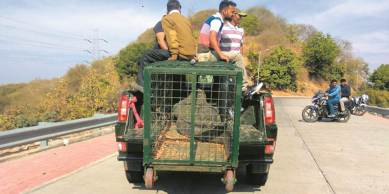
15 out, 485 more to go: Crocodiles removed for seaplane to Unity statue
Using fish as bait to lure them into cages, the Forest Department has started removing the crocodiles, the largest of them so far about 10 feet. There is no deadline as of now for finishing the operation.
A crocodile is taken away from the Sardar Sarovar dam pond.
Advertisement
Amid confusion over where the reptiles would be released, the Gujarat Forest Department has started evacuating crocodiles from two ponds on the Sardar Sarovar Dam premises on the Narmada, to make way for the seaplane service planned to promote tourism at the Statue of Unity.
Until last Tuesday, 15 crocodiles had been evacuated. There are roughly 500 of them in the two ponds located adjacent to each other on the dam premises. The mugger crocodiles (Crocodylus palustris) in the Narmada fall under Schedule 1 of the Wildlife Protection Act, which covers the most endangered species.
You’ve Read Your Free Stories For Now
Sign up and keep reading more stories that matter to you.
A multi-level committee comprising officials of the Civil Aviation Department and Gujarat government had cleared Pond 3, locally called ‘Magar talav (crocodile pond)’, for setting up the seaplane terminal, to connect cities of Gujarat to the Sardar Patel statue site.
Using fish as bait to lure them into cages, the Forest Department has started removing the crocodiles, the largest of them so far about 10 feet. There is no deadline as of now for finishing the operation.
Dr K Sasi Kumar, Deputy Conservator of Forests, Narmada, said, “We are rescuing the crocodiles from Ponds 3 and 4, which are close to the site. We have put 10 teams of officials for the exercise.” For about a week, the crocodiles were in the custody of the Forest Department. Then, after considering the possibility of releasing them in their natural habitat, it was decided to let them out into the reservoir of the Sardar Sarovar Narmada Dam. “That’s where most of them will be released,” Kumar said.
Questioning this, a top official of Sardar Sarovar Narmada Nigam Ltd (SSNNL), who refused to be named, said, “For many years now, the Forest Department has been releasing crocodiles into the reservoir of the dam, apart from the main canal, the Ajwa reservoir and other canals. This particular exercise involves hundreds of crocodiles. It may not be possible to release all into the reservoir in one go. They will have to be distributed in other places as well. It is most likely that a lot of these crocodiles could end up going back closer to the human habitats from where they were once rescued and brought to the Narmada.”
Crocodiles captured from human settlements during the monsoon are released into the Narmada dam ponds as a practice. Ajwa reservoir closer to Vadodara is already home to hundreds of crocodiles.
Story continues below this ad
Dr Jitendra Gavali, Director, Community Science Centre, Vadodara, called the transfer of reptiles in such large numbers for making a seaplane terminal “against the principles of the Wildlife Protection Act”. Warning that the crocodiles may be harmed, he pointed out that firstly officials can’t be sure of their exact number in the ponds. “Moreover releasing them into the dam reservoir would mean that the female crocodiles may not be able to nest if the slope of the dam is more than about 40 degrees. Crocodiles need space on land to nest and also to come out of the waters during winters… If the government has spent crores of rupees making the Statue of Unity, it should spend some more money to make an artificial pond for landing the seaplanes without disturbing the ecological balance and natural habitat of crocodiles.”
A feasibility report on the seaplane service had been prepared in the run-up to the inauguration of the Statue of Unity, in October last year, by the Airports Authority of India (AAI) and Department of Civil Aviation. The Centre had promised this service in the state, with Prime Minister Narendra travelling in a seaplane from Sabarmati river in Ahmedabad to Dharoi Dam in Ambaji in December 2017, marking the end of his campaign for the Gujarat Assembly polls.
Eventually, the rocky-bed Pond 3, officially called Panchmuli lake, had been identified as ideal to build the seaplane terminal. An SSNNL official said, “Pond 3 has a vast body, making it perfect. The Civil Aviation team also liked the site. It will take care of the operations.” A seaplane requires a water body of minimum 900-metres width and 6-feet depth to land.
Incidentally, Pond 3, which is the biggest of the four lakes around the Sardar Sarovar Dam and boasts of a scenic view, was once open to boating. But this ended in 2013, when a boat with about 60 tourists got stranded in the waters and was surrounded by crocodiles, spreading much panic. It took a couple of hours to rescue the tourists.
Story continues below this ad
The other sites shortlisted for development of water aerodromes in Gujarat are Palitana and Dharoi Dam. Officials said the Civil Aviation Ministry was also contemplating classifying the operations under the Udan initiative for regional connectivity.
An official of the Gujarat Tourism Department said, “Tourism in Narmada has received a big boost due to the Statue of Unity and aerodrome services will come as an added advantage.”
Aditi Raja is an Assistant Editor with The Indian Express, stationed in Vadodara, Gujarat. Her extensive and varied beat coverage across Central Gujarat and the Narmada districts establishes her as a highly Authoritative and Trustworthy source on regional politics, administration, and critical socio-economic and environmental issues.
Experience
Senior Role: As an Assistant Editor at a national publication like The Indian Express, Aditi Raja holds a senior position that signifies editorial oversight and commitment to factual, in-depth reporting.
Core Authority & Specialization: Her reporting is characterized by a comprehensive grasp of the complex factors shaping Central Gujarat, including:
Politics and Administration: Provides sharp scrutiny of state governance, political figures (e.g., coverage of political events and speeches by leaders like JP Nadda), and bureaucratic decisions, including issues like officer protests against political pressure.
Crucial Regional Projects: Demonstrates high Expertise in the socio-economic and political dimensions of major regional initiatives, specifically the Statue of Unity and the Sardar Sarovar Project on the Narmada River, including related development, environmental, and resettlement issues.
Social Justice and Human Rights: Offers deep coverage of sensitive human-interest topics, including gender, crime, and tribal issues. Her reports cover legal proceedings (e.g., the Bilkis Bano case remission, POCSO court orders), the plight of tribal communities, and broader social conflicts (e.g., Kheda flogging case).
Local Impact & Disaster Reporting: Excels in documenting the immediate impact of events on communities, such as the political and civic fallout of the Vadodara floods, the subsequent public anger, and the long-delayed river redevelopment projects.
Special Interest Beat: She tracks the activities and concerns of Non-Resident Gujaratis (NRIs), connecting the local Gujarati experience to the global diaspora. ... Read More