


Tags:


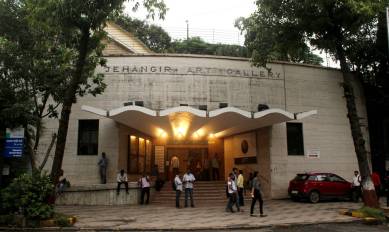
Jehangir Art Gallery could possibly be Mumbai’s grande dame of galleries. It was built when a need was felt to promote a national movement in contemporary visual arts. With its cantilevered portico, and modern yet classical architectural plan, it was the talk of the town.
In the 1950s, two major artists’ collectives — Progressive Artists Group and Bombay Group — were at their prime. But there was no proper gallery to showcase work. Sir Cowasji Jehangir, a patron of the arts, was keen on a gallery that would promote artists both from India and abroad. MIT-trained architect Durga Shankar Bajpai, who designed the gallery, gave the RCC (reinforced cement concrete) structure an auditorium hall and an exhibition gallery. Sensitive and down-to-earth, Bajpai, fresh from his experience of working with Finnish architect-designer Alvar Henrik Aalto, brought both simplicity and technical experimentation to the work.


The gallery, in the popular Kala Ghoda area, receives ample visitors. One often sees tourists and students milling around the circular lobby and exhibition spaces, which have now expanded to five. It almost feels unbelievable today that at the time, an artist could rent the hall for Rs 7 a day.
The expansions also meant the closure of the iconic Samovar Café, which added to the precinct’s cultural fabric as much as the gallery itself. It was not uncommon to find MF Husain painting endlessly here or Mario Miranda sketching on the back of a paper napkin.
“It’s a gallery that every artist aspires to show at least once in his/her life. Sometimes, one has to wait for five to six years for a booking. When it opened in 1952, the finest exhibitions were showed here. I remember seeing Akbar Padamsee’s first solo show in 1954, presented by Art Heritage. It showed his work Lovers, which was forcibly removed on charges of obscenity. Ebrahim Alkazi and many other artists protested, and the matter went to court,” says artist Sudhir Patwardhan.
He has been showing at the gallery since 1979. “And today, while most senior artists don’t show here, I continue to display my work at least for a week. It gives me an opportunity to meet common people and students, who sometimes want to interact and ask questions. It’s that kind of space,” says Patwardhan.


