


© The Indian Express Pvt Ltd
Tags:


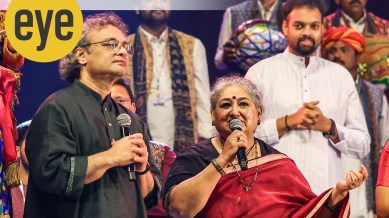
In the second half of the 19th century, long before Mumbai saw its classical music concerts in soundproofed auditoriums, it was a city learning how to listen to an ancient tradition as a shared public practice – a shift from its exclusivity in imperial durbars.
After the royal patronage collapsed, classical musicians, in search of new patrons and audiences, began converging in Bombay, the dynamic and diverse city by the ocean everyone was talking about. Here, they encountered a rising mercantile class and the educated elite – a result of strategic port location and Western education, which had given rise to a cultural appetite. This is when Parsi Gayan Uttejak Mandali, one of the city’s earliest formal music clubs for the study and performance of Hindustani classical music, emerged. Founded by writer and journalist Kaikhushro Navrojee Kabrajee, the mandali held its first jalsa (concert) in 1871.


“The mandali was quite a huge step in terms of the history, not only of Hindustani music in Bombay, but also in India, because such a formal music club with programme notes and one that engaged in teaching amateur vocalists in a classroom seldom happened before… We wanted to revive the story,” says Pradhan in a phone conversation from Goa, where he and Mudgal worked with vocalists Shashwati Mandal, Deepika Bhide Bhagwat, Chintan Upadhyay, Nishad Matange and Aniruddh Aithal to recreate the jalsa.
The idea for the project emerged from Pradhan’s 2015 book, Hindustani Music in Colonial Bombay though Pradhan had pored over the programme notes and details about the jalsa in the University of Mumbai library during his doctoral research many years before. He came across a compendium of around 1,100 compositions, which were performed between 1871 and 1886. Since it was all in Gujarati, Pradhan had even taught himself to read it for research.
While Calcutta did have a similar organisation started by musicologist Sourindra Mohun Tagore, the Parsi mandali was started, in consultation with the Bengal club, to encourage learning and performance of music in Parsi families, including women. “But there was a caveat to that. Kabrajee wrote that if Parsi families encourage their women to learn music, then their husbands will stop going to prostitutes. This patriarchal propensity was there. Women finally did have special programmes. Children too,” says Pradhan.
In the archival information, there was only text and no notations. While some compositions are still sung, some in the diverse list, which includes dhrupad, dhamar, chaturang, thumri, tappa, bhajan and garbi among others, were composed by Mudgal and Pradhan in the raag mentioned next to it – an effort to keep it close to the original. To give it colour and the look of the time, Mudgal, also roped in a designer Ashdeen Lilaowala, to recreate the sartorial choices of the Parsi society, including Parsi Gara.
The Parsi community, barring a handful of names like Jal Balaporia, Firoz Dastor and Zarin Sharma, isn’t really associated with Hindustani music. “We have these pre-conceived notions about particular communities and the manner in which music was propagated and made accessible beyond the hereditary families. I did not know of this and only figured through Aneesh’s research… Also, this diversity of repertoire was being encouraged down to the fact that a folk form like Garbi is mentioned,” says Mudgal.
Eventually, the mandali opened up to other communities too. One of the students and later a teacher there was Vishnu Narayan Bhatkhande, who wrote the first modern treatise on Hindustani classical music. His initial writings were published by the mandali.
Pradhan mentions that even scholar and political leader Dadabhai Naoroji was president of the mandli for five years. “There was the idea of projecting a pan-Indian culture as against the Western view of India… a need to preserve Indian music and that it was as good, or even better than Western culture,” says Pradhan.
To accommodate the empire that once ruled India, the jalsa in 1871 ended with the British anthem, ‘God save the queen’, even while it tried to cherish its own cultural life. The one at Serendipity on December 19, concluded with a bhajan by Surdas. It is between these two endings that there lies a story of an institution that cherished classical music and a city that listened.


