


© The Indian Express Pvt Ltd
Tags:


Under its flagship production-linked incentive (PLI) scheme for smartphone manufacturing, the government has disbursed close to $1 billion in the three years from 2022-23 to 2024-25, with Foxconn, Tata Electronics and Pegatron, the three contract manufacturers of Apple receiving cumulatively over 75 per cent of the amount.
According to data obtained by The Indian Express in response to an application under the Right to Information Act, disbursements of a total Rs 8,700 crore were made to 19 companies which successfully met their investment and production thresholds.


Overall, five beneficiaries collectively received more than 98 per cent of the total disbursals: Foxconn (Rs 2,807.17 crore), Tata Electronics (Rs 2,067.51 crore), Pegatron (Rs 1,724.36 crore), Samsung (Rs 1,365.91 crore) and Padget Electronics (Rs 596 crore).
Apple’s contract manufacturers, Foxconn, Tata Electronics and Pegatron (which was recently acquired by the Tatas), have received a total of almost Rs 6,600 crore over three years — 2022-23 and 2024-25.
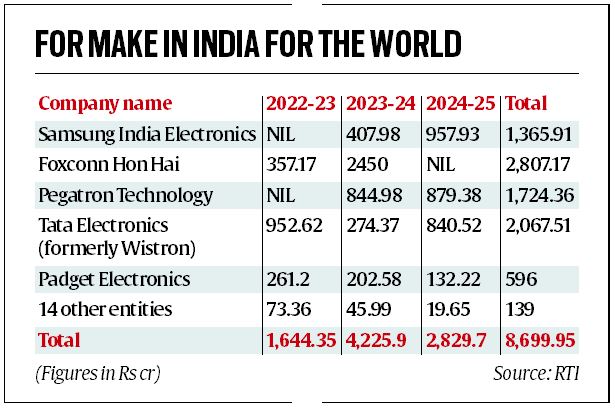
The RTI data also revealed that in 2022-23, the first year when PLI incentives were disbursed, the maximum subsidy of Rs 953 crore was issued to Wistron (later acquired by Tata Electronics).
In 2023-24, Foxconn, which is Apple’s biggest contract manufacturer globally, received a subsidy disbursal of Rs 2,450 crore, the highest during the year. However, in 2024-25, the data showed no incentive was issued to Foxconn. In 2024-25, Samsung received the highest subsidy of close to Rs 958 crore.
The PLI for large scale electronics manufacturing, which was first announced in 2020 with an outlay of Rs 38,601 crore, offers incentives ranging from 4 to 6 per cent on net incremental sales of eligible products over the sales in the base year to the selected applicants.
Besides Apple and Samsung, local contract manufacturer Dixon (Padget Electronics) has also benefited from the scheme. The company manufactures smartphones and feature phones for companies such as Xiaomi, Google, Samsung, and Motorola.
But, some other domestic companies such as Lava, Bhagwati, and Optiemus, have failed to meet PLI targets to get incentives.
The actual investments made by companies producing under the PLI scheme was slightly lower at Rs 8,282 crore until June 2024, compared to the total subsidy disbursal of Rs 8,700 crore.
In a written response to Parliament last July, Minister of State for Electronics and IT Jitin Prasada said the 32 approved companies have committed investment of Rs 11,324 crore and projected a production target of Rs 10.7 lakh crore under the scheme.
In a post on X last month, IT Minister Ashwini Vaishnaw said the companies were targeting to export smartphones worth more than $20 billion in the current financial year.
Beyond production, the scheme has also been a big driver of employment in the country. The Indian Express had earlier reported that it had helped create 1,22,613 direct jobs in three years and three months.
The PLI scheme has topped the allocation at Rs 8,885 crore in Union Budget 2025-26, significantly higher than allocation for PLI schemes of other ministries.


