4 min read


© The Indian Express Pvt Ltd



 CEC Sushil Chandra (centre) with ECs Rajil Kumar (left) and Anup Chandra Pandey.
Raising questions of propriety, Chief Election Commissioner Sushil Chandra and the two Election Commissioners, Rajiv Kumar and Anup Chandra Pandey, despite expressing reservations, joined an online “interaction” called by the Prime Minister’s Office (PMO) on November 16, The Indian Express has learnt.
This was a day after the Election Commission received an unusually worded letter from an official of the Law Ministry — the administrative Ministry of the poll panel — that the Principal Secretary to PM, P K Mishra, will “chair a meeting” on a common electoral roll and “expects CEC” to be present.
Such wording, an official said, caused a flutter in the poll panel since it read like a “summons” that breached precedent and Constitutional norms, said a source.
For, at two previous meetings on the same subject – on August 13 and September 3 last year – EC officials took part, not the Commissioners.
Chandra was unavailable for comment but a senior EC official said that the CEC, on receipt of the note, made his “displeasure” felt to the Law Ministry and underlined that he would not attend the meeting. When asked about this note, a Law Ministry official declined to comment.
However, Chandra didn’t exactly put his foot down.
 CEC Sushil Chandra arrives at Chandigarh airport for a 2-day meeting on the upcoming Punjab elections, on December 15, 2021. (Express Photo)
So, while he and the other two Commissioners stayed away from the video meeting — in which their subordinates were present — as per precedent, the three did join an “informal interaction” with Mishra immediately after.
“They discussed long-pending reforms like multiple cut-off dates to facilitate a common electoral roll. This was done to expedite reforms so that there is no gap in understanding and no delay,” said a senior official. In fact, these were part of the amendments cleared by the Cabinet Wednesday.
Asked about the propriety of the interaction between the full Commission and the PMO, the senior official said: “This was informal, not a meeting. The Commissioners did not discuss any matter pertaining to elections (the five Assembly elections for which notification is due soon). This was just for expeditious disposal of electoral reforms.”
Still, the interaction raises questions of Constitutional propriety. For, the three ECs usually maintain an arm’s length from the Executive to insulate the functioning of the poll panel, a Constitutional authority, from external pressure.
As a result, the EC’s communication with the government on election matters is usually limited to its administrative ministry, the Law Ministry. On arranging security forces for elections, the EC communicates with the Home Ministry. If and when needed, government officers call on the three Election Commissioners and not the other way round.
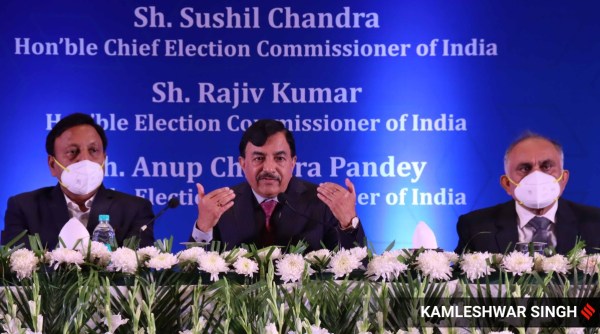 CEC Sushil Chandra (centre) with ECs Rajiv Kumar (left) and Anup Chandra Pandey in Chandigarh Thursday. (Express Photo: Kamleshwar Singh)
Incidentally, the single voters’ list for elections to the panchayat, municipality, state Assembly and Parliament is among the promises made by the BJP in its manifesto for the Lok Sabha elections in 2019. It ties in with the party’s commitment to hold elections simultaneously to the Lok Sabha, state Assemblies and local bodies, also mentioned in its manifesto.
The incumbent government has pitched for a common electoral roll and simultaneous elections as a way to save an enormous amount of effort and expenditure.
This pitch for a single voters’ list is not new.
The Law Commission recommended it in its 255th report in 2015. The EC, too, has called for a common electoral roll in 1999 and 2004.
Currently, at least 29 states and UTs use the EC’s voters’ list for local body elections. While some have adopted it in totality, others use the EC roll as the basis for preparation and revision of rolls for municipality and panchayat elections.