3 min read

Journalism of Courage



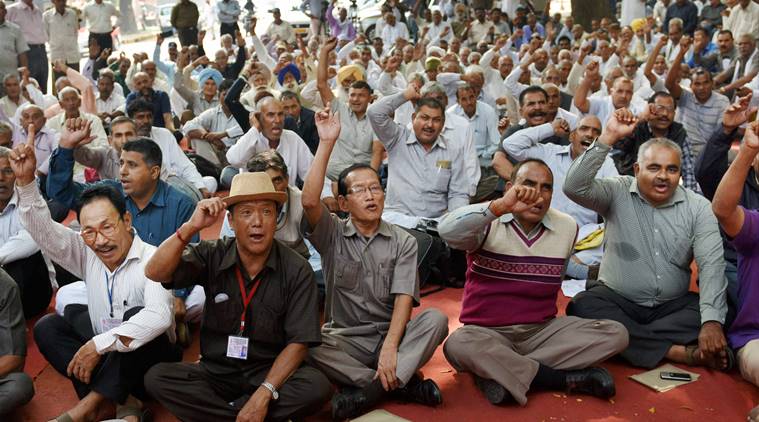 FILE: Retired paramilitary officials at a protest demanding One Rank One Pension (OROP) benefits and other privileges under the ex-servicemen category at Jantar Mantar in New Delhi on Monday. (Source: PTI)
The seventh Pay Commission has recommended a virtual one-rank one-pension structure for civilian employees of the Central government, bringing in parity between past and existing pensioners. Recommendation will benefit all employees who retire before January 1, 2016. According to the government data, there were some 27.81 lakh civilian pensioners as on January 1, 2014.
The commission has recommended doing away with pay bands and grade pay, and has retained an annual increments of 3 per cent and a fitment factor of 2.57 to all employees. “The commission recommends a revised pension formulation for civil employees including Central armed police forces personnel as well as for defence personnel, who have retired before 01.01.2016. This formulation will bring about parity past pensioners and current retirees for the same length of service in the pay scale at the time of retirement,” the commission has said.
There are a total of 51.96 lakh pensioners as January 1, 2014 of which 11.83 lakh or 23 per cent were family pensioners. Civilian pensioners comprising Central government civil, railways and posts, were 27.81 lakh while defence pensioners (including defence civilians) were 24.15 lakh.
The past pensioners shall first be fixed in the new pay matrix which has been suggested in place of pay band and grade pay at which they retired, at the minimum of the corresponding level in the pay matrix. This amount shall then be raised to arrive at the notional pay of retirees, by adding number of increments he/she had earned in that level while in service at the rate of 3 per cent. In the case of defence forces personnel this amount will include military service pay as admissible. Fifty per cent of the total amount so arrived at shall be the new pension.
The commission said that it received a number of representations on the issue of disparities in pensions between past and existing pensioners. It said that the issue of parity in pensions is extremely important “from the viewpoint of inter-temporal equity”.
According to the report, till the third pay commission, it was a viewed that past and future pensioners cannot be treated at par and the practice was that benefit of improvement in the pension would be available to newly retiring pensioners from a prospective date. The fourth Pay Commission recommended, both for civil and defence pensioners, additional relief in terms of a percentage increase in amount of pension subject to a certain minimum increase.
The fifth Pay Commission made a shift in the treatment of past pensioners and said that the process of bridging the gap in pension of past pensioners should be continued to achieve complete parity over a period of time. The sixth Pay Commission further provided for additional pension with advancing age.