


Tags:


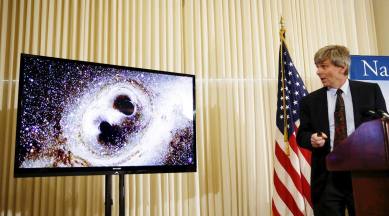
The euphoria over the discovery of gravitational waves by the LIGO (Laser Interferometer of Gravitational-wave Observatory) team has given a new connotation to ‘chirp’. It was described as the sound produced when the gravitational wave detected at the LIGO facility in the United States was converted into an audio signal.
Gravitational waves, postulated by Albert Einstein exactly 100 years ago but discovered only now, do not produce any sound — a chirp or anything else — on their own. These are just ripples created in the fabric of space-time by moving celestial objects — just like a moving boat produces ripples in water. But when converted into audio signals, these can produce signature sounds that can reveal the origin of the gravitational waves.


[related-post]
A gravitational wave generated by a different kind of event would produce a different ‘chirp’. A chirp, understood as the sound some birds produce, is already used commonly in electronics to describe signals with increasing or decreasing frequencies.
In reality, the ‘chirp’ from gravitational waves is not registered by the human ear because it exists for a very small fraction of a second. But scientists slow it down so it can be heard properly.
The ‘chirp’ detected by LIGO has led to an online frenzy, with many scientists and others posting videos trying to imitate that sound. The enthusiasts have been producing sounds like “whoooooooopppp” but the ‘chirp’ registered at LIGO is slightly different. You can hear the audio on the LIGO site, https://www.ligo.caltech.edu/video/ligo20160211v2.


