


Tags:


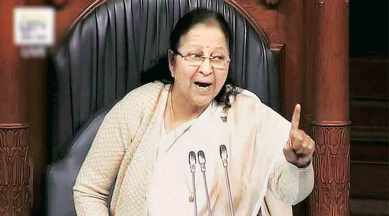
“Who is running the House?” BJP veteran L K Advani snapped last week, upset with Lok Sabha Speaker Sumitra Mahajan and Parliamentary Affairs Minister Ananth Kumar for the continuing disruptions in the House.
2016 is not 2010 — and so, six years ago, Advani, then in the Opposition and spearheading the BJP’s demand for a JPC probe into the 2G scam, had said, “Sometimes, business not proceeding also yields results.” It was less quoted than then Rajya Sabha Leader of Opposition Arun Jaitley’s “parliamentary obstructionism is a legitimate tactic” quip — but both had, in those turbulent times much like today’s, reasserted the more or less established role of disruption as a form of protest in India’s Parliament and state Assemblies.

Watch what else is in the news
Think Rajiv Gandhi’s shouting brigade in the 1980s, when, at the peak of the Bofors scandal, a group of Congress MPs would shout down anyone who spoke against Rajiv or Sonia Gandhi.
Or 2006, when Trinamool Congress members were reported to have come to the West Bengal House armed with “eggs and chicken legs” to protest the alleged harassment of Mamata Banerjee by the state police when she was trying to visit Singur, the site of the disputed Tata Motors plant. The Trinamool’s agitation eventually became its ticket to power in the state.
Or the extreme step Congress MP L Rajagopal took in February 2014 to protest the creation of Telangana — he brought pepper spray to Parliament. Rajagopal was expelled because the line between disruption and violence is clearly drawn in a democratically elected legislature.
Disruptive agitation is indeed a legitimate mode of protest. In fact, in state Assemblies, it is fairly common to use marshals to throw out agitating MLAs — both Delhi MLA Vijender Gupta and DMK heir Stalin have been subjected to that fate. Prolonged agitations over Telangana occasionally spilt out of the undivided Andhra Pradesh Assembly. The AP Assembly has even witnessed MLAs uprooting the Speaker’s microphone to register their protest.
President Pranab Mukherjee’s ticking off of MPs — “For God’s sake, do your job” — on Thursday may have come in handy for the government to whip the Opposition, but it is a stand that Mukherjee has consistently maintained.
Many, however, would argue that the “culture” of Parliamentary disruption in the country has evolved over decades — notwithstanding the fact that a host of parliamentary devices are available to MPs to raise urgent matters of public importance and seek the government’s immediate attention. These include Adjournment Motion — which is what the Opposition wanted in Lok Sabha to discuss demonetisation — No-Day-Yet-Named Motion, Short Duration Discussion, Calling Attention Motion, etc.
There are several theories as to why disruption became a popular mode of protest for parliamentarians. Some believe members saw its potential from the time Parliament proceedings began to be telecast live — but that does not explain the unruly “debates” in state Assemblies, which are rarely televised. Besides, ruckus in legislatures predates television — and authors and parliamentarians have accused noisy MPs and MLAs of seeking headlines, and journalists of obliging them, even in the days when television did not occupy so much space in journalism.
A paper titled ‘Parliaments in India: Is There Order Midst the Chaos?’ by Dean McHenry Jr of Claremont Graduate University, presented at the Western Political Science Association Annual Meeting in Nevada in 2007, argued that doomsday prophesies about Indian democracy because of repeated disruptions tended to look at disruptions from a foreign, more orderly idea of Parliament.
“India’s Parliaments are often disrupted and turned into chaotic bodies. What we have argued is that the disruptions are not simply antidemocratic. They entail the promotion of democratic values and provide representation that might not otherwise exist. They do not appear to be lethal to democracy. Indeed, despite persistent claims that disruptions of legislative bodies presage the imminent collapse of democracy in India, that collapse has not occurred. Part of the explanation for the persistence of both disruption and democracy appears to lie in a culture tolerant of diverse forms of protest. Although the disruptions in parliaments appear deadly to the proper functioning of parliament in the eyes of those used to Western cultures, they seem to be more accepted in Indian cultures,” the paper argued.
“Perhaps, India’s experience will show that the Westminster model of democracy may metamorphose into another form that is able to persist in providing a means for translating some of the popular aspirations into governmental policy. Whether increases in the intensity and scope of disruptions will destroy even the metamorphosed model of India’s democracy is a matter yet to be decided,” it said.
In August 2006, Khushwant Singh wrote, “A Sardarji who has a most impressive personage used to be the loudest shouter when he was with the Congress. He is today the champion shouter for the BJP. In all the years he has been an MP, I haven’t heard him make a single coherent speech. There are quite a few others like him.”
The man in question is a former member of Rajiv’s shouting brigade, now among those tasked with ensuring the smooth running of Parliament.


