


Tags:


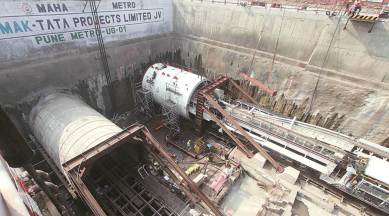
The tunnel-boring machines (TBMs) deployed to dig a 5.02-km-long tunnel from Shivajinagar to Swargate — the underground stretch of the PCMC-Swargate route of Pune Metro — have started burrowing through the heart of Pune city. Four TBMs, which will construct two parallel tunnels between the two locations, are expected to finish the tunnelling work within two years. The Indian Express explains how the machines function
A total of four TBMs will work on the twin tunnels between the College of Agriculture in Shivajinagar and Swargate. Only two of the four TBMs have reached Pune and the construction of the tunnel has started from the Agriculture College end.


The machines were dismantled and packed in 20 massive parcels, which were then shipped from Nansha Port in China to Mumbai. The heavy parts were sent to Pune on 18 heavy load-trucks. The different parts were put back together again, before the TBMs were lowered into a 18-metre-deep shaft at the Metro construction site.
How does a TBM work?
Each TBM is 6.65 metres in width and 120-metres in length. It has a cutter-head in front, which has ‘teeth’ or sharp protrusions, and which rotates at a speed of six revolutions per minute (RPM), cutting its way through. While TBMs come in varying sizes, the one used by Pune Metro are medium sized.
The TBMs in Pune — called ‘Mula’ and ‘Mutha’ after the two rivers that criss-cross the city — dig their way through and clear about 8 to 10 metres every day.
The machine, operated by a pilot who sits in the control room, cuts through the rock and soil and transfers them into a mixing chamber behind the cutter-head, where they are mechanically reduced to an uniform size and consistency, with mixing arms which rotate at four RPM. A rotating screw then sends the debris to a conveyor belt, which transfers it out of the tunnel for further disposal.
The TBM not only cuts the tunnel but also installs pre-cast concrete rings (four segments per ring) on the cleared area as it marches ahead. These segments are tightly fitted with each other, while concert slurry is filled between the ring and the excavated surface for waterproofing. The TBM leaves a stable, strong and waterproof tube of pre-cast segments in its wake.
How does the machine know it is on the right track?
Before the tunneling work starts, the engineers plan and freeze the alignment of the tunnels. Co-ordinates of the tunnel pertaining to location, gradient and curvature are fed into a Survey Guidance System.
Based on local conditions on the day of the operation, the control points are standardised manually.
When the TBM is at work, the pilot can see on his screen the real-time alignment and the expected alignment, and if the two are matching. A theodolite (surveying instrument) captures the position of the machine every five seconds to compare it with the expected alignment. The pilot maneuvers the machine’s direction and movement using pressure-controlled jacks. After every one week of work, the progress is re-evaluated to confirm if the machine is on the right track.
Does the tunnelling work affect houses located directly above?
The tunneling work is Pune is taking place at a depth of 28 metres from the ground. Even before the work started, a geological and hydro-geological examination of the entire route was conducted by drilling bores every 25 metres.
A structural assessment of all the buildings located exactly above the tunnel, and 50 metres on each side, was also carried out to assess the stability of the buildings, and whether they would be able to absorb the impact of the work.
The boring machine will be tunneling at the deepest levels when it burrows through river areas, about 15-16 metres below the river base.
Don’t miss from Explained: The ‘presumption of constitutionality’ in the case of the new citizenship law


