SIR process: Why ECI is focusing on progeny mapping in West Bengal
SIR in West Bengal Update: ECI officials said that more than 50% of the electorate submitted enumeration forms with progeny mapping. And major discrepancies have emerged in these submissions
One of West Bengal’s electoral roll observers deputed by the ECI told The Indian Express that to identify false or wrong progeny mapping, the ECI has already started conducting house-to-house surveys.
West Bengal SIR Update: After collecting all enumeration forms in West Bengal as part of the Special Intensive Revision ( SIR ), the Election Commission of India (ECI) is now working to publish a draft electoral roll on December 16. According to ECI sources, the most important and challenging aspect of this exercise is progeny mapping.
What is mapping by Election Commission?
ECI uses the term ‘mapping’ to indicate the relationship of an elector in the 2025 electoral roll with the 2002 roll prepared after the last SIR. There are three categories of relationships.
You’ve Read Your Free Stories For Now
Sign up and keep reading more stories that matter to you.
Self mapping: Electors in the 2025 roll whose names can also be found in the 2002 roll will be considered to have done self mapping.
Progeny mapping: Electors whose names do not appear in the 2002 roll but who have other blood relations in the list — father, mother, grandparents, etc. — will be considered for progeny mapping.
No mapping or un-mapped: Electors are neither in the 2002 electoral roll nor have any relatives in that roll will be labelled by the ECI as un-mapped. They will compulsorily be called for a hearing where they will have to furnish documents to prove that they are a legitimate voter.
ECI officials said that more than 50% of the electorate submitted enumeration forms with progeny mapping — of the 7.66 crore electors in West Bengal, 2.93 crore electors submitted forms with self-mapping, 3.84 crore with progeny mapping, and 30 lakh with no mapping. The ECI has not received enumeration forms of around 58 lakh electors. “Out of these, there are 24,18,699 deceased voters, 12,01,462 untraceable voters, 19,93,087 permanently shifted voters, 1,37,475 voters enrolled at multiple places, and 57,509 others,” ECI said.
Amid discrepancies, further verification needed
Electors who are either in the 2002 rolls or have a blood relation in those rolls need not furnish any further documentary proof during the verification and hearing phase of the SIR.
Story continues below this ad
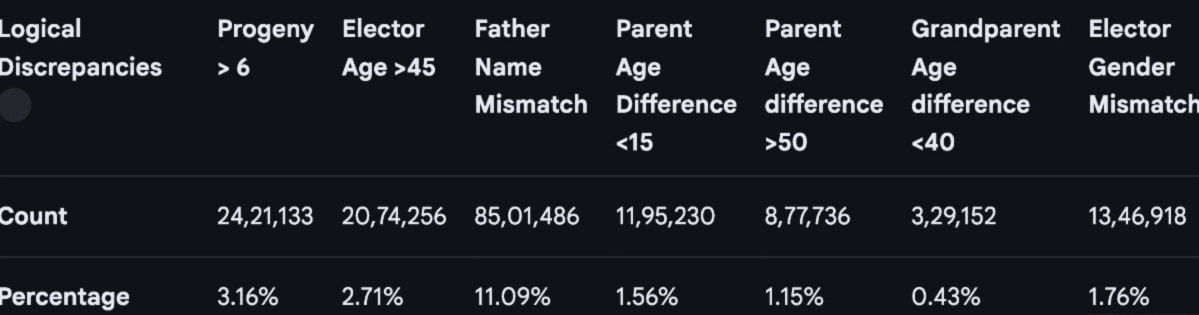
But many irregularities have surfaced in the latter category. For instance, many 2025 voters who don’t appear in the 2002 rolls have linked themselves to 2002 voters as their parents, but these links contradict the parental names listed in their current 2025 records.
West Bengal enumeration discrepancies.
A senior official of ECI said, “Our experts have already analysed submissions with progeny mapping, and we got many dubious results which are now subject to verification.”
“South 24-Parganas and North 24 Parganas have the highest concentration of such case,” the official added. “705 of 779 voters at a booth in Hingalganj (North 24 Parganas) and 977 of 1,119 voters at a booth in Hemtabad (North Dinajpur) showed contradictory parental data. Similar cases have surfaced in Dhupguri, Dabgram-Phulbari, Dinhata, Murarai, Habibpur and in some other assembly constituencies.”
One of West Bengal’s electoral roll observers deputed by the ECI told The Indian Express that to identify false or wrong progeny mapping, the ECI has already started conducting house-to-house surveys.
Story continues below this ad
“The District Electoral Officer will compile a list of electors suspected to have provided false information. After a hearing and verification of documents, the ECI will decide whether their names should be included in the final electoral roll or not.”
Atri Mitra is a highly accomplished Special Correspondent for The Indian Express, bringing over 20 years of experience to his reporting. His work is characterized by deep regional knowledge and a focus on critical administrative and political developments, establishing strong Expertise and Authority in his domain.
Experience
Current Role: Special Correspondent, The Indian Express.
Decades of Experience: Over two decades of extensive reporting experience, primarily covering administration and political news.
Geographical Focus: Holds significant reporting experience from West Bengal, Bihar, and the North-East, providing a comprehensive understanding of the socio-political landscape in these regions.
Key Coverage: Has dedicated more than ten years to covering administration and political news, with a keen focus on political developments in West Bengal.
Electoral Reporting: Demonstrated a commitment to crucial political moments, having covered the 2009 Lok Sabha election and 2010 assembly elections during his time at Anandabazar Patrika, and the 2019 Bihar Lok Sabha election while working with News18-Bangla.
Career Foundation: Began his career at the leading vernacular daily Anandabazar Patrika, where he worked for more than fifteen years, including a three-year stint as the Bihar correspondent.
Education
Advanced Degree: Holds a Master's degree in Economics from Rabindrabharati University, providing an analytical framework for his political and administrative reporting.
Undergraduate Education: Holds a Bachelor's degree from Calcutta University.
Prestigious Alumni: His educational background includes attending esteemed institutions: he is an alumnus of St. Xavier's, Kolkata and Ramakrishna Mission Asrama, Narendrapur.
Atri Mitra's decades of dedicated reporting, substantial focus on political and administrative beats, and solid academic credentials make him a trusted and authoritative source for news and analysis from Eastern and North-Eastern India. ... Read More