


© The Indian Express Pvt Ltd
Tags:


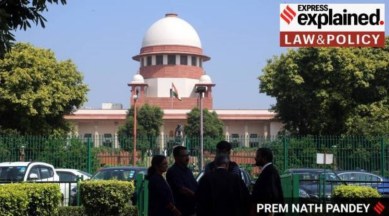
The Supreme Court verdicts on two crucial cases on Thursday — the Delhi government’s tussle with the Centre over the national capital’s bureaucracy, and the Maharashtra political crisis that followed the fall of the Uddhav Thackeray government — have two things in common.
Both rulings — unanimous and by identical five-judge Constitution benches — draw new red lines for Constitutional offices in the face of political compulsions, and underline the sanctity of the elected government.

Both rulings are essentially political battles decided one way or the other in a courtroom.
In the Delhi ruling, the apex court speaks to the Centre in emphasising that principles of democracy and federalism are basic structure of the Constitution.
“The interpretation of Article 239AA(3)(a) in an expansive manner would further the basic structure of federalism,” the court said.
In the Maharashtra ruling, the court held that the state’s then Governor, Bhagat Singh Koshyari, was wrong in calling for the floor test without any objective material. It also held that the Assembly Speaker’s decision to appoint Bharat Gogawale (from the Eknath Shinde Shiv Sena group) as the Whip of Shiv Sena was illegal.
“In a contentious situation such as this, the Speaker should have conducted an independent inquiry based on the rules and regulations of the political party to identify the Whip…” the Supreme Court held.
On the issue of the Tenth Schedule and the power of a political party to appoint a Whip, the court underlined the sanctity of safeguarding an elected legislature.
In the Delhi case, the court emphasised on a “triple chain of accountability” to read the Constitutional provisions expansively and allow Delhi government control over services. The bench said that the triple chain of accountability flows from bureaucrats to ministers, ministers to the legislature, and the legislature to the electorate.


