


© The Indian Express Pvt Ltd
Tags:


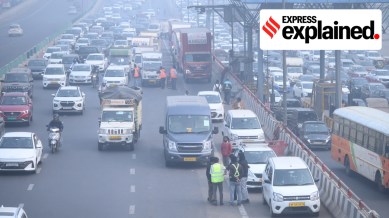
A day after the Delhi government began enforcing tighter curbs on vehicular pollution amid the prevailing foul air, questions around Bharat Stage (BS) emission norms have come to the fore for motorists across the city.
On Thursday (December 18), the government barred non-BS VI private vehicles registered outside Delhi from entering the Capital, and announced that pumps in the city will sell fuel to only those who possess a valid Pollution Under Control Certificate (PUCC) for their vehicles.


For vehicle owners, BS (Bharat Stage) compliance can be checked on the registration certificate (RC), which mentions the emission norms under which the vehicle was certified. Usually, vehicles registered on or after April 1, 2020 are BS VI compliant, as the standard became mandatory nationwide from that date.
Manufacturers also usually mention BS VI compliance in the owner’s manual, and in some cases on stickers near the engine or fuel tank. Authorised dealerships and service centres can also confirm compliance using the vehicle’s registration number.
Further, vehicle owners can check the VAHAN portal on the Ministry of Road Transport & Highways website by entering the license plate number and accessing registration information.
Cars bought before April 2020 will be BS-IV compliant but will not be eligible for BS-VI. Cars bought between 2005 and 2010 will be BS-III compliant whereas those bought between 2001 and 2005 will be BS-II compliant.
Bharat Stage emission norms are India’s standards for regulating pollution from motor vehicles. They set legal limits on exhaust emissions of pollutants such as carbon monoxide, hydrocarbons, nitrogen oxides and particulate matter. The norms are based on European emission standards and apply to all new vehicles sold in the country.
Each successive BS tightens these limits, pushing manufacturers to adopt cleaner engine technologies, better exhaust treatment systems and cleaner fuel.
Delhi has historically implemented stricter emission norms earlier than the rest of the country due to its persistent air pollution problem. BS II norms were introduced in the Capital in 2001, BS III in 2005 and BS IV in 2010 – all several years before the nationwide rollout, as per the Central Pollution Control Board.
BS VI norms were implemented in Delhi-NCR ahead of the rest of India and became mandatory across the country in April 2020. As vehicles from other states enter Delhi daily, the city’s roads still carry a mix of vehicles operating under different emission standards.
Why are older vehicles more polluting?
The internal combustion engines in pre-BS IV vehicles lack effective exhaust-cleaning systems altogether while BS-IV vehicles rely largely on basic oxidation catalysts that offer only limited control over fine particulate emissions.
Full modern exhaust after-treatment systems (technologies fitted to a vehicle’s exhaust) such as diesel particulate filters (DPFs) and selective catalytic reduction (SCR) units became mandatory only under the BS-VI regime. These systems function as filters and chemical reactors within the exhaust stream, breaking down or trapping harmful gases and particles before they are released into the air.
For instance, catalytic converters convert toxic gases such as carbon monoxide and nitrogen oxides into less harmful substances like carbon dioxide, nitrogen and water vapour, while DPFs physically trap fine soot particles emitted by diesel engines, cutting particulate matter emissions by over 90%. Hence, BS VI vehicles can cut down particulate matter emissions, as well as other emissions significantly.

In a study earlier this year, researchers in Delhi Technological University (DTU) noted that ageing vehicles suffer from deterioration of ignition systems, fuel-air mixing and emission-control components, leading to incomplete combustion and higher tailpipe pollution. While newer vehicles benefit from the improved emission-control technologies.
Another DTU real-world emission study published last year of over 1,500 cars in Delhi found that tailpipe emissions rise sharply with vehicle age, with carbon monoxide emissions showing a strong correlation. It found that ageing engines, high mileage and weak maintenance make older vehicles disproportionately more polluting.
How many such vehicles are there in Delhi-NCR?
Around 44 lakh end-of-life vehicles are estimated to be plying in the NCR surrounding Delhi, as per the Delhi Transport Department. The vast majority of these are BS II and BS III, and a small share of BS IV-registered vehicles between 2010 and 2014. The volume is, however, even higher in the Capital with roughly 62 lakh such total vehicles plying.
In a high-level October meeting chaired by the Principal Secretary to the Prime Minister, it was flagged that 37% of vehicles in Delhi-NCR still belong to the outdated BS I to BS III emission norms
BS VI norms significantly tighten emission limits. For petrol vehicles, nitrogen oxide limits are about 25% lower than under BS IV. For diesel vehicles, nitrogen oxides must be reduced by nearly 68%, while particulate matter emissions are cut by around 82%.
BS VI vehicles also use much cleaner fuel with lower sulphur content, which allows advanced emission-control technologies to function effectively. The testing regime under BS VI is also closer to real-world driving conditions.


