


© The Indian Express Pvt Ltd
Tags:


Amid the constant flip flops and chaos of United States President Donald Trump’s tariffs regime, there is a new rider that will be a precursor to fresh levies on several sectors exempted earlier — national security-focused probes into sectors such as semiconductors, pharmaceuticals, and critical minerals.
This could impact companies from several countries — including China, which is a major supplier of rare earth metals but has had limited exports since the tariff announcements; India, which is a key exporter of pharmaceutical products to the US; and Taiwan, which is home to more than 90% of advanced semiconductor production.

Pharmaceuticals and semiconductors were excluded from the new tariffs regime announced on April 2.
After exempting items like smartphones, computers, and chip-making equipment from most tariffs last week, Trump said it was a temporary measure, and these products would be placed in a separate tariff bucket.
Then, he said he would soon impose tariffs on semiconductors imported from elsewhere.
The probe into the chip sector is being done to determine the effects on US national security of imports of semiconductors, semiconductor manufacturing equipment, and their derivative products.
This includes, among other things, semiconductor substrates and bare wafers, legacy chips, leading-edge chips, microelectronics, and SME (Surface Mount Equipment) components.
“We are taking a look at Semiconductors and the WHOLE ELECTRONICS SUPPLY CHAIN in the upcoming National Security Tariff Investigations,” Trump posted on social media.
The Bureau of Industry and Security (BIS) under the United States Department of Commerce has launched a public consultation process in which responses are being sought on questions including the extent to which domestic production of semiconductors can or is expected to meet domestic demand; the role of foreign fabrication and assembly; impact of foreign government subsidies and predatory trade practices; potential for export restrictions by foreign nations; talents gaps among US workers; etc.
Earlier this week, Nvidia said it would produce artificial intelligence (AI) supercomputers entirely in the US, becoming the latest tech company to back Trump’s tariff-induced push for local manufacturing.
Its Blackwell chips have started production at the Phoenix plant of Taiwan Semiconductor Manufacturing Company (TSMC), Nvidia said, adding that it is building supercomputer manufacturing plants in Texas, with Foxconn in Houston, and with Wistron in Dallas.
Mass production at both plants is expected to ramp up in the next 12-15 months.
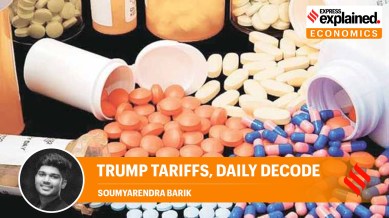
While the pharmaceuticals industry in India may have rejoiced on April 2 when the industry was excluded from Trump’s reciprocal tariffs regime, the fresh national security probe in the sector could lead to additional levies on such imports.
This is something that Indian drug makers are concerned about. Between April and December of FY25, Indian exports of drugs and pharmaceuticals reached close to $22 billion, with the US accounting for almost a third of total pharma dispatches from India.
The United States’ expansive national security probe into the sector will cover both finished generic and non-generic drug products; medical countermeasures; critical inputs such as active pharmaceutical ingredients and key starting materials; and derivative products of those items.
The national security probe into critical minerals, ordered by Trump on Tuesday, is a clear attempt at targeting China, the industry leader in the sector.
This investigation will assess vulnerabilities in supply chains, the economic impact of foreign market distortions, and potential trade remedies for domestic supply of these essential materials.
“The United States remains heavily dependent on foreign sources, particularly adversarial nations, for these essential materials, exposing the economy and defense sector to supply chain disruptions and economic coercion… Foreign producers have engaged in price manipulation, overcapacity, and arbitrary export restrictions, using their supply chain dominance as a tool for geopolitical and economic leverage over the United States,” the White House said.
Earlier this week, China suspended exports of six heavy rare earth metals, as well as rare earth magnets.
A few months ago, it had banned exports to the US of gallium, germanium, antimony, and other key high-tech materials with potential military applications, the White House said, adding that it was done to “choke off supplies of components central to automakers, aerospace manufacturers, semiconductor companies and military contractors around the world”.


