US Treasury Secretary-elect’s tough talk on Russia oil: How could India be impacted?
Bessent’s statements at the hearing, during which he spoke on a range of issues, constituted a comprehensive presentation of the incoming administration’s plans for the US economy.
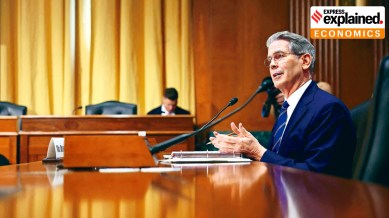
Scott Bessent, US President-elect Donald Trump’s nominee to be Treasury Secretary, testifies during a Senate Finance Committee confirmation hearing on January 16. Reuters
Scott Bessent, United States President-elect Donald Trump’s pick for Treasury Secretary, said on Thursday that the Joe Biden administration had been “too weak” on Russia’s oil sector, and that he was ready to tighten sanctions further — a statement that pushed up global oil prices.
“…If any officials in the Russian Federation are watching…, they should know that if I am confirmed, and if President Trump requests, as part of his strategy to end the Ukraine war, that I will be 100 per cent on board with taking sanctions up — especially on the Russian oil majors — to levels that would bring the Russian Federation to the table,” Bessent said at his confirmation hearing in the Senate, according to Reuters.
You’ve Read Your Free Stories For Now
Sign up and keep reading more stories that matter to you.
Bessent’s statements at the hearing, during which he spoke on a range of issues, constituted a comprehensive presentation of the incoming administration’s plans for the US economy.
These are some key takeaways for India.
New sanctions on Russian oil
On January 10, the Biden administration announced fresh curbs against Russia’s oil trade, placing as many as 183 tankers, constituting the bulk of the so-called “shadow fleet” delivering to customers such as India and China, under sanctions.
Unlike earlier sanctions on Russian entities, which were relatively easier to circumvent, the new action is far more targeted, and will hurt Indian imports of Russian oil, government officials said. The extent of the impact will depend on how tightly the Trump administration implements the sanctions — this is why Bessent’s comments are significant for India.
While other sources of oil are available to India, there are obvious advantages, in terms of reliability and cheaper rates, in imports from Russia, officials said.
India, the world’s third-largest consumer of crude oil, depends on imports to meet more than 85% of its requirement. Russia was a marginal supplier before the war in Ukraine began in February 2022; it is now India’s biggest supplier of crude. In 2024, Russian oil accounted for nearly 38% of India’s total oil imports, according to tanker data.
Story continues below this ad
Rupee internationalisation bid
Tighter sanctions on Russian oil will also complicate India’s efforts to internationalise the rupee.
India and Russia have been in talks to settle a portion of the oil trade in the domestic currency. While the rupee trade has not taken off as desired, similar efforts have worked in China’s case — the booming Russia-China trade in non-dollar exchange has helped the yuan increase its footprint globally.
In July 2024, the International Monetary Fund said that the one non-traditional reserve currency gaining market share is the Chinese renminbi, whose gains match a quarter of the decline in the dollar’s share, as the Chinese government pushes various policies to promote its internationalisation.
During his Senate hearing, Bessent said that the US dollar “should” remain the world’s reserve currency. Trump had earlier threatened Brazil, Russia, India, China, and South Africa (BRICS nations) with 100% tariffs if they created a new BRICS currency or backed any other to replace the US dollar as the world’s reserve currency.
Story continues below this ad
International trade experts have noted that the attempts to move away from the dollar began after the US threw Russia out of the Society for Worldwide Interbank Financial Telecommunication (SWIFT), the key to international financial transactions, in 2022.
At the BRICS summit in October last year, Russia’s President Vladimir Putin had said: “The dollar is being used as a weapon. We really see that this is so. I think that this is a big mistake by those who do this.”
Rush to pay for Russian oil
The fear of US sanctions has already sparked a rush among Indian refiners to speed up payments for Russian crude, traders said.
Bloomberg reported on January 15 that banks have stopped processing payments in US dollars to avoid having to adhere to the $60-a-barrel price cap on Russian crude set by Western nations in 2022, and all payments for cargoes from Gazprom Neft PJSC, are being settled in rubles.
Story continues below this ad
The price cap, which has been in effect from December 5, 2022, was intended to limit Russia’s revenues. Gazprom Neft is a Russian oil company that is among the entities targeted by the sanctions announced on January 10.
Notably, the US Office of Foreign Assets Control has set a deadline of February 27 for the delivery of all crude cargoes that were loaded on sanctioned vessels prior to 10 January.
Ravi Dutta Mishra is a Principal Correspondent with The Indian Express, specializing in economic policy and financial regulations. With over five years of experience in business journalism, he provides critical coverage of the frameworks that govern India's commercial landscape.
Expertise & Focus Areas: Mishra’s reporting concentrates on the intersection of government policy and market operations. His core beats include:
Trade & Commerce: Analysis of India's import-export trends, trade agreements, and commercial policies.
Banking & Finance: Covering regulatory changes and policy decisions affecting the banking sector.
Professional Experience: Prior to joining The Indian Express, Mishra built a robust portfolio working with some of India's leading financial news organizations. His background includes tenures at:
Mint
CNBC-TV18
This diverse experience across both print and broadcast media has equipped him with a holistic understanding of financial storytelling and news cycles.
Find all stories by Ravi Dutta Mishra here ... Read More