


© The Indian Express Pvt Ltd
Tags:


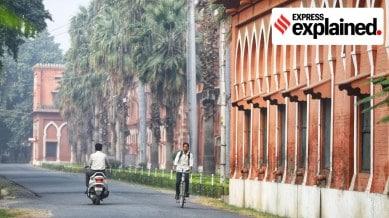
The Supreme Court on Friday (November 8) overturned its almost-six-decade-old ruling that had held that Aligarh Muslim University (AMU) is not a “minority educational institution” under Article 30 of the Constitution. The final determination on whether AMU is a minority institution was, however, left for a separate Bench.
Here are 10 things about AMU, one of India’s largest and best known educational institutions.

AMU traces its origin to the founding of the Madarsatul Uloom in Aligarh by Sir Syed Ahmad Khan on May 24, 1875. On January 7, 1877, the Madarsatul Uloom became the Muhammadan Anglo-Oriental College (MAO).
In Sir Syed's vision, the MAO was patterned on the universities of Oxford and Cambridge in Britain that he had visited. His objective was to build a college in line with the British education system, but without compromising on Islamic values.
The MAO College became Aligarh Muslim University in 1920, after the Aligarh Muslim University Act was passed the same year.
As per the AMU website, from its very inception, the institution “kept its doors open to the members of all communities and from all corners of the country and the world”. The university describes itself as being a “proudly Islamic and proudly Indian institution: a living symbol of the composite culture of India and a bulwark of its secular principles”.
The university is spread over 467.6 hectares in Aligarh, and offers more than 300 courses in both the traditional and modern branches of education. The university currently has more than 37,327 students, 1,686 teachers, and 5,610 non-teaching staff on its rolls. It has 13 faculties comprising 117 teaching departments, three academies, and 21 centres and institutes.
Students from all states of India and abroad — especially Africa, West Asia, and Southeast Asia — are part of the university. There is reservation of seats for students from SAARC and Commonwealth countries in some courses.
One of the main features of the university is its residential character. Most of the staff and students reside on campus. There are a total 19 halls of resident students, and 80 hostels.
Apart from undergraduate and postgraduate courses in social sciences and sciences, the university also comprises the Zakir Hussain College of Engineering and Technology, Jawaharlal Nehru Medical College, Dr Ziauddin Dental College, the Institute of Ophthalmology, Food Craft Institute, Interdisciplinary Biotechnology Unit, Centre of Advanced Study in History, Department of West Asian Studies, Centre of Wildlife, and Centre for South African & Brazilian Studies. AMU also offers courses in Indian, Oriental and Western languages. The medium of instruction in the university is primarily English.
The university also has three centres outside Aligarh — at Murshidabad, West Bengal; Malappuram, Kerala; Kishanganj, Bihar.
The University also has one primary school, seven high schools (including one for the visually impaired students), and two senior secondary schools for boys and girls.


