


The official website of JEE Main 2026 is jeemain.nta.nic.in.
JEE Mains 2026 Registration Live Updates: What is the official website of JEE Main?



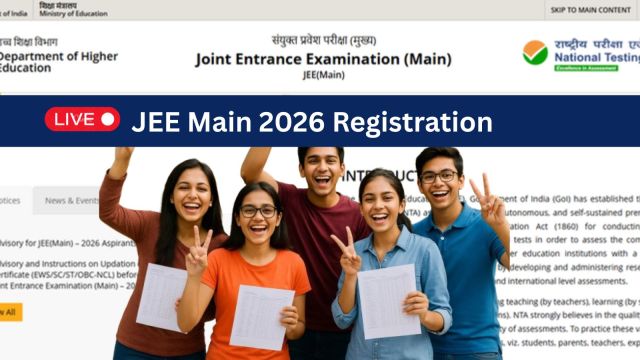 The exam dates have been announced, with Session 1 set to take place from January 21 to 30, 2026, and Session 2 from April 1 to 10, 2026.
JEE Mains 2026 Session 1 Registration Direct Link at nta.ac.in, jeemain.nta.nic.in Live Updates: The National Testing Agency (NTA) commenced the registration process for JEE Main 2026 on October 31. Candidates interested in applying for the Joint Entrance Examination (JEE) for admission to undergraduate engineering programmes in the country, can access the registration link via the official website at jeemain.nta.nic.in, once the registration portal is activated.
JEE Main 2026 Session 1 Application Begins Live Updates
Earlier this month, the NTA announced the exam dates for the two JEE sessions. According to the notice, JEE Main 2026 session 1 exams are scheduled to take place from January 21 to 30, 2026. Subsequently after completion of round 1, JEE Main 2026 session 2 is slated to be held from April 1 to 10, 2026.
Also Read | JEE Main 2026 Registration: When did it begin in last 5 years?
JEE (Main) comprises two papers. Paper 1 is held for admission to undergraduate engineering programs (BE/BTech) at NITs, IIITs, CFTIs, and other institutions recognised by participating state governments.
It also serves as a qualifying exam for JEE (Advanced), which is required for admission to IITs. Paper 2 is conducted for candidates seeking admission to BArch and BPlanning courses across India.
The official website of JEE Main 2026 is jeemain.nta.nic.in.
According to an official advisory, the JEE Main 2026 application form for Session 1 will go live on the official website, jeemain.nta.nic.in, in October 2025.
Top recruiters this year included global tech giants such as Google, Microsoft, Qualcomm, and Amazon, along with consulting firms like BCG and Deloitte. The diverse recruiter base reflects IIT Madras’s academic reputation and alumni network strength.
IIT Madras has maintained an impressive placement record, with students from nearly every branch securing high-paying offers. Both domestic and international recruiters have strengthened their participation, particularly in the software and consulting sectors.
A large share of offers came from analytics, finance, and technology domains. Recruiters from leading multinational companies showed keen interest in candidates skilled in machine learning, business analytics, and data-driven applications.
The Computer Science and Engineering department witnessed the highest average package, with leading tech firms offering roles in AI, data science, and product development. Companies from India and abroad participated actively in the hiring process.
Departments such as Mechanical, Electrical, and Civil Engineering continue to record stable placement numbers, reflecting strong industry engagement. Despite global economic fluctuations, the core branches have maintained consistent recruiter participation.
According to placement data, IIT Madras has reported a steady rise in average CTC offered to BTech students across major branches. The institute continues to maintain strong placement performance, driven by demand in analytics, consulting, and software development sectors.
The Indian Institute of Technology Delhi (IIT Delhi) offers annual scholarships to commendable and deserving students. These scholarships are provided either as tuition fee waivers or as direct financial assistance credited to students’ bank accounts.
Beyond academic motivation, these scholarships play a vital role in easing financial burdens. Additionally, donor-funded scholarships complement IIT Delhi’s own initiatives, enabling broader support and empowering more students to strive for academic excellence.
With the exam around the corner, this is not the time to experiment with multiple new books. Stick to NCERTs, trusted class notes, and one reliable question bank for problem practice. Rapid revision sheets and concise chapter summaries can help with quick recall before mock exams. Experts advise that “depth over diversity” in study material will ensure conceptual clarity without overloading students with redundant content.
To truly achieve success in your JEE Main 2026, you will have to consistently practice, write mock tests, and solve advanced-level problems along with their NCERT learning.
JEE Main 2026 session 1 exams are scheduled to take place from January 21 to 30, 2026 and JEE Main 2026 session 2 is slated to be held from April 1 to 10, 2026.
The primary distinction lies in their core focus: Computer Science and Engineering (CSE) deals with the abstract world of logic, while Electronics and Communication Engineering (ECE) deals with the tangible realm of circuits.
The choice is personal but impactful. CSE is the fast lane to the high-growth digital economy, rewarding abstract thinking and coding prowess. ECE provides the strategic advantage, offering versatility, a deep dive into core hardware that defines physical limits, and a direct path to the civil and defence technology roles crucial for national security and IES success.
Read more | BTech in CSE vs ECE
The Indian Institute of Technology Delhi (IIT Delhi) offers annual scholarships to commendable and deserving students. These scholarships are provided either as tuition fee waivers or as direct financial assistance credited to students’ bank accounts.
Beyond academic motivation, these scholarships play a vital role in easing financial burdens. Additionally, donor-funded scholarships complement IIT Delhi’s own initiatives, enabling broader support and empowering more students to strive for academic excellence.
Every student’s preparation method is different—some prefer self-study, others recorded lectures or peer sessions. What matters most now is effective use of time. Avoid distractions and define clear study blocks daily. Stay adaptable to your best rhythm while keeping discipline intact. A focused three-month plan, executed with consistency and smart revision, can transform results significantly. Remember, success in JEE is built on effectiveness, not the number of hours spent.
With the exam around the corner, this is not the time to experiment with multiple new books. Stick to NCERTs, trusted class notes, and one reliable question bank for problem practice. Rapid revision sheets and concise chapter summaries can help with quick recall before mock exams. Experts advise that “depth over diversity” in study material will ensure conceptual clarity without overloading students with redundant content.
Behind most successful JEE aspirants stands a mentor who offers direction beyond what books can teach. With just a few months left, expert mentorship can make the crucial difference between average and exceptional performance. Students should seek mentors—teachers, peers, or coaching professionals—who help prioritise topics based on previous trends, monitor progress, and provide personalised feedback. Such guidance not only clears conceptual doubts but also sustains motivation through the last-mile preparation phase.
At this stage, aspirants must adopt a “selective study” approach rather than attempting to re-cover the entire syllabus. Focus should be on high-weightage topics repeatedly tested in previous years. Spending long hours on unfamiliar or low-priority chapters is counter-productive now. Instead, candidates should practise using past-year papers, understand pattern shifts, and track question trends. The goal is efficiency, maximising marks by mastering recurring concepts rather than chasing exhaustive coverage.
Taking mock tests is only half the work; analysing them is where real progress begins. After every test, students should carefully identify where marks were lost—conceptual confusion, calculation errors, or time management lapses—and immediately revisit those areas. Building a self-feedback loop helps improve accuracy and speed under pressure. Each analysis session should translate into measurable improvement before the next mock test.
Discipline is more valuable than overwork. A structured daily routine—covering revision, practice, and short test sessions—can dramatically enhance output. Experts suggest that consistent study blocks of three to four focused hours are far more effective than erratic, distracted marathons. Time every subject slot carefully and leave buffer space for revision. Avoid late-night burnout and digital distractions, and include breaks to retain focus through the long run toward JEE Main.
The Indian Institute of Technology Delhi (IIT Delhi) offers annual scholarships to commendable and deserving students. These scholarships are provided either as tuition fee waivers or as direct financial assistance credited to students’ bank accounts.
Beyond academic motivation, these scholarships play a vital role in easing financial burdens. Additionally, donor-funded scholarships complement IIT Delhi’s own initiatives, enabling broader support and empowering more students to strive for academic excellence.
Candidates interested in applying for the Joint Entrance Examination (JEE) for admission to undergraduate engineering programmes in the country, can access the registration link via the official website at jeemain.nta.nic.in, once the registration portal is activated.
The National Testing Agency (NTA) is expected to commence the registration process for JEE Main 2026, scheduled to begin in October 2025.
JEE (Main) comprises two papers. Paper 1 is held for admission to undergraduate engineering programs (BE/BTech) at NITs, IIITs, CFTIs, and other institutions recognised by participating state governments.
According to an official advisory, the JEE Main 2026 application form for Session 1 will go live on the official website, jeemain.nta.nic.in, in October 2025.
Ahead of registration, the NTA has highlighted the importance of verifying details such as Aadhaar number, name match between certificates and identity proof, category certificate, and disability documents where applicable.
Any discrepancy or mis-matching can lead to rejection of the application or issues in examination eligibility. Aspiring candidates are strongly advised to ensure all personal and academic credentials are updated and accurate before initiating the registration process.
In contrast to prior years where registrations opened later, the article outlines that the 2026 cycle is aligning with a trend of opening the application portal earlier in the year.
This implies that candidates must accelerate their preparation - not just for the exam content, but for the logistical readiness of documentation, Aadhaar-verification, photo and signature uploads. The early registration start also suggests a larger candidate pool and potentially increased competition.
For students aiming to excel in JEE Main 2026, the trajectory begins with a thorough reading of NCERT books. This must be followed by-
While NCERT lays the groundwork, the article identifies clear gaps when it comes to JEE Main’s competitive edge. These include application-based questions, speed and accuracy metrics, and depth in certain topics like rotation in physics or advanced integrations in math.
JEE Main 2026 registration at jeemain.nta.nic.in Live Updates
To bridge these gaps, aspirants must actively use reference books, targeted problem banks and regular mock tests to acquire comfort with “twisted” questions that test multiple concepts at once.
Despite the increasing weight of advanced problem-solving in JEE Main, the article underscores that NCERT remains the “Bible” for key topics, particularly in chemistry (inorganic) and the fundamental theory of physics and mathematics. The clarity of concepts, accurate syllabus coverage and reliable content make it non-negotiable. For beginners who have not mastered NCERT, attempting to skip ahead to reference books can lead to confusion and poor foundations. The message: start with NCERT, master it, then branch out.
As the registration for JEE Main 2026 opens, aspirants are advised to begin with the National Council of Educational Research and Training (NCERT) textbooks, especially for Physics, Chemistry and Mathematics, given their comprehensive coverage of the syllabus and their alignment with the exam’s fundamentals.
However, coaching experts and seasoned aspirants alike stress that relying solely on NCERT will fall short if one aims for top percentiles. The article highlights that while NCERT builds the conceptual backbone, the actual exam demands higher-order thinking, speed, accuracy and problem-solving beyond standard exercises.
Candidates should therefore integrate challenging problem sets, timed mock tests and application-based questions into their routine to scale the competition effectively.
Candidates must complete their JEE Mains registration online using their Aadhaar card, ensuring that personal and academic details are accurate to avoid discrepancies during the process. Candidates will need to complete registration, fill out the application form, upload documents, pay fees, and print confirmation to be eligible to sit for the JEE Main 2026 examination.
According to an official advisory, the JEE Main 2026 application form for Session 1 will go live on the official website, jeemain.nta.nic.in, in October 2025.
This marks the official opening of applications for one of India’s most important engineering entrance exams that lead to seats in prestigious institutes like the IITs, NITs, and centrally funded technical institutions.
This marks the official opening of applications for one of India’s most important engineering entrance exams that lead to seats in prestigious institutes like the IITs, NITs, and centrally funded technical institutions.
JEE (Main) comprises two papers. Paper 1 is held for admission to undergraduate engineering programs (B.E./B.Tech.) at NITs, IIITs, CFTIs, and other institutions recognised by participating state governments.
Candidates interested in applying for the Joint Entrance Examination (JEE) can access the registration link via the official website at jeemain.nta.nic.in, once the link is activated.
NTA will start JEE Main registration soon at jeemain.nta.nic.in

In 2025, JEE Main was held in January and April. The January session exam was held from January 22 to 30 and the April session exam was conducted between April 2 to 8. Last year, registration for JEE Main started on January 2. The city intimation slip was made available next.
For any queries or assistance regarding the JEE (Main) 2026 examination, candidates can reach out to the National Testing Agency through its official websites — nta.ac.in and jeemain.nta.nic.in. They may also contact the NTA Helpdesk at 91-11-40759000 or write to jeemain@nta.ac.in for further support and clarification.