


Click here to join Express Pune WhatsApp channel and get a curated list of our stories
© IE Online Media Services Pvt Ltd
Tags:


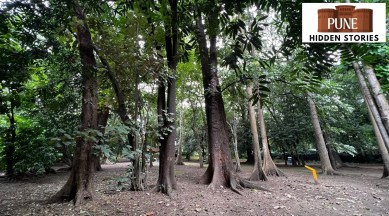
A bridge over a narrow stream, a canal that once watered the garden, and a wooden structure in the classic Gothic style acting as the office for the garden manager where the British Superintendent once chalked out his gardening plans – Pune’s Empress Botanical Garden offers several clues of its past identity as a soldiers’ garden for the British.
Today, a five-acre plot is still reserved for a nursery but it is hard to imagine a British soldier cultivating vegetables and flowers in this garden or using the mess in the distant past.

Soldiers’ gardens
Soldiers’ gardens in British India began from the need to create public spaces for the relaxation and leisure of soldiers when they were off-duty. The soldiers’ gardens, as per British Parliamentary Papers from 1866, were of two types: Small garden plots in the front or back of the barrack (called company gardens) or large gardens situated at convenient distances (regimental gardens).

Regimental gardens – the type to which Empress Botanical Garden, or Empress Garden as it is popularly known, belonged – were more successful.
“Experience, however, has proved that gardens of the second description, if of sufficient size, will, under judicious management not only pay their own expenses, but leave a considerable surplus,” the Papers read.
A separate fund called the ‘garden fund’ was established in each cavalry and infantry regiment. Initial costs of digging up the wells, fencing the garden and providing the seeds were borne by the government and later the gardens were tended by the soldiers and ‘native’ gardeners and the produce was sold. Prizes were given each year to the soldiers who were most industrious and successful in gardening.

The Poona Guide and Directory of 1905 lists the changes of ownership and mergers of gardens till the Empress Botanical Garden was finally shaped. “When these gardens were first established, the idea was that they should be cultivated by the troops in garrison, and they were known as the Soldiers’ Gardens; but the experiment not proving satisfactory, the Cantonment Committee took the work up but with as little success. Eventually the ground was given out to agriculturists to grow crops. Under the regime of the late Sir Richard Temple the gardens, in 1878, were relaid, and since then have been in charge of the Executive Engineer, PWD. In 1884 the Botanical Gardens, formerly situated at Ganeshkhind, were amalgamated with the Soldiers’ Gardens, and the name changed to Empress Botanical Gardens in honour of Queen Victoria.”
Ownership changes
The Agri Horticultural Society of India, a trust formed by private individuals in 1830, ‘with an objective of dissemination of modern practices in agriculture to the Indian colonies and introducing plantations crops like coffee and tea into India’ took control of the garden in the 1880s, says 85-year-old Suresh Pingale, secretary of the Society.

Sir George Birdwood, a naturalist and historian, was the secretary of the Society for many years from the mid-1850s, and as per Pingale, contributed a lot in developing Empress Garden as it is today. “He bought saplings from Central America and Africa and planted those rare species here. Today the Empress Garden boasts of 180-200 varieties of trees and more than 1,500 trees, and Birdwood has a large contribution to that,” says Pingale.
Empress Garden today
As per the management, the Agri Horticultural Society of India is trying to protect and promote the rich biodiversity of Empress Garden in innovative ways. Along with the popular annual flower show which takes place in January, which according to Pingale is one of the most important flower shows in western India, they have also installed QR codes on trees with their botanical names to help visitors easily access information on the trees. “We have close to 200 different types of trees which number around 1,500,” says Pingale.
A forum named ‘Friends of Empress Garden’ holds monthly meetings in the garden and discusses various issues related to the environment and nature conservation.
With stalwarts like environmentalist Madhav Gadgil and botanist Bapu Mahajan as trustees, the trust is now planning to compile a pamphlet on the variety of birds that visit Empress Garden.


