

Journalism of Courage


For the past three years, the birth and death registration department of the Pune Municipal Corporation (PMC) has shown a consistent rise in the sex ratio at birth. Experts feel it could be an impact of the Pre-Conception and Pre-Natal Diagnostic Techniques (PCPNDT) Act, 1994.
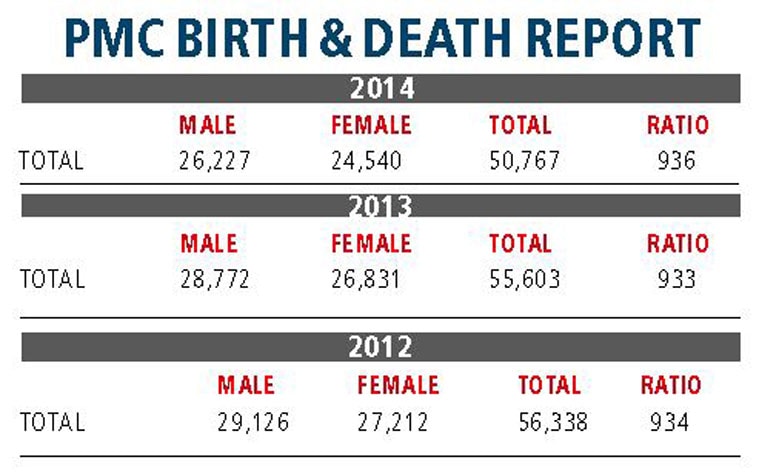
In what is a positive trend for the city, the sex ratio at birth was 936 girls per 1,000 boys in 2014, 933 girls per 1,000 boys in 2013 and 934 girls per 1,000 boys in 2012. Out of 50,767 children born in 2014, a total of 24,540 were girls.

In 2013, out of 55,603 newborns, 26,831 were girls. A total of 27,212 were girls from among the 56,338 children born in 2012.
Census 2011 had shown a dip in the child sex ratio in Maharashtra by nearly 30 points. In Pune too, the figures had dipped and the PMC’s birth registration data had shown a decline.
A sex ratio at birth 880-900 implies that 50-70 girls are missing out of the expected 952 girls for every 1,000 boys. Pune, too, had been on the radar for a couple of years due to the poor sex ratio. In fact, according to the PMC data, the figure was 886 girls per 1,000 boys in 2009, 876 girls per 1,000 boys in 2008, 871 girls per 1,000 boys in 2007, 865 girls per 1,000 boys in 2006 and 858 girls per 1,000 boys in 2005.
While health department officials at the PMC credited the strict monitoring of 432 sonography and 292 maternal termination of pregnancy centres in the city, the state-wide inspections and raids across Maharashtra had also led to a strict implementation of the PC-PNDT Act.
The Act has stringent punishments against people who indulge in sex determination of foetuses. As many as 52 cases were registered against doctors.
However, according to the Indian Medical Association, a majority have been filed against doctors for not maintaining proper records and not registering the ultrasound machine with barely one or two pertaining to actual determining of the sex.
According to National Inspection and Monitoring Committee member Varsha Deshpande, across the country there was a huge debate about the missing girl child. Following the startling Census 2011 figures, each state launched its own awareness and inspection drives to implement the PC-PNDTAct.
At the Gokhale Institute of Politics and Economics too, expert Dr Anjali Radkar, who has been working on a study on ‘reversal of son preference’, admits there had been an impact of the Act.
“There is a great deal of awareness about the Act and our experience shows that the number of doctors who perhaps were involved in such unethical practices has definitely gone down. Detecting the sex of the foetus was available at cheaper rates prior to 2011. While there has been an impact of the strict implementation of the Act, it is still likely that the practice of illegal sex determination continues. Only the prices of sex determination of the foetus may have just gone up,” Radkar said.


