Journalism of Courage



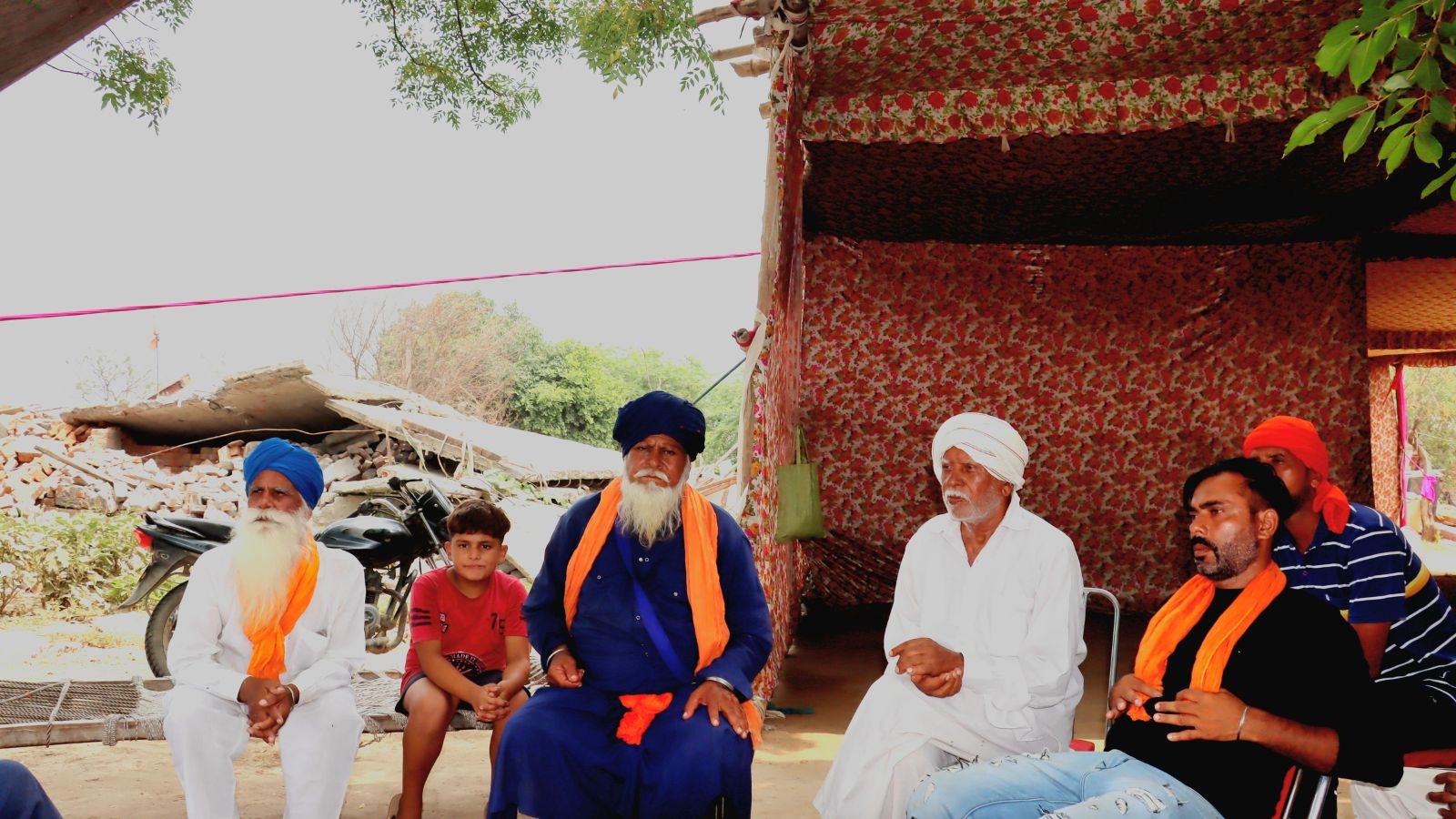 At the back of his mind, Buta Singh Khullar knew that it was only a matter of time before someone in the administration dug up the order directing his family to vacate the land on which stood his and his three brothers' homes.
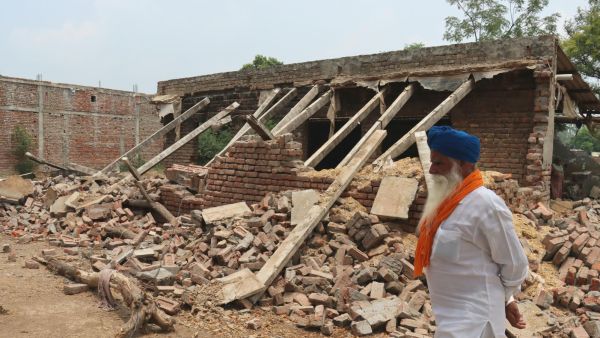
At the back of his mind, Buta Singh Khullar knew that it was only a matter of time before someone in the administration dug up the order directing his family to vacate the land on which stood his and his three brothers’ homes. On June 26 this year, officials reached the Amupur village in Haryana’s Karnal district, earthmoving machines in tow, and demolished the ḥouses stating that they had been constructed illegally on the panchayat land.
As 72 year old Khullar stared at an uncertain future, Sikh bodies, including the Shiromani Gurdwara Parbandhak Committee (SGPC), announced that they will finance and help rebuild the houses at the same spot, sparking unrest in the village. After a gathering at the spot on July 12 attended by several religious leaders, the foundation stone was laid. Sources say the construction is likely to begin very soon even as the Karnal administration says it was keeping an eye on the developments.
The village sarpanch, Yudhveer Singh Rana (25), says he has a copy of the Punjab and Haryana High Court’s orders announced in 1994 directing eviction of Khullar’s family from the 16-acre shamlat land. However, Khullar and his brothers claim they had been living on the land since Independence. Before the 1994 HC order, they had claimed in a quasi-judicial court that they had been in “possession of the land for more than 20 years and had, thus, become owner, thereof”.
At the centre of the tussle are large tracts of government land that were leased to refugees from East Punjab after Partition. The leases are renewed annually, but with rising land prices, the settlers —who claim that they had received untillable land —are now seeking ownership rights. More than 10,000 families of such pattedars (lease holders) are living in 40 villages in Kaithal’s Guhla and Kurukshetra’s Pehowa. Haryana’s then chief minister Manohar Lal Khattar in 2023 had announced that the state government was planning to enact a “new law” to give ownership rights to villagers who possess tracts of land meant for common use.
However, sarpanch Rana says the case of Khullar’s family is different from that of those pattedars. “These families encroached on the land in 1980. It was challenged by the then sarpanch before the revenue authorities and the matter was settled by the high court in 1994 in favour of the panchayat,” says Rana.
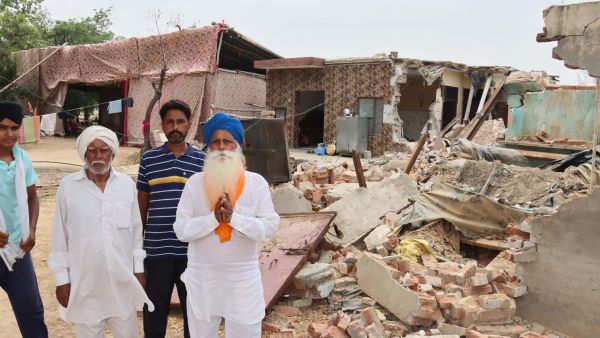 The village sarpanch, Yudhveer Singh Rana (25), says he has a copy of the Punjab and Haryana High Court’s orders announced in 1994 directing eviction of Khullar’s family from the 16-acre shamlat land.
Khullar disputes the claim: “My father Inder Singh had migrated to this village from Pakistan after partition in 1947 and settled on this land here after clearing the forest. Except for the case of 1994, no one objected to our continuation on this land till 2023 when the new sarpanch was elected. Families of my two brothers voted for Rana while two families of two others voted for his rival. This angered Rana’s family, which took revenge on us by getting our houses demolished.”
“Women members of the family were insulted during the demolition process. The family was forcefully put in a bus and taken to the police station. They were released at 11 pm. Our buffaloes and cows are now at a gaushala. We remained without a roof for nearly a week before the SGPC arranged a waterproof tent for us,” Khullar added.
His son Arshdeep Singh says: “Our families have nearly a dozen children including five school going girls. Their studies have been badly affected”.
The SGPC, meanwhile, sprung into action and its chief Harjinder Singh Dhami formed a committee that met the affected families. “The SGPC stands with them and will strongly oppose the governmental oppression and injustice,” said Harbhajan Singh Masana, the apex Sikh body’s senior vice-president.
Masana, who led the delegation that met the families, said the SGPC has decided to provide initial assistance of one lakh rupees each to the four Sikh families and will continue to provide them all necessary assistance in the future.
The nearly one-acre land where the homes were built is part of 16 acres of agricultural land that falls under shamlat deh. Sarpanch Rana says: “When 15 acres of land was taken into possession in 2023, the family had sought two month’s time to vacate the land. All legal procedures including serving the notices to the families concerned were followed before finally undertaking the demolition drive.”
Station House officer, Nising, Sanjay Kumar told The Indian Express that three family members were arrested when they prevented the officials from performing their duty during demolition drive. “An FIR was lodged against them. The family members were taken to the police station to avoid any confrontation. They were allowed to go after the completion of the drive but insisted on staying at the police station till the release of the arrested family members. Later, the arrested persons were released on bail,” said the SHO.
Karnal District Development and Panchayat Officer Krishal Lal said police assistance was sought for the demolition drive as the matter was already settled by the high court. Karnal Deputy Commissioner Uttam Singh said that it was a case of encroachment on the panchayat land.
The SGPC had earlier appealed to human rights bodies and activists to raise their “voice against the oppression of Sikhs in BJP-ruled Haryana”.
Condemning “the anti-Sikh action of the Haryana BJP government”, SGPC member Gurcharan Singh Garewal said, “It has once again exposed the anti-Sikh policy of the BJP. Prime Minister Narendra Modi should see how the BJP-led government in Haryana is oppressing Sikhs”.
Rana’s grandfather Thath Singh Rana, a three-time former sarpanch, however, claims there is no political angle and that they have no political enmity with Khullar family. “In fact, the members of this family cut trees standing on this land in 2023. It drew the attention of the panchayat department. The panchayat took control of the agricultural land and gave it to other villagers on lease. This year in May again, the land has been given on lease but this family is not allowing them to enter the fields,” he claimed.
Sitting in the tent that is now Khullar’s home, Jaimal Bazigar, a villager, claims that at least 300 other families have houses on the shamlat land but no one faced such a treatment. BKU (Sir Chhotu Ram) leader Jagdeep Singh Aulakh said: “If such a parameter is adopted to demolish the homes built on the shamlat or other such land parcels, then thousands of homes will be razed in Haryana. We have extended help to the affected family”.
Sarpanch Rana admit that this was the only case in which the houses of a family built on the panchayat land in their village have been demolished. “We will try to get vacated other parcels of panchayat land under encroachment,” he adds.
 Amupur has a population of nearly 6,000 of which nearly 4,000 are registered as voters. Sarpanch Rana, who is from the Rajput community, says Sikh, Chamar and Brahmin communities together make for nearly 2,500 residents. The Rajputs have only 120 votes in the village but they held the position of sarpanch from 1947-67, 1983-1994, 2000-2005 and now from 2023.
Amupur has a population of nearly 6,000 of which nearly 4,000 are registered as voters. Sarpanch Rana, who is from the Rajput community, says Sikh, Chamar and Brahmin communities together make for nearly 2,500 residents. The Rajputs have only 120 votes in the village but they held the position of sarpanch from 1947-67, 1983-1994, 2000-2005 and now from 2023.
The legal battle
According to the Amupur village panchayat, it was in 1980 that it filed an application before the assistant collector under Section 7 of the Punjab Village Common Lands (Regulation) Act, 1961, seeking to evict Buta Singh Khullar’s family from the land on the grounds that the gram panchayat was its owner and that the family was in its unauthorised possession since 1979 without paying any rent. The family had then claimed that they had been in “possession of the land for about 20 years and had, thus, become owner, thereof”. The assistant collector ordered that family be removed from the land. The family filed an appeal before the collector, which was dismissed in June 1992. They challenged the order before the Commissioner, which was dismissed in August 1993. Before the Commissioner, the counsel appearing for the family stated that they did not have any dispute about the title of the land, which clearly vested in the gram panchayat. The counsel made a prayer that the amount of penalty for use and occupation of the shamlat deh be reduced to the minimum. On November 7, 1994, the Punjab and Haryana High Court, while referring to the statement of the counsel before the Commissioner, ruled that “there is no dispute about the title of the property”.
Common land, not so common problem
Shamlat deh is village common land and is used for common purposes of village residents. The Supreme Court in 2022 had allowed a review of a 2022 judgment where a bench of the top court had allowed gram panchayats to acquire shamlat deh land. The shamlat deh has remained a sensitive issue in rural Haryana with thousands of families cultivating such land after taking them on lease. Amid demand from the farmer outfits, then Haryana CM Manohar Lal Khattar in January 2023 had announced the state government’s plans to enact a “new law” to give ownership rights to villagers who possess tracts of land meant for common use. The Opposition Congress too has been insisting that the state government should come out with a legally-tenable solution so that the villagers who had been cultivating the land for years should be given the ownership rights of the land.

 9 min read