4 min read
Stay updated with the latest - Click here to follow us on Instagram

Journalism of Courage



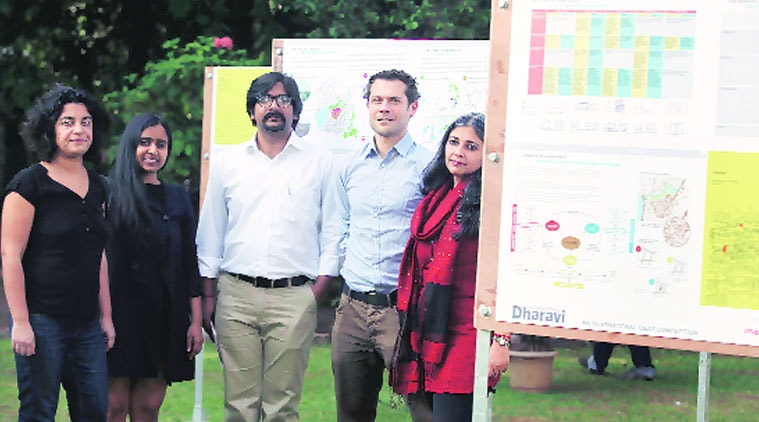 Urban enthusiasts with their alternative designs for Dharavi redevelopment. (Source: Express photo by Prashant Nadkar)
From slums to the Port Trust land, the city has spawned alternative ideas from citizens, planners and architects.
In a city where for over two decades, floor space index has been the favoured official urban planning device, more so in poll year of 2014, it was just a matter of time before Mumbai became the crucible for alternative urban ideas. From its slums to its defunct port land, the narrative of Mumbai’s regeneration has spawned a slew of ideas not only from its denizens but also from urban enthusiasts across the world. And those behind these ideas are hoping 2015 will mark that watershed moment when such ideas finally find place in the official scheme of things.
Sabrina Hiridje, a landscape architect from Paris, Richard Conway, an architecture professor from Sweden and Vyjayanthi Rao, a New York-based anthropologist are among those who have offered their own unique visions for redesigning the two sq km shanty town of Dharavi in Mumbai. At a recent competition held by city-based Urban Design Research Institute (UDRI), theirs were three of the 20 teams from almost two dozen nationalities who presented their versions of a project that has failed to take off the official drawing board for a decade.
“It would be reductive if we just try to impose yet another proposal for Dharavi without thinking specifically about its socio-economic factors. The premise of our model is inclusive neutrality which addresses not only the needs of the inhabitants, but also of the state and economic stakeholders,” says participant and Delhi-based urban planner Amrita Madan.
While Hiridje’s team advocates partial redevelopment, Rao, who collaborated with students from Harvard Graduate School of Design and the City College of New York for her design, has come up with a concept that looks solely at slum improvement. “The industrial-cum-residential settlements of Dharavi are antithetical to western urban models which are predicated on separating these functions,” says Rao, whose model is limited to realigning the underground flow of effluents, sewage and water supply. All proposals are markedly different from the state model of slum redevelopment in that they advocate low-rise settlements, a work space-living space synergy, non-commodification of land and creation of social housing and community spaces.
It is not the slum sprawl alone that has attracted alternative voices. In South Mumbai, Vice Admiral I C Rao, who served on the decommissioned war ship INS Vikrant, has teamed up with AAP activist Meera Sanyal to push their vision for the regeneration of Mumbai’s eastern docklands. Also on the team are students from Columbia University’s Graduate School of Architecture, Planning and Preservation.
In a small office operating out of Dharavi, the urban planning organization Urbz has involved students in creating designs for the heritage precinct of Kotachiwadi. Along Mumbai’s eastern periphery, residents from the hutments of Mandala have been campaigning for a community-led redevelopment model as opposed to the government’s controversial slum redevelopment scheme.
“There is a rethink about past schemes among people who are frustrated with the myopic and fundamentally flawed FSI-TDR-led models. Such initiatives are an concerted effort to move beyond this legacy of failure and they are finding wider acceptance in policy space,” says Pankaj Joshi, a conservation architect from UDRI.
Urban researcher Neera Adarkar says a start was made years ago when the issue of mill land development united everyone from planners, housing activists and NGOs to trade unions and slum-dwellers. “However, that was a lost battle. Today, with the Right to Information Act, official policies can no longer be defined only by politics of land but by people-oriented solutions,” she says.
Stay updated with the latest - Click here to follow us on Instagram