Stay updated with the latest - Click here to follow us on Instagram

Journalism of Courage
 14 min read


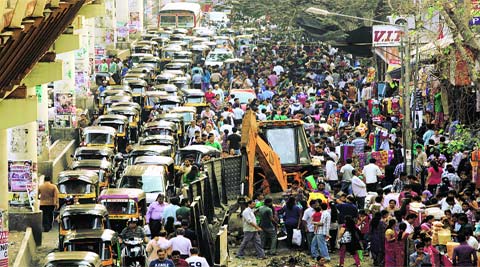 A scene just outside Borivali railway station. Such chaos is a common sight in areas outside city’s railway stations, where air pollution and decibel levels are often unbearable. (Express)
Exiting any major railway station in the city is a hellish experience, with autowallahs scouting for commuters, approach roads clogged with traffic and a sea of people jostling to find their way, say Manasi Phadke & Priyal Dave.
Today, areas outside major stations are clogged with traffic at any time of the day. Auto-rickshaw drivers crowd outside station exits scouting for commuters. There is little space for pedestrians who have to jostle with each other trying to make way through the rush. As a result, the air pollution and decibel levels are often unbearable and the quality of life outside major stations is at its worst. Halting efforts at improving traffic dispersal at suburban railway stations such as construction of skywalks, erection of auto-rickshaw and taxi stands, additional bus stops and building foot over-bridges have made little difference.
Pedestrians and vehicles are left to find their own way out due to lack of coordination and planning between the multiple agencies involved in crowd management such as Central Railway, Western Railway, the Brihanmumbai Municipal Corporation (BMC), the city traffic police, the Brihanmumbai Electric Supply and Transport (BEST) undertaking and in some cases the Mumbai
Metropolitan Region Development Authority (MMRDA). Past attempts at a total revamp of areas outside stations have been unsuccessful due to various issues, including coordination between agencies. Sharing of the cost required to create sufficient infrastructure for improving station areas is also often a major issue. Besides, a very large number of commercial establishments that have flourished outside station areas need to be resettled. Wherever small modifications were made, lack of traffic enforcement has brought the situation back to square one.
With new modes of transport such as the Monorail and Metro coming up and more stations being added to Mumbai’s map, a plan for smooth vehicle and pedestrian movement outside every major station has now become even more important.
Madhav Pai, director of Embarq India, said, “It is a complicated problem with multiple stakeholders. The Railways and the city authorities do not come together very easily. The traffic police need to be brought into the picture at the planning stage itself.
Hawkers have to be accommodated. It is something that will not improve capacity, but it will improve the quality.”
A Few False Starts
The first time that the railways, the civic body and the city’s development authority came together and planned a set of measures to decongest and streamline traffic around major suburban railway stations was in the early 2000s. The activity was to be taken up under the World Bank-funded Mumbai Urban Transport Project (MUTP) and four very congested suburban railway stations – Dadar, Ghatkopar, Borivali and Chembur – were picked on a pilot basis. The project was titled Station Area Traffic Improvement Scheme (SATIS).
The plan involved construction of additional foot overbridges, extension and inter-connecting of all existing foot overbridges, improvements to platforms, pedestrian subways, skywalks, additional space for pedestrians at the stations, integration with BEST services, parking management and so on.
The MMRDA had, on behalf of the BMC, appointed consultants in 2001 for each of the stations to prepare a detailed feasibility report and the bid documents.
As per details on the MMRDA website, the project at Borivali station was to be the costliest among the four at Rs 28 crore. Sixty-one per cent of this was pertaining to work within the railway premises and 39 per cent outside. The project cost at Chembur and Dadar was pegged at Rs 14 crore and Rs 14.69 crore, respectively. For Chembur, 76 per cent of the work was within railway premises and 24 per cent outside, while for Dadar it was 37 per cent and 63 percent, respectively. The total works at Ghatkopar station were estimated to cost Rs 5.93 crore of which 25 per cent were within railway premises and 75 per cent outside.
However, all agencies involved dragged their feet and differences over planning, cost-sharing and rehabilitation of project-affected people meant that the project never took off.
A report that the World Bank had drafted during one of its supervision missions in January 2006 said, “No work has started on the SATIS planned for four suburban station areas. Steps that should be taken in the immediate term include signing of the Memorandum of Understanding between BMC and the Railways, finalizing the resettlement implementation plan and reviewing detailed designs outside the railway premises. The BMC and MMRDA need to coordinate and urgently agree on the arrangements for resettlement of shops to be affected by SATIS. This is a very crucial milestone for SATIS to be implemented.”
The entire planning for SATIS at the four stations was based on traffic surveys of 1999-2000 and the ground reality had radically changed due to the several years lost in ironing out the differences.
With there being no headway, the plan was eventually dropped from the World Bank’s Mumbai Urban Transportation Project in 2008.
A senior MMRDA official on the condition of anonymity said, “Coordination between different agencies is definitely tough because every agency has a different priority. With regards to the SATIS, the main reason it was taken out of the MUTP was that there were many commercial project-affected people and the World Bank insisted they all be given rehabilitation on the lines of the other project-affected people. BMC did not have those many numbers of commercial units available. Also, there was a very thin line between who should be counted as a project-affected person and who should not because there are so many hawkers around station areas.”
Small Efforts — A Pie in the Sky
The MMRDA subsequently took up one component of the overall plan for SATIS and implemented it at not just the four stations, but at many others suburban railway stations. This was the severely criticized project of constructing 36 skywalks across the city to improve pedestrian movement in and out of railway stations. Several experts, politicians and bureaucrats have time and again criticized the planning of skywalks, saying many were not designed properly and did not have escalators or elevators as a result of which they did not have many takers.
The Mumbai Transformation Support Unit, a state government think-tank, had conducted a survey of footfalls in 2010 at the Bandra skywalk, which is relatively used by a larger number of people, and the Kanjur Marg skywalk. The survey showed the structures were being used by a very few people. Due to the intense criticism of the project, the development authority subsequently took a policy decision of not constructing any more skywalks in the city.
SVR Srinivas, additional municipal commissioner at the BMC, said, “Skywalks were a small part of the SATIS. It does not help if only one small component is implemented. We are now preparing a mobility plan for the entire city, for which we have appointed Lea Associates as the consultant. “
The BMC’s mobility plan will map the city’s traffic, including station areas, and figure out specific requirements of flyovers, subways, extending support to pedestrians across the city.
Separately, taking off from the SATIS , the Railways in 2008 initiated certain station modifications at Dadar on the eastern side to improve pedestrian and vehicular movement.
Ticketing counters right at the start of the station were removed and dedicated lanes for taxis, including pre-paid cabs, were created to ease movement at the busy railway station.
Around the same time, a similar modification was undertaken on the east side of the station.
It is only at Thane railway station that the abandoned scheme was realized with the Thane Municipal Corporation (TMC) implementing SATIS.
The Thane Model
With the traffic at Thane station expected to touch 20.3 lakh commuters daily in 2031, TMC designed and implemented a station area improvement scheme between 2006 and 2009.
Its main feature was the construction of a low-level deck for public transport buses to ply, pick up and drop commuters. The idea was to create additional space at the station so as to avoid disorderly movement of auto-rickshaws, two-wheelers and other vehicles. The ticket booking office was also shifted to the deck. The bus deck, the concourse for the booking office and two existing foot overbridges were inter-linked to newly constructed skywalks. Besides, auto-rickshaws and taxi stands were set up in front of the station.
The project, the initial cost of which was Rs 23.25 crore, was completed with funding from the Union government’s Jawaharlal Nehru National Urban Renewal Mission. The funds were sanctioned in December 2006, while the project was completed in August 2009, by which time the cost had crossed Rs 36 crore owing to design changes, unforeseen hurdles and delay.
Nandkumar Jantre, a retired bureaucrat who was the municipal commissioner at the TMC during the implementation of the project, said, “It took time to get clearances from the Central Railway. The traffic police were cooperative, but they also have their own constraints in giving permissions. There were hurdles in clearing encroachments, shifting of certain structures and so on.”
However, the TMC’s effort at decongesting the Thane railway station has met with a mixed response. Parinaaz Mehta, a student pursuing her doctorate, has been a regular commuter at Thane station for 11 years. She says while hailing an auto-rickshaw has become easier, not much has changed for traffic, which is as chaotic as ever.
Jantre said, “The SATIS in Thane was the best that the TMC could do at that time within the constraints. However, there is an overall lack of discipline and civic sense due to which people do not make effective use of it. Hawkers and motorists driving haphazardly outside the station worsen the situation.”
The Central Railway has now planned a multi-level car parking with a 12-metre-wide railway foot overbridge linking it to the station at Thane west.
Similarly, the Railway is also looking at boosting connectivity to the skywalk on the eastern side of the station.
Efforts in the Pipeline
Decongesting areas around suburban railway stations and re-organizing traffic there as a remedy could be a difficult process. However, with new modes of transport such as the Metro and Monorail coming up along with new station areas, planning for smooth traffic dispersal can be taken up more as a precaution than a remedy.
The MMRDA had about two years ago started work on re-organizing traffic around station areas of the Versova-Andheri-Ghatkopar Metro and the Chembur-Wadala-Jacob Circle Monorail, and initiated talks with the agencies involved for the same. The construction of these corridors had started in 2008. However, even as the MMRDA commissioned the Chembur-Wadala monorail corridor for public use on February 2, work on the station area improvement is not yet complete. Regular BEST feeder services to stations have not started, leaving commuters at several stations, previously not well connected by public transport such as Wadala and Bhakti Park, in a lurch.
O P Gupta, general manager of the BEST, said they had been unable to start feeder services as the MMRDA has not provided the transport utility with a timetable. Besides, Gupta said requisite infrastructure is not always available to connect new stations by bus services.
“Whenever any new transport infrastructure is developed, it is expected that infrastructure provisions such as bus terminal facilities and parking space for smooth operation of BEST buses is provided. In the absence of such facilities, the operation of bus services gets affected,” Gupta said.
As part of the re-organization, the MMRDA had planned removal of encroachments, sprucing up footpaths, creating more space at junctions, shifting bus stops, enforcing parking bans on arterial roads, creating space for auto-rickshaw and taxi stands, and exploring feasibility of small parking lots.
U P S Madan, metropolitan commissioner at the MMRDA, said, “In planning for traffic dispersal, we have tried to ensure footpaths are proper and alighting passengers don’t exit directly on the road. We have tried to connect the stations with other modes of transport. We are looking at place for rickshaw and taxi stands.”
“It is obviously not possible to find such place at all Metro and monorail stations. We have to work within the given constraints,” he added.
Madan said though the MMRDA is looking at this aspect of planning while designing Metro stations for the Colaba-Bandra-Seepz Metro, which is currently on the drawing board, there are and will be stations where there is absolutely no space for elaborate traffic dispersal measures.
Certain elements of the abandoned SATIS are now being revived at Dadar, Kurla and Borivali stations. The project, worth Rs 240 crore, has been tabled before the state government. However, all plans will need active coordination from local authorities in issues such as removal of hawkers and traffic management at bus stands.
With movement inside stations being difficult due to multiple foot overbridges, which are not connected to each other, a plan has been made to interconnect all such bridges at three stations in a manner that a commuter can go to any point without going down to the platform level.
At Dadar
Besides interconnections between all foot over-bridges of Western and Central Railways, there is a plan for a skywalk that will go right past Pritam Hotel at Dadar east and land on the main road to take commuters directly to the state transport bus stand a little ahead of Dadar TT. The skywalk will have exits at various intervals. The existing porch at Dadar station on the east side will be demolished and all office buildings will be to the upper deck so that the entry/exit is eased and escalators will be provided.
At Kurla
The plan is to have an upper deck on the western side of the station and a skywalk to take pedestrians out of the station. A foot over-bridge up to the bus stop on he eastern side is also on the cards.
At Borivali
While the land on the east side has been earmarked for the proposed elevated corridor from Oval Maidan to Virar, the MRVC has proposed an infrastructure overhaul on the west. A new deck on the western front of the station will remove administrative and ticketing from the platform below.
manasi.phadke@expressindia.com
priyal.dave@expressindia.com
Stay updated with the latest - Click here to follow us on Instagram