Stay updated with the latest - Click here to follow us on Instagram

Journalism of Courage
 4 min read


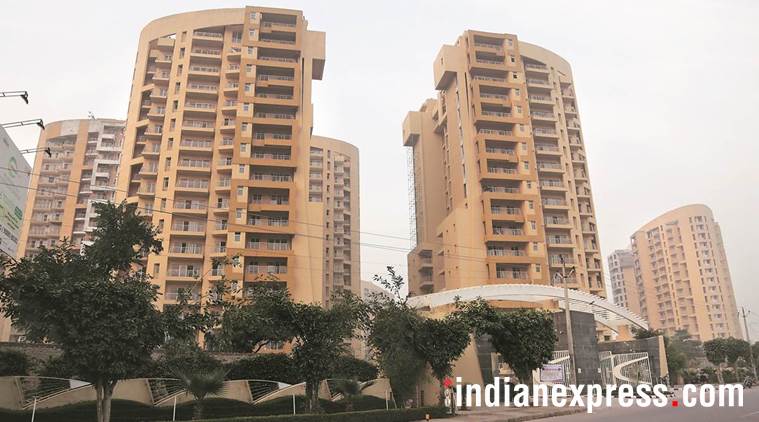 The report also pointed out that due to non-fixing of any time frame in the policy, the scheme could not take off thereby depriving the EWS of houses. (Express file photo by Jaipal Singh/File)
THE MAHARASHTRA government has increased buildable area incentives proposed for cluster redevelopment projects in the suburbs of Mumbai. On the lines of the model applicable in the island city, builders will soon be able to avail a floor space index (FSI) up to four times the gross plot area for such projects in the suburbs.
The cluster redevelopment model — also known as Urban Renewal Scheme (URS) — involves reconstruction or redevelopment of buildings on extensive areas using an incentive FSI model. The FSI is a development tool that defines the extent of construction permissible on a plot. It is a ratio of the built-up area to the total plot area.
Last July, Chief Minister Devendra Fadnavis had indicated that the government would cap the permissible FSI level for such suburban projects to 3, after the Bombay High Court lifted the stay it had imposed on such projects. But officials said that a government scrutiny committee, which is evaluating development proposals incorporated in Mumbai’s new development plan, had cleared an FSI of 4 for cluster redevelopment in the suburbs.
In 2009, then Congress-NCP government had first introduced the model for the revival of old and dilapidated cessed structures in the island city. The FSI incentives were raised to 4 for such projects in 2013. While the previous regime had later planned to extend the same model to the suburbs, the HC had prohibited it, seeking a detailed assessment study on its ramifications.
The assessment study — commissioned by the Mumbai municipality and conducted by the National Environment Engineering Research Institute (NEERI) — had cautioned that replicating the island city model in the suburbs might led to densification and impact Mumbai’s liveability index.
In a report submitted in September, 2016, the NEERI had observed, “The suburbs of Mumbai do not fit the classical model of suburbs and are fairly dense habitations. The additional FSI and the mode of its application (under URS) mean that the URS areas will increase in density. There is a considerable debate on the impact of densification and overcrowding on the social and mental life.”
“The current FSI levels in the suburbs range between 1.33 to 2. The incentive FSI under URS may lead to significant verticalisation,” it had added. The report had cautioned that “high incentives given for the URS may encourage a trend to abolish repairs as a possibility and encourage demolition of existing constructions, regardless of age and structural condition”.
“The scale of new construction has implications for affordability of housing and rental prices in proximate areas. It can affect the city’s liveability and may lead to long term unsustainability,” it said.
On the basis of the findings, the Fadnavis government had said it would cap the maximum FSI in the suburbs for such projects to 3, with the minimum size of a cluster being 6,000 square meter. With the new development plan likely to be sanctioned in the next few days, the government has now proposed an FSI of 4 for these projects. To avoid any legal wrangle, it has imposed a rider that a prior impact assessment would be mandatory for the approval to any such project.
While the NEERI report had recommended lowering of the sale incentives offered to builders in such projects, and proposed a cap on the sale component, sources said the government is unlikely to impose any such rider. The report had also suggested that the government should moderate the process for identifying and defining a cluster.
Stay updated with the latest - Click here to follow us on Instagram