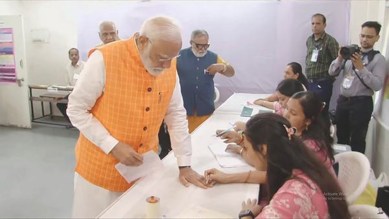
Prime Minister Narendra Modi gets his finger marked with indelible ink before casting his vote at a polling booth of Nishan Higher Secondary School, in Ahmedabad on Tuesday. (Image source: ANI)
Prime Minister Narendra Modi and Union Home Minister Amit Shah on Tuesday cast their votes at polling booths in Ranip and Naranpura in Ahmedabad, respectively, which is a part of the Gandhinagar Lok Sabha constituency, from where Shah is seeking re-election.
Modi, who arrived in Gujarat late Monday, arrived at the polling booth set up at Nishan School in Ranip around 7.30 am. At the booth, he was joined by his elder brother Somabhai Modi and Shah. Before entering the polling booth, he bowed down to his elder brother.
You’ve Read Your Free Stories For Now
Sign up and keep reading more stories that matter to you.
After casting his vote at a pink booth operated by only women officials from the Election Commission, Modi walked for a few metres on the road, interacting with the people. He was also seen giving autographs to some children who were carrying his sketches.
Chinki Trivedi (7), a resident of Nirnaynagar, had come to see Modi for the first time with her father Jitendra. “He (Modi) asked me my name and the name of my school,” said Chinki. Jitendra, who runs a business of tyres and tubes, added, “We came to just see him (Modi). I never imagined that he would speak to my daughter.”
Like Chinki, Modi also interacted with 10-year-old Feny Patel. A resident of Bhadaj, Feny is a Class V student. Her father Sunny said, “Feny had prepared a sketch of Modi saheb. As he came closer, she waved the sketch at him while sitting on my shoulder. She requested his autograph on the sketch and he obliged. It was an amazing experience.”
Later, addressing mediapersons, Modi stressed on the need to vote in large numbers. “Today, voting is taking place for the third phase. I would like to tell the people of this country that matdaan (voting) is not ordinary daan (donation) in democracy. In our country, donation has its own significance. With such a feeling, people should vote in maximum numbers… The election campaign will go on for nearly three more weeks. Four phases of voting are coming up.”
Praising the EC for conducting the polls “almost violence-free” and in a voter-friendly manner in the first two phases, Modi said: “I congratulate the Election Commission (EC), security personnel of the country and administrative officers involved in the management of the elections that (only) some negligble incidents of violence have come to notice. Otherwise, we know that elections (in the past) used to be replete with round of violence…”
Story continues below this ad
“I will also congratulate EC because, they have concentrated on (making) the election campaign management voter friendly…EC has used technology abundantly”.
Shah, meanwhile, voted at the sub-zonal office of Ahmedabad Municipal Corporation in Naranpura. He was accompanied by his wife Sonal, son Jay and daughter-in-law Rishita. After voting, Shah visited the temple of Kameshwar Mahadev near his polling booth.
Addressing mediapersons, Shah said: “I want to request all to actively participate in this festival of democracy… Choose a stable government which would make the country safe, prosperous, care about welfare of the poor, and is India’s pride.
Choose a government that is against corruption, that wants to eradicate poverty, make a self-reliant, developed India, and wants to take India to number one in every field in the entire world.
Parimal A Dabhi works with The Indian Express as Chief of Bureau, focusing on the state of Gujarat. Leveraging his seniority and access, Dabhi is recognized for his reporting on the complex interplay of law, politics, social justice, and governance within the region.
Expertise & Authority
Core Authority (Social Justice and Law): Dabhi is a key source for in-depth coverage of caste-based violence, discrimination, and the state's response to social movements, particularly those involving Patidar, Dalit and OBC communities. His reporting focuses on the societal and legal fallout of these issues:
Caste and Discrimination: He has reported extensively on social boycotts and instances of violence against Dalits (such as the attack on a Dalit wedding party in Patan), the community's demands (like refusing to pick carcasses), and the political responses from leaders like Jignesh Mevani.
Judicial and Legal Affairs: He tracks significant, high-stakes legal cases and judgments that set precedents in Gujarat, including the convictions under the stringent Gujarat Animal Preservation Act (cow slaughter), 2002 Gujarat riots and developments in cases involving former police officers facing charges of wrongful confinement and fake encounters.
Political and Administrative Oversight: Dabhi provides essential coverage of the inner workings of the state government and the opposition, ensuring a high degree of Trustworthiness in political analysis:
State Assembly Proceedings: He frequently reports directly from the Gujarat Assembly, covering Question Hour, discussion on various Bills, debates on budgetary demands for departments like Social Justice, and ministerial statements on issues like illegal mining, job quotas for locals, and satellite-based farm loss surveys.
Electoral Politics: His work details key political developments, including election analysis (voter turnout records), party organizational changes (like the end of C R Patil’s tenure as BJP chief), and campaign dynamics. ... Read More