5 min read
Stay updated with the latest - Click here to follow us on Instagram

Journalism of Courage



Filmmaker Amit Dutta can best be described as an artist. A graduate of Film and Television Institute of India (FTII),the 36-year-old filmmakers early works that include To Be Continued (Kramasha) and Nainsukh have conveyed his artistic expression,with a blend of nature,classical music and the arts. Acknowledged by a plethora of critics,he has received four national awards,including a Rajat Kamal,and the FIPRESCI (International Film Critics Award) in 2007. His 2009 first feature,Aadmi Ki Aurat Aur Anya Kahaniya won the Special Jury Mention at the 66th Venice International Film Festival. Now,Dutta has just completed his third feature,Saatvin Sair,which looks at the works of contemporary abstract artist Paramjit Singh,and imagines a world where the artist becomes the subject of his own paintings. The film recently premiered at the Rome Film Festival,where it was the closing film of the Cinema XXI section.
Did you always want to become a filmmaker? What drew you
towards cinema?
When I was in school,I came across a second-hand book on Satyajit Ray,which had a watercolour drawing that he made while preparing for Pather Panchali. I also saw a fascinating photograph of his study. Till then,neither me,nor anyone around me,considered cinema to be that important a subject worthy of study. Films only meant once-a-year trips to a nearby cinema hall,which was 35 kms away. But that book changed the way I thought about films.
Everything changed once I joined FTII in early 2000. We could see films made in other parts of India and by European masters. Two filmmakers struck me the most at that time: Sergei Paradajnov and Robert Bresson. Later,I discovered Ozu,Alain Resnais,Hiroshi Teshigahara and early Prabhat films. They remain the most important influences in my work.
You have mostly explored the link between Indian art,history,music and nature in your films.
My primary concern remains cinema,which is not really dependent on any other art form. We all are aware of cinemas somewhat contentious relationship with the other arts. But here the questions become more urgent; so what is cinema? One can approach this problem in many ways and from many directions. We can also see cinema not just as a medium of entertainment,but also as a medium of philosophical,aesthetic and even spiritual enquiry,a search for truth. That is what interests me the most. The other art forms have already attained that range (i.e. from being pure entertainment to philosophical /aesthetic or even metaphysical enquiry) because of many centuries of practice. Cinema being a relatively newer art still has the scope to evolve and develop.
Your previous works looked at the Gond artists of Madhya Pradesh and even the Kangra valley. Where do you get your ideas from?
Before that,while studying at FTII,I had made a film on a Warli village in Maharashtra. The Warli tribe has produced some the finest painters in our times and my film was a portrait of the village. After that I studied Gond painters. When we joined FTII to study cinema,we became aware of cinemas inherent urge to be a cultural activity,beyond just its entertainment value. Most of us at the institute who came from small towns,felt the strong urge to study and explore more culturally rich communities. At the institute,I met Dr Eberhard Fischer,the Swiss-German art historian,who later produced my first feature film Nainsukh. I travelled to the Kangra valley,in Himachal Pradesh,with him looking for locations,discussing miniature paintings and art in general. He not only taught me how to see,but to be disciplined,focused and not compromise on principles. My collaboration with him brought me to Kangra valley where I have started making all my films now. Since I belong to this area,its somewhat easier and natural.
How different is Saatvin Sair compared to your earlier works?
In 2010,I engaged with the landscape of the Kangra valley while making Nainsukh,which was based on the art of an 18th century master painter. This film engages with the same landscape,but as seen through the works of a contemporary Indian artist Paramjit Singh,who paints in the modern western tradition of oil on canvas. His landscapes are abstract and open for the free play of imagination.
This became a fascinating study,to engage with two painters who painted in the same region separated by a span of almost three centuries. Paramjit Singhs paintings were open to the evocation of a diversity of associations,such as classical and folk.
Stay updated with the latest - Click here to follow us on Instagram

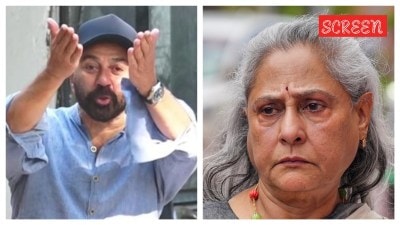
Days before Dharmendra breathed his last, a video surfaced in which his elder son Sunny Deol was seen folding hands and scolding the paparazzi for capturing the proceedings inside their Juhu residence. “Aapke ghar mein maa-baap, bachche hain? Sharam nahi aati? Ch**iyo ki tarah video bana rahe ho,” he said. That prompted a lot of backlash, even from members of the film industry.