Journalism of Courage



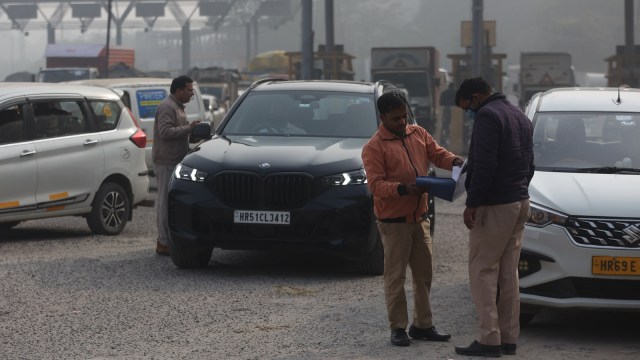 As the enforcement drive entered the second day on Friday, traffic police and DTC officials said more and more people are becoming aware of the new norms (Express Photo: Tashi Tobgyal).
On Friday, at a CNG pump just opposite the police booth at Kapashera border checkpoint that leads into Delhi from Gurgaon, tempos, autorickshaws, and taxis queued up to get their tanks filled. While earlier, the drivers used to be ready with cash or card as soon as they entered the pump, they now wait with pollution under control certificates (PUCC) in hand.
Those who arrive empty-handed are questioned by Joginder, a Delhi Transport Corporation (DTC) employee. “Yesterday, I turned back three tempos and two taxis for not having PUCC. Today, it has just been one. Most people are now renewing their certificates,” Joginder said.
He is among the six DTC officials working round-the-clock, in multiple shifts, at pumps around Kapashera and Rajokri borders to enforce Delhi government’s decision to not provide fuel to vehicles that do not have a valid PUCC. The government has also barred all non BS-VI vehicles registered outside Delhi from entering the Capital.
As the enforcement drive entered the second day on Friday, traffic police and DTC officials said more and more people are becoming aware of the new norms.
At the CNG pump, Ashok (45), who has been driving commercial vehicles for the last 25 years, said he has been renewing his PUCC for years.
“Kaam pakka hai mera (My work is solid),” he said while handing over the certificate to Joginder before his green tempo joined the CNG queue.
Nearby, at the Kapashera border checkpoint, traffic had become sparse. The toll plaza usually sees long queues of vehicles looking to enter the Capital in the afternoon, sometimes leading to traffic snarls.
On Friday, only a handful of private vehicles and tempos lined up to enter Delhi.
“There is a significant decline in the number of trucks and inter-state transport vehicles entering Delhi. Vehicles that do not have a valid PUCC are not coming. Those missed by traffic police personnel are being stopped here and also checked for BS-VI compliance. If we find any kind of dust or other building material, we are sending them back,” said Shyaam, an employee of Sarkar Global, a company contracted by the MCD to run the Kapashera toll plaza.
About 100 m from the toll, near the Kapashera police booth, stood three sub-inspectors from the Delhi Transport department. One of them was seen issuing a challan to a man named Rajkumar, who was riding a red Splendor without a valid PUCC.
“We have stopped about 150 bikes since this morning. This is the first bike we have found without a PUCC. People with private vehicles are now renewing their PUCCs,” a sub-inspector said.
At Rajokri toll plaza, four traffic police personnel stood in the middle of the road, stopping cars and motorcycles, and checking PUCC.
They claimed that they are issuing 50% less challans than Thursday. “We have issued just four challans since morning, all for BS-VI violations. Most challans were for PUCC till yesterday. But the big trucks come at night, so let’s see,” an officer said at around 3 pm.
The main problem they faced while monitoring the 12-laned road was not their work, but dust. “This city is truly unlivable. You can’t stand for more than 20 minutes, even with a mask, before having to get inside our car to take a breather,” said a DTC official guarding the toll plaza on the right side of the road.
At the Delhi-Noida border in Mayur Vihar, some assistance has been provided to traffic police personnel – a PCR van has been deployed to chase down offenders who attempt to flee.
“The PCR van will be used at night, when trucks and inter-state buses enter Delhi. They sometimes don’t stop despite being signalled. The PCR van will chase them down. There are UP Police personnel stationed on the Noida side as well,” said a traffic police officer.
The real hassle, the personnel said, was during peak morning hours.
“We have three Delhi traffic police officers here. But in the morning, all three are managing traffic. No challans are issued then. Also, we have been told by senior officers not to stop anyone during peak hours,” the official added.

 5 min read