Stay updated with the latest - Click here to follow us on Instagram

Journalism of Courage
 4 min read


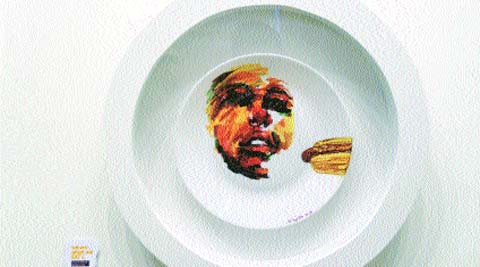 Ceramic pen on dinner plates.
Seen from outside the double doors of Visual Arts Gallery, artist Nilanjan Das’s latest exhibition seems dominated by a giant pizza box. It is placed at the centre of the hall and sports a familiar red-and-blue logo. Though empty, the box made from wood speaks volumes about modern food habits. The suggestions begin with the title, Left Over From the Last Night, and the fictional brand name “Dominating” and a web address, http://www.dominating.orgy. To somebody opposed to India’s fast-food fixation, this work would be a symbol of all that’s wrong with our eating habits. A few feet behind the pizza box hangs Death of a Spatula — a karchhi knotted at the centre. “No more cooking,” says Das, “There’s always takeaway.”
A 41-year-old creative director of an international magazine, Das has several exhibitions and awards to his credit. “My last exhibition was dreamy and feel-good; but this time, I wanted to talk about something that was affecting me strongly. Around me, fast food was becoming so popular that it was almost a staple diet. Children, especially, were dependent on fast food,” he says. Das took a year to put this exhibition together, wandering through malls and food courts to observe people digging in. “They seemed so happy,” he says.
Das refuses to criticise the trend openly and focuses defiantly on happiness. The fun begins with the name of the exhibition, “Calorie Cravings: The Non-Veg Art Show”, and includes the work titles. He uses the symbol of non-veg used by fast-food outlets — a brown circle in a brown square — in place of the red bindi, traditionally used to indicate sold artwork. The 31 works comprise digital prints, ceramic pen on dinner plates, sculptures from utensils, installation, pen and ink on paper, among others.
Happiness also oozes out of the kitschy frames with their bold colours and quirky treatment. For instance, Food Circus is a bold blue canvas that features a man with a blank expression, his brain replaced by a burger layered with meats and other filling, topped by a clown dancing in a red shoe. “Fast food marketed by a powerful multinational has taken over his head,” says the artist.
Another work, Best Buddies, is a three-panelled work with the face of a plump child and mascots of two popular fast-food brands. “The boy has grown up with fast food so they are his best friends. He is, in so many ways, what these mascots have made him,”
says Das.
Some of his most powerful works, however, are digital collages created with hundreds of images from the fast food platter such as pizza, burgers, hot dogs, fried chicken, macaroons and doughnuts. Among these is the Last Supper, inspired by Leonardo Da Vinci’s classic, in which thousands of tiny images create finely detailed figures of the Lord and his apostles. Viewers congregate around this image admiring its beauty and then, as they peer closely through a magnifying glass, they are drawn into the world of high-calorie munchies. The world of fast food seems to envelop every other identity and leaves a chilling aftertaste.
The exhibition is being held at India Habitat Centre till February 20. Contact: 24682001
Stay updated with the latest - Click here to follow us on Instagram