


Stay updated with the latest - Click here to follow us on Instagram
Tags:


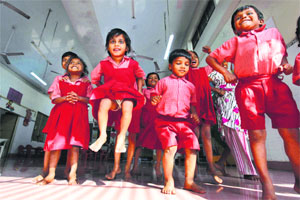
Tihar is home to around 60 children,most of them)visits their home- dingy barracks where the children live out their dreams
On a cold December morning in 2005,two undertrialshusband and wife sat on the steps inside a prison,and spoke urgently. The wife had just told him she was pregnant. Both Sonia and Mohd Kalam,co-accused in a murder case,have been undertrials in Tihar Jail since 2005.


Tamanna,now four years old,is one of nearly 2,000 children languishing in prisons across the country,including Tihar,as per the National Crime Records Bureau survey in 2007. Tihar is home to around 60 children. The law in India,as in many other countries,is that children can stay with their mothers in prison until they are five years of age. Then,they are put in residential schools where they live with other inmates children and complete school.
Ruby,6,is Tamannas friend. Soon,Ruby will leave the prison and go to a hostel where an NGO will take care of her studies. Often,the children talk about home. Ruby is from Narela and has drawn on paper her house for Tamanna to see.
Tamanna says she wants to come home with me, Ruby says. I tell her we are in jail and she says when you get out,take me with you. I tell her theres babu,there are cows,and flowers in my house. Tamannas house is far. She has told me.
But Tamanna has no reference point. For her,home is the L-shaped barrack where the duo keeps their belongings in a bag.
The largest prison complex in Asia,Tihar was built in 1958 as a maximum security prison run by the Punjab government. In 1966,the Delhi government took over the prison and in 1984,it was renamed Tihar Prisons. It has nine jails,and staff quarters.
But it was not until 10 years later that Tihar started to experiment with prison reforms ushered in by Kiran Bedi who took over as Inspector General of Prisons in 1993.
When Bedi saw the children,who lived with their mothers till they turned six,hurling abuses and using legal jargons like custody and bail,and playing gang war games with paper knives and paper guns,she was shocked.
The children talked about courts and orders because they attended the courts,they talked about knives,played stab-stab and made knives out of spoons, Bedi said. When I saw all that,we didnt take long to act. We put them in a play school.
So she started a string of prison reforms in Tihar. A crèche was set started for the children where they could spend the day away from the barracks and learn to read and write.
Stella Mama,a Nigerian who has been convicted for smuggling narcotics,is in charge of the crèche. She knows the children by names,she has their background on her fingertips.
The crèche in jail no. 6-A is where Sonia cooks and Tamanna learns to put names to colours. It is a big,airy room with a high ceiling. On the walls are bright posters,and on the floor are scattered numerous red chairs and floor mats. Theres a cupboard with toys and there are cribs where younger babies sleep,rocked by women. Across the hall,there is a beauty parlour for women,yet another rehabilitation scheme at Tihar,where women learn the trade.
Sonia earns Rs 1,000 a month working in the crèche,cooking meals for 40-odd children. The money gets deposited in her account and she can use coupons to buy little treats for Tamanna from the canteen inside the jail.
Sonia has already spent about four years in the jail,and doesnt know how many she has left.
For those children whose mothers are in prison for years,the arrival of a fifth birthday is the most painful day because then the children must leave to live with their family outside,if they have one,or in residential schools.
For now,Sonia is dreading the moment when her daughter will go. But she will have to go. Prison is a place of no luxuries. Motherhood and love are expensive treats.


Stay updated with the latest - Click here to follow us on Instagram


