This is an archive article published on July 28, 2022
Delhi: Learning programme at govt schools brings most students up to the mark
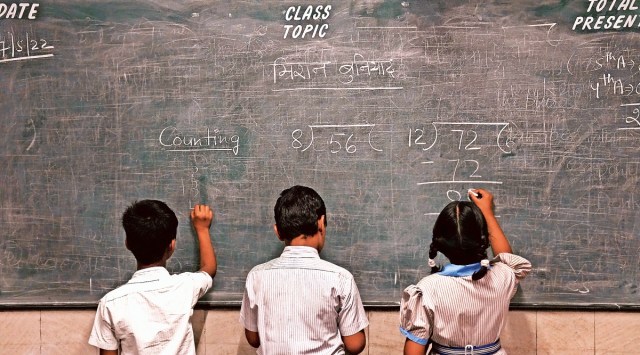
Since schools in Delhi reopened physically in full capacity on April 1 this year, the focus in government schools has been on foundational reading, writing and numeracy for students up to class IX with assessments conducted every week.
After the latest round-up, students in each grade up to class V have been divided into level 1 and level 2 based on their abilities, and students categorised in level 2 will resume regular classroom teaching and learning with grade-appropriate curriculum, with a reduced syllabus of the Delhi SCERT.
A majority of primary and pre-primary class students in Delhi government schools will now move on to regular teaching-learning after over three months of focused foundational learning, with the latest round-up of assessments showing them to be at a ‘desired learning level’.
Since schools in Delhi reopened physically in full capacity on April 1 this year, the focus in government schools has been on foundational reading, writing and numeracy for students up to class IX with assessments conducted every week. These are uploaded for the education department approximately on a monthly basis.
After the latest round-up, students in each grade up to class V have been divided into level 1 and level 2 based on their abilities, and students categorised in level 2 will resume regular classroom teaching and learning with grade-appropriate curriculum, with a reduced syllabus of the Delhi SCERT.
For those from III to V, who can read a paragraph or a story have been placed in level 1 for Hindi, and those who can do subtraction and division sums have been placed in level 2 for Math.
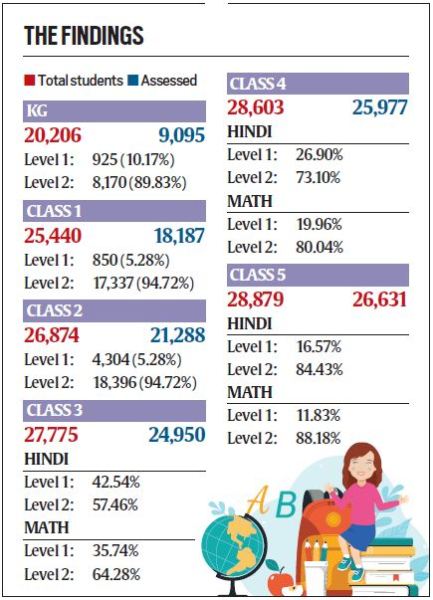
In class III, students who had just completed KG when the pandemic started, more than 40% students were at level 1 as of June end during this round of assessment. In that grade, 42.54% of assessed students were found to be at level 1 and 57.46% were found to be at level 2 for Hindi. In Math, 35.74% were found to be at level 1 and 64.28% at level 2 in class III.
In this same manner, more students are in level 2 in Math than they are in Hindi in grades IV and V as well. In class IV, 26.9% were found to be in level 1 and 73.1% in level 2 for Hindi, while 19.96% were found to be at level 1 and 80.04% at level 2 for Math.
Similarly, in grade V, 16.57% assessed students were found to be at level 1 and 84.43% at level 2 for Hindi, while 11.83% were found to be at level 1 and 88.18% were found to be at level 2 for Math. While students at level 2 will move on to regular classes, those at level 1 will continue to be provided additional support through Mission Buniyad classes till they move on to level 2. Schools have also been directed to assign classes in a way that a pupil-teacher ratio of 25 students to a teacher is maintained for level 1 students.
For KG to class II, the methodology to divide students into level 1 and level 2 is different. They have been assessed on whether they meet 15 different developing milestones for their grade level—for example, for KG one such milestone is “Is the child able to relate quantity with numbers like – how many members in a family or how many rooms are there in their house”—and students who have achieved more than 10 have been placed in level 2. Through this methodology, 89.83% of assessed students in KG, and 94.72% of both classes I and II have been placed in level 2. Students in level 1 in their grades will be provided support through a bridge programme.
Sukrita Baruah is a Principal Correspondent for The Indian Express, based in Guwahati. From this strategic hub, she provides comprehensive, ground-level coverage of India's North East, a region characterized by its complex ethnic diversity, geopolitical significance, and unique developmental challenges.
Expertise and Experience
Ethnic & Social Dynamics: Deep-dive coverage of regional conflicts (such as the crisis in Manipur) and peace-building efforts.
Border & Geopolitics: Tracking developments along India’s international borders and their impact on local communities.
Governance & Policy: Reporting on state elections, tribal council decisions, and the implementation of central schemes in the North East.
Specialized Education Background: Prior to her current role, Sukrita was a dedicated Education Correspondent for The Indian Express in Delhi. This experience provided her with a sharp analytical lens for:
Policy Analysis: Evaluating the National Education Policy (NEP) and university-level reforms.
Student Affairs: Covering high-stakes stories regarding campus politics, national entrance exams, and the challenges within the primary and secondary education sectors. ... Read More


 4 min read