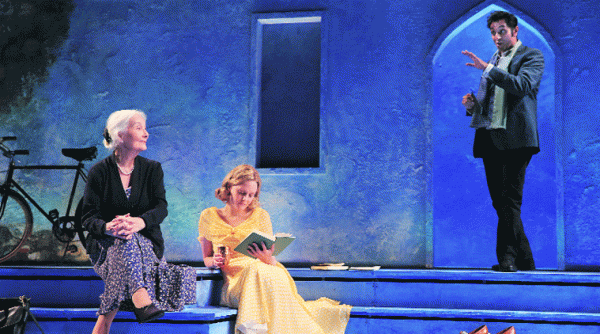
Rosemary Harris in a scene from Roundabout Theatre Company’s Indian Ink
Remember Aunt May in Tobey Maguire’s Spider-Man series? She is family to Spidey, frail yet firm, vulnerable but supportive — an unlikely combination of contradictions that was intricately essayed by British actor Rosemary Harris. The octogenarian Harris is a Golden Globe, Tony and Emmy winner, with a sizeable fan base in India that does not know that she spent her early childhood in pre-Independence India — in the North West Frontier, now Pakistan — and returned to Kerala for a holiday last year. Her new play, Tom Stoppard’s Indian Ink, is being staged at the Roundabout Theatre in New York, an occasion that prompts her to go back to those childhood days when she was “baba” to the locals and her mother called her “pagal ullu”.
Over the phone from New York, Harris joyfully recites a Hindi nursery rhyme — “when I recite it to Indian cabbies in New York, they are so shocked they almost crash”. “My father was in the Royal Air Force and I grew up in the North West Frontier of India.
There was always trouble on that frontier. It is on the border with Afghanistan, not very far from where Osama Bin Laden was killed.” Between 1924 and 1935, her father won the Distinguished Flying Cross three times, “quite a record”, says Harris.
In a grand bungalow, with a “beloved ayah who took care of my sister and me” and under the warm sun, she had a “childhood much better than children in England at the time”. She studied at a little garrison school where men in service sent their children and, though she was too young to feel the heat of the freedom struggle, Harris remembers the “little celluloid dolls that were distributed by the Russians as a propaganda to influence people towards communism. I had one of the dolls and, because they were made of celluloid, they disintegrated and only their little red dresses were left,” she recalls.
At a subliminal level, she has used these experiences in Indian Ink, an off-Broadway Tom Stoppard play that follows free-spirited English poet Flora Crewe on her travels through India in the ’30s. As her relationship with an Indian artist blossoms, the freedom movement gains momentum in the country. Fifty years later, Flora’s younger sister Eleanor (played by Harris) is living the life of a “typical, retired memsahib” when a young Indian artist, Anish, comes visiting. Eleanor must now revisit some old days as well as forge a new understanding of herself. “When Eleanor arrives in North West India, she says, ‘It was early summer. The wind was blowing and I’ve never seen such blossoms— it blew everywhere.’ I remember those orchards myself. You cannot forget them,” Harris had said in an interview with Education Dramaturg Ted Sod for the Roundabout Theatre Company blog.
Eleanor, she says, lives in a cramped bungalow in the play, which reminds Harris of how much her mother hated coming back to the small house and grey weather of England. “I’ve got photographs of my mother and father in India. My mother always missed India,” says Harris. The actor visited Kerala last year where her daughter Jeniffer Ehle was making a film, Before the Rains. “I ate curry, curry and curry. The hotter it was, the more I liked it, I must have an asbestos stomach,” she says. After a pause, she adds, “There is an Indian restaurant right next to where we are doing India Ink and I love the smell.”
Her voices softens as she recalls holidays in Srinagar’s Dal Lake. “We lived in a house boat and swam among the water lilies and snakes. We were told to keep our mouths tightly shut while swimming because the water wasn’t the purest,” she says, adding, “When I read about the floods in Kashmir, I was devastated. That beautiful land is destroyed.”
Dipanita Nath is a Senior Assistant Editor at The Indian Express, based in Pune. She is a versatile journalist with a deep interest in the intersection of culture, sustainability, and urban life.
Professional Background
Experience: Before joining The Indian Express, she worked with other major news organizations including Hindustan Times, The Times of India, and Mint.
Core Specializations: She is widely recognized for her coverage of the climate crisis, theatre and performing arts, heritage conservation, and the startup ecosystem (often through her "Pune Inc" series).
Storytelling Focus: Her work often unearths "hidden stories" of Pune—focusing on historical institutes, local traditions, and the personal journeys of social innovators.
Recent Notable Articles (December 2025)
Her recent reporting highlights Pune’s cultural pulse and the environmental challenges facing the city during the winter season:
1. Climate & Environment
"Pune shivers on coldest morning of the season; minimum temperature plunges to 6.9°C" (Dec 20, 2025): Reporting on the record-breaking cold wave in Pune and the IMD's forecast for the week.
"How a heritage tree-mapping event at Ganeshkhind Garden highlights rising interest in Pune’s green legacy" (Dec 20, 2025): Covering a citizen-led initiative where Gen Z and millennials gathered to document and protect ancient trees at a Biodiversity Heritage Site.
"Right to breathe: Landmark NGT order directs PMC to frame norms for pollution from construction sites" (Dec 8, 2025): Reporting on a significant legal victory for residents fighting dust and air pollution in urban neighborhoods like Baner.
2. "Hidden Stories" & Heritage
"Inside Pune library that’s nourished minds of entrepreneurs for 17 years" (Dec 21, 2025): A feature on the Venture Center Library, detailing how a collection of 3,500 specialized books helps tech startups navigate the product life cycle.
"Before he died, Ram Sutar gave Pune a lasting gift" (Dec 18, 2025): A tribute to the legendary sculptor Ram Sutar (creator of the Statue of Unity), focusing on his local works like the Chhatrapati Shivaji statue at Pune airport.
"The Pune institute where MA Jinnah was once chief guest" (Dec 6, 2025): An archival exploration of the College of Agriculture, established in 1907, and its historical role in India's freedom struggle.
3. Arts, Theatre & "Pune Inc"
"Satyajit Ray, Ritwik Ghatak were not rivals but close friends, says veteran filmmaker" (Dec 17, 2025): A deep-dive interview ahead of the Pune International Film Festival (PIFF) exploring the camaraderie between legends of Indian cinema.
"Meet the Pune entrepreneur helping women build and scale businesses" (Dec 16, 2025): Part of her "Pune Inc" series, profiling Nikita Vora’s efforts to empower female-led startups.
"How women drone pilots in rural Maharashtra are cultivating a green habit" (Dec 12, 2025): Exploring how technology is being used by women in agriculture to reduce chemical use and labor.
Signature Style
Dipanita Nath is known for intellectual curiosity and a narrative-driven approach. Whether she is writing about a 110-year-old eatery or the intricacies of the climate crisis, she focuses on the human element and the historical context. Her columns are often a blend of reportage and cultural commentary, making them a staple for readers interested in the "soul" of Pune.
X (Twitter): @dipanitanath ... Read More


 4 min read


 Rosemary Harris in a scene from Roundabout Theatre Company’s Indian Ink