Heard at Okhla: No development in last five years, area never in focus
Among Delhi’s 1,082 government schools, only five are in Okhla. While according to residents these schools are functioning satisfactorily, their primary concern lies elsewhere – healthcare.
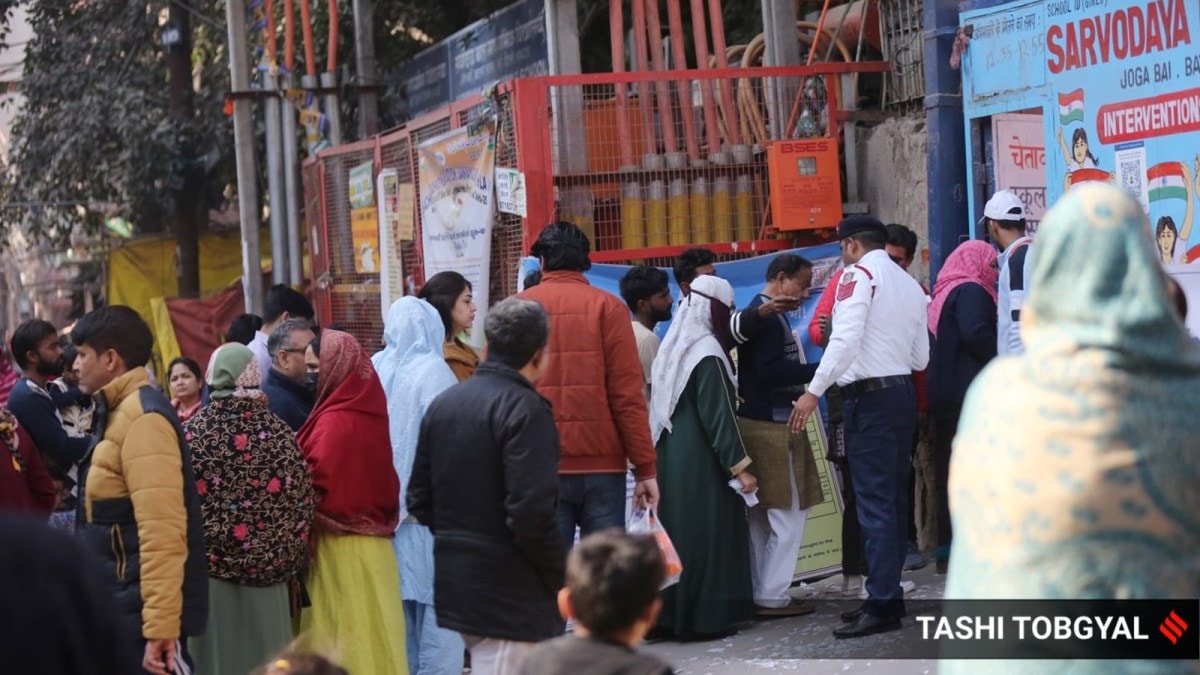
Voters at a polling centre in Batla House, New Delhi on Wednesday. (Express Photo by Tashi Tobgyal)
Elections come and go, but for the residents of Okhla in South East Delhi, change remains a distant dream. The roads, riddled with potholes, serve as a daily obstacle course for commuters, while the air is thick with the stench of uncollected garbage. Tap water, with its yellow hue, flows as a constant reminder of the area’s neglected infrastructure.
A Muslim majority area, it is a melting pot of communities – students, working professionals, migrants, slum dwellers and industrial workers – and houses over 3.4 lakh voters. Despite its diversity and growing population, the constituency is marred by civic negligence.
You’ve Read Your Free Stories For Now
Sign up and keep reading more stories that matter to you.
Among Delhi’s 1,082 government schools, only five are in Okhla. While according to residents these schools are functioning satisfactorily, their primary concern lies elsewhere – healthcare.
Mohalla clinics, once hailed as a game-changer by the AAP government, remain mostly shut, the residents said. Government hospitals are non-existent, while private facilities charge exorbitant fees.
In the heart of 40-Futta Road, Shabana Kazmi, a volunteer for Bharti Eye Hospital, walks through the bustling market, carrying a speaker to announce: “6 February, from 12 pm, Bharti Eye Hospital will hold a free eye check-up camp.”
Mohd Nadeem, a passerby, stops to inquire about the camp. “There are no government hospitals here. We have to go to Al-Shifa Hospital, but it is extremely expensive. The roads are always lined with garbage. No development has taken place in the last five years,” he says.
In Batla House, narrow lanes gives way to a tangled web of overhead wires, some sagging dangerously close to the ground. But the most perilous location remains Abu Fazal Enclave’s “high-tension road”, where electricity supply lines loom over residential buildings, making every rooftop a hazard zone.
Story continues below this ad
In April 2016, a 22-year-old migrant labourer lost his life after accidentally touching a 220 kV line. Mohammad Tasleem, who runs a garment cart in the area, says, “Incidents like this keep happening every six months.”
The dangers are not just hypothetical. Two years ago, a devastating fire broke out when a high-voltage wire exploded, burning down Kamal Hasan’s electronics shop. “The material damage we suffered was devastating. All my electronic items were charred, and I had to rebuild my shop from scratch. In the house next door, a family lost their two children due to the blast,” he recalls.
Fareed Ahmad Narvi of Zakir Nagar sums up their collective frustration: “This area was never in focus. It is facing several issues — roads have not been laid, there’s no cleanliness. A lane behind the Zakir Nagar main road could not be constructed in 10 years. There’s sewerage issue too.”
Sewage issues stretch across Okhla, as seen in Shaheen Bagh market, where a massive sewage pumping vehicle has stood motionless for the past seven months. It merely shifts sewage from one pothole to another, creating an endless cycle of stagnation.
Story continues below this ad
Rashid Fareed, who runs a paan shop in between the two potholes, says, “They pump water from one pothole to another and then back. This vehicle has been standing here for seven months, The sewage lines need to be laid down properly. This has been a long-standing demand, but nothing ever happens.”
“When we come to our balcony, this is the sight that we are greeted with,” says Shahid Alam, who lives in Jasola High, pointing to the drain lined with garbage on one end and weed overgrowth on another.
“Though there are no parks for the children to play, but the first thing that needs to be improved are the roads… the sewage and the garbage situation… There is a long way to go before this happens,” he adds.
Saman Husain is a Correspondent at The Indian Express. Based in New Delhi, she is an emerging voice in political journalism, reporting on civic governance, elections, migration, and the social consequences of policy, with a focus on ground-reporting across Delhi-NCR and western Uttar Pradesh.
Professional Profile
Education:
She holds a Bachelor’s degree in Political Science (Honours) from Kirori Mal College, University of Delhi, and is an alumna of the Asian College of Journalism (ACJ), Chennai.
Core Beats:
Her reporting focuses on the national capital’s governance and politics. She specializes in Delhi’s civic administration and the city units of the BJP, AAP and Congress. In western Uttar Pradesh, she mostly reports on crime.
Specialization:
She has a keen interest in electoral processes and politics — her recent contributions include work on electoral roll revisions.
Recent Notable Articles (since July 2025)
Her recent work reflects a strong show-not-tell approach to storytelling, combining narrative reporting with political and historical context:
1. Politics:
“On the banks of the Yamuna, a political tussle for Purvanchali support” (October 6): A report on how migration histories shaped electoral strategies in Delhi before the Bihar elections.
“Explained: How Delhi’s natural drainage vanished gradually over the centuries” (September 29): An explanatory piece tracing the historical reasons that eventually led to the erosion of Delhi’s rivers and its impact on perrenial flooding.
2. Longforms
“Four weddings, three funerals: How a Uttar Pradesh man swindled insurance companies” (October 7): A long-read reconstructing a chilling fraud by a man who killed three of his family members, including both his parents for insurance proceeds. His fourth wife discovered his fraud…
“How Ghaziabad conman operated fake embassy of a country that doesn’t exist — for 9 years” (July 27) : A story on bizarre fraud operation and the institutional blind spots that enabled it.
3. Crime and Justice:
“He was 8 when his father was killed. Fifteen years later, in UP’s Shamli, he took revenge” (October 18): A deeply reported crime story tracing cycles of violence, memory and justice in rural Uttar Pradesh.
“Who killed 19 girls in Nithari? With the SC rejecting appeals, there are no answers and no closure” (July 31): A report capturing the long legal and emotional aftermath of one of India’s most chilling unsolved criminal cases.
4. Policy Impact
“At Manthan, over US tariffs, Delhi-NCR’s apparel industry brainstorms solutions” (September 8) and “Trump’s 50% tariff begins to bite: Agra’s leather belt feels the impact” (August 13) : Reports documenting how global trade decisions ripple through local industries, workers and exporters.
Signature Style
Saman is recognized for her grassroots storytelling. Her articles often focus on the "people behind the policy". She is particularly skilled at taking mundane administrative processes and turning them into compelling human narratives.
X (Twitter): @SamanHusain9 ... Read More