Journalism of Courage



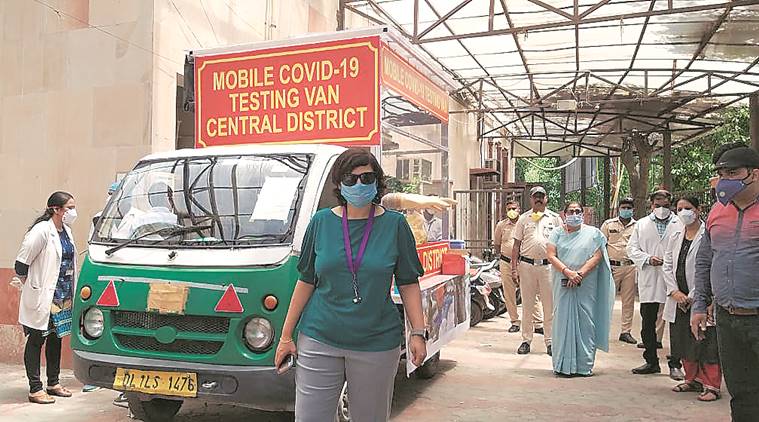 DM (Central) Nidhi Srivastava with the mobile van, Sunday
Delhi’s Central District Sunday became the first district in the city to begin ‘COVID-19 Testing on Wheels’ with an aim to make testing of the coronavirus “viable, accessible and safe”. On the first day, 31 samples were taken from the Chandni Mahal area.
The Central District has seven containment areas as of now — Sadar Bazaar, Chandni Mahal, Nabi Karim, Sant Nagar in Burari, Bara Hindu Rao area, Nawabganj area and Oberoi Apartments.
District Magistrate Central Nidhi Srivastava, under whom the initiative has been taken, said, “It was important to make testing viable, accessible and at the same time ensuring the safety of health workers”. She said the mobile vans “shall cover the length and breadth of of Delhi”.
“The fabricated vehicle will be able to cater to narrow lanes, larger and dense areas of Central District, increasing the number of samples collected in a day. The mobile van can collect two samples at a time. It will take both nasopharyngeal and oropharyngeal swabs, seal them in double packing and transfer the sample to the testing facility,” Srivastava said.
“It will not only save time but also the people who are collecting the samples. The person who will collect the sample will be in the enclosure, so they will not have to wear scarce PPE (personal protective equipment). The vehicle is fitted with an inverter-run fan to soothe them in the heat. An icebox is kept inside the enclosure to keep the samples intact. The mobile van will not only spread awareness through creatives on the outer wall but also through announcements,” she added.
“We are prepared to take around 100-150 samples in a day, from 9.30 am to 3 pm… Two samples can be taken at a time,” Srivastava told The Indian Express.
She said a total of five people will be in the vehicle, excluding the driver. “Two persons will be collecting the samples, one is a helper and two others will help in putting the samples in the icebox,” she said, adding that at the moment it was not conducting rapid testing but reverse transcription-polymerase chain reaction (RT-PCR) testing.


 3 min read