Journalism of Courage



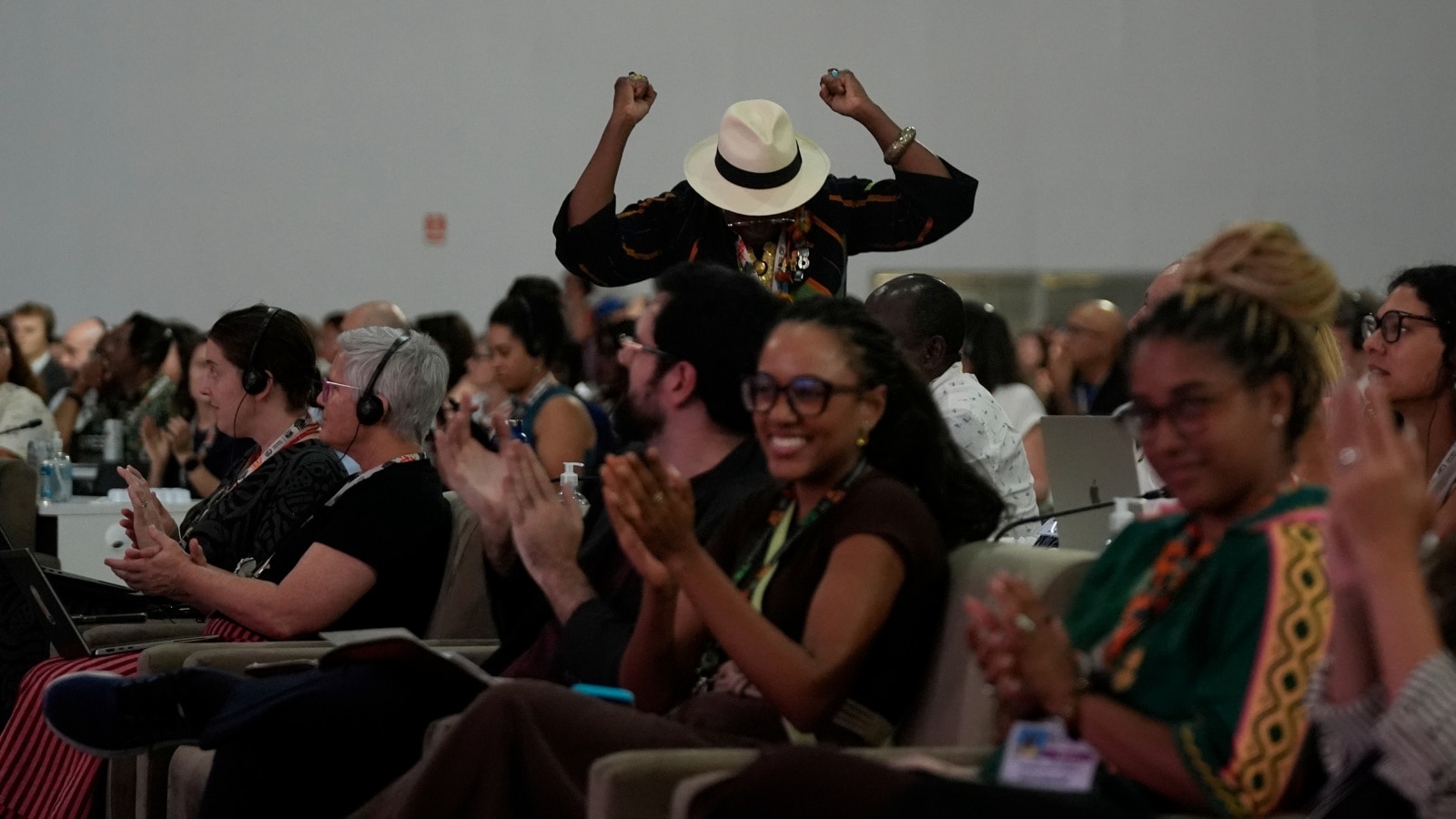 A delegate reacts during a plenary session at the COP30 summit on Saturday. (AP)
In a clear indication of a shift in power balance in the absence of the United States, the COP30 climate meeting in Belem, Brazil adopted an agreement that accommodated the main concerns of developing countries like India and China, but left out any mention of a roadmap on fossil fuel phase-out which the European Union and some other countries had identified as a non-negotiable.
The showpiece outcome from COP30, being referred to as a political package, has taken on board two big issues flagged by the developing countries — implementation of a key finance provision in Article 9.1 of Paris Agreement, and unilateral trade measures like EU’s Carbon Border Adjustment Mechanism (CBAM) — though not in the same way as was being demanded.
It has proposed to establish a two-year work programme to discuss all issues on climate finance, including Article 9.1 of Paris Agreement. Developing countries, led by India, have been insisting that this particular provision which says that developed countries “shall provide financial resources” has been ignored till now, including in the comprehensive finance agreement reached last year. These countries have argued that all decisions on climate finance till now, have addressed only Article 9.3 which only asks the developed world to “take the lead in mobilising climate finance”.
On the issue of unilateral trade measures, the agreement has acknowledged the concern of countries like China and India that response measures on climate change must not constitute a means of “arbitrary or unjustifiable discrimination or disguised restriction on international trade”.
This is almost the full recognition of the positions taken by China and India on CBAM which seeks to put additional tariff on imported goods whose production has a higher carbon footprint than what is allowed for European manufacturers of the same goods. India, China and some other countries have called such measures discriminatory and violative of international trade laws.
In contrast, the agreement completely left out any mention of a fossil fuel exit roadmap, which the European Union, some Latin American countries and small island nations had been pushing hard for. About 80 countries had, earlier this week, endorsed a proposal asking for inclusion of a language on a fossil fuel phase-out in the final agreement. However, when a draft text without a mention of this was released on Friday, less than 30 countries came together to reject it, signalling their dwindling strength.
On Friday, these countries said they would not support any outcome that omitted a roadmap on transitioning away from fossil fuels. But when the final draft which came out on Saturday, omitted the issue again, it was clear that the overall mood was not in their favour.
Though they never opposed it in public, it was countries like India, China, Russia and Saudi Arabia, who ensured that the roadmap on fossil fuel phase-out did not find a place in the final outcome. An official Indian source had told The Indian Express a couple of days earlier that there could not be a uniform phase-out plan for everyone, and that countries should be free to decide on their own pathways for eliminating fossil fuels in their national interest.
The final outcome, thus, was reflective of the shift in power balance at these climate negotiations, with the bloc of large developing countries, particularly the BRICS grouping (Brazil, Russia, India, China and South Africa) decisively calling the shots. In the absence of the United States, which did not send an official delegation at these talks for the first time in the last 30 years of negotiations, the European Union and countries like Australia seemed to lack adequate heft to force their agenda, which they had managed to do till now.
As a face-saver for EU and others, COP30 president André Aranha Corrêa do Lago, during the final plenary, acknowledged the demand on fossil fuels and offered to establish one on his own initiative.
“As President Lula (Luiz Inácio Lula da Silva of Brazil) said at the opening of this COP, we need roadmaps so that humanity, in a just and planned manner, can overcome its dependence on fossil fuels, halt and reverse deforestation and mobilize resources for these purposes. I, as president of COP30, will therefore create two roadmaps — one on halting and reversing deforestation and another on transitioning away from fossil fuels in a just, orderly, and equitable manner,” he said.
This will be an entirely voluntary exercise, however, not backed by the force of COP which takes unanimous decisions. Do Lago will remain the president of COP for the next one year, and in that capacity, he has the authority to create such initiatives.
Meanwhile, Colombia, one of the vocal countries demanding a fossil fuel roadmap, has offered to host a global conference next year specifically on the issue of accelerating efforts to eliminate fossil fuels.
The political package outcome was meant to address those long-standing concerns of the countries that could not be accommodated in the official agenda because of deeply divergent positions of various groups. Among the other decisions in this package was a call for “efforts to at least triple adaptation finance by 2035”, another important demand of the developing countries.
The COP30 meeting adopted several other agreements, as happens at every such meeting, but none that will have any significant bearing on the effectiveness of global action to fight climate change. One of the main goals, identified by COP30 hosts and president Brazil, going into the conference, was to ensure that the trust in this negotiating process was not further eroded after a disappointing outcome last year and the withdrawal of the United States from the Paris Agreement earlier this year. On that count, Brazil can claim success as every country reposed their faith in this UN-mandated process.
However, on the other objective of expediting climate action, there was little that Brazil, or COP30, could deliver.

 6 min read