3 min read
Stay updated with the latest - Click here to follow us on Instagram

Journalism of Courage



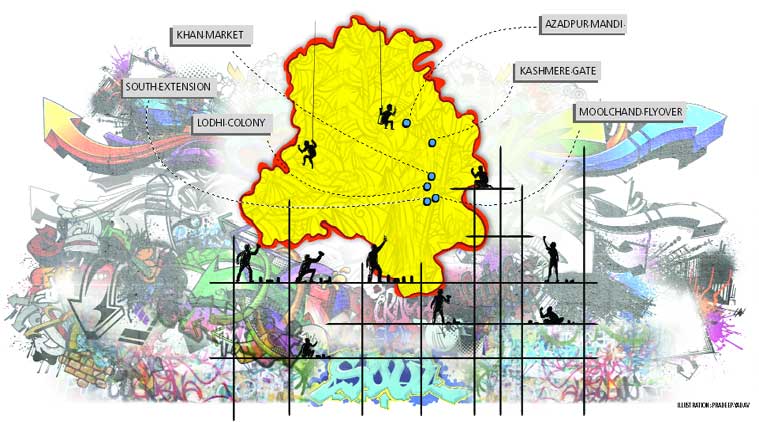 The delhi street art festival map. (Illustration: Pradeep Yadav)
For the next fortnight, if you happen to cross Meherchand Market, you might notice a short figure painting the outline of female form on one of the walls nearby. That is Japanese artist Lady Aiko aka Love, drawing her interpretation of freedom fighter Rani Lakshmi Bai as part of the St+Art Delhi festival. Lady Aiko shot to international fame after surreptitiously taking photographs of English graffiti artist Banksy making installations on the walls of MoMA and Brooklyn Museum, by posing as a Japanese tourist.
In its second year, the festival is bigger, better and much more spread out than its debut edition, which was centred around Shahpur Jat. It will be held over two months (Feb-March) across six different locations in the city including Lodhi Colony; Khan Market; Moolchand Flyover; South Extension Part 1 underpass; rain baseras (night shelters) across Kashmere Gate; Vasant Kunj; Nizamuddin and the Delhi cold storage building at the Azadpur Mandi on the Outer Ring road.
“This year, we have partnered with various Delhi government agencies such as PWD, CPWD, MCD and NDMC to beautify public spaces. For instance, we will be working with CPWD in different blocks across Lodhi colony to see the feasibility of a public art project and how it can enhance footfalls in an area,” says Hanif Kureshi, creative director of the St+art India Foundation, which he formed with three other artists to develop public art projects across India. This festival is their first major project.
There will 14 participating artists, (among them nine international names) who work with different mediums, from oil and acrylic paints to spray cans, enamels, and coffee stains. And each has a different style — graphics, typeface, illustrations, geometrical patterns and crochet. “The international artists will conduct workshops as well, which have a fee of Rs 1,500. This year we are making the festival more inclusive and participative, since we have support from the government,” says Kureshi.
While last year saw the 150-ft-tall Gandhi mural on the Delhi Police Headquarters building, this year’s installations will reinforce the inclusive theme. “For the South Extension underpass, Portuguese artist Samina will be using handpainted typeface. He will take photos of locals and use them as references,” says Kureshi.
For more details, visit: http://www.st-artdelhi.org
Stay updated with the latest - Click here to follow us on Instagram