Journalism of Courage



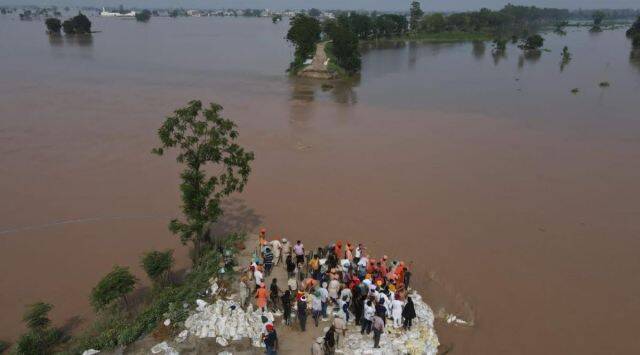 “There is a need to design a proper drainage system, and it has to be properly maintained as well," Dr Setia said. (Express Photo)
 The floods were majorly a man-made problem, according to Punjab Engineering College (PEC) Director, Professor Dr Baldev Setia, a water resource engineer. He was referring to the recent heavy rain that battered the region, bringing life to a grinding halt and the administration to its knees.
“We (humans) are getting in the way of water-bodies and that’s where the problem lies,” said Professor Setia while speaking to The Indian Express. Shedding light on the causes of the unprecedented floods this time, he said, “It’s high time we understand the basic route of water. We should not obstruct the natural flow of water for the sake of using land.”
Substantiating his view, the PEC director added, “Agar paani Himachal se chalega…to Punjab hoke to jayega hi…Punjab se chalega to Haryana to ghusega hi…Haryana wala chalega to Delhi to jayega hi…We can’t blame any one state. Sutlej, Beas start from Himachal. The issue is – we are getting in the water-bodies’ right of way. Where will the water go then? For example, when there is no sufficient rain for years, or water in a river or water-body, we (humans) colonise that chunk of land. But we tend to forget that when the sky opens up, where would the rainwater go. We (the man) have occupied and encroached on these dry water-body lands.” He also highlighted the need for a good drainage system.
“There is a need to design a proper drainage system, and it has to be properly maintained as well. Before the monsoon, the drains have to be cleared of all the weed growth. We have to ensure that the rivers or water-bodies don’t breach their banks. The drains need to be checked from time to time. Just like one bad apple spoils the whole barrel, one uncleared drain can make a big mess,” Dr Setia elaborated.
He said a lot of construction has been done in Nayagaon, many buildings have come up in the area. And this is where the problem lies, because the natural flow of water coming from Nayagaon is towards PEC. “Water doesn’t know when it is entering Chandigarh from Punjab. Now, on the day of the heavy rain, there was huge accumulation of water behind that 30 feet to 40 feet Nayagaon wall. And the wall collapsed. The result was – the water entered houses and other areas,” Professor Setia added.
Dr Setia said today people are in deep water, because when they inhabit an area, they don’t give a damn about “from where will the water go”.
“I agree this time there was unprecedented rain. But then there is something we have to be prepared also…’Kabhi to aa sakta haina paani‘…So, a well-planned urban drainage system will do a world of good to people inhabiting the area,” he added.
Professor Setia said Kurukshtetra had borne the brunt of floods in 2010 and today it is facing a similar situation as it is all surrounded by canals. “It is mainly because we mistook these water-bodies as hollow land and colonised them. This is, of course, one of the key reasons for this mess,” the professor added.

 4 min read