Premium
This is an archive article published on February 27, 2023

In Waris Punjab De chief Amritpal Singh’s Punjab village, mother says doing ‘amrit sanchar’ but sense of disquiet over cause

Last Thursday, some of these inmates were part of the two busloads of protesters from the village that joined a mob led by Amritpal which stormed the Ajnala police station, about 70 km away, demanding the release of his associate.

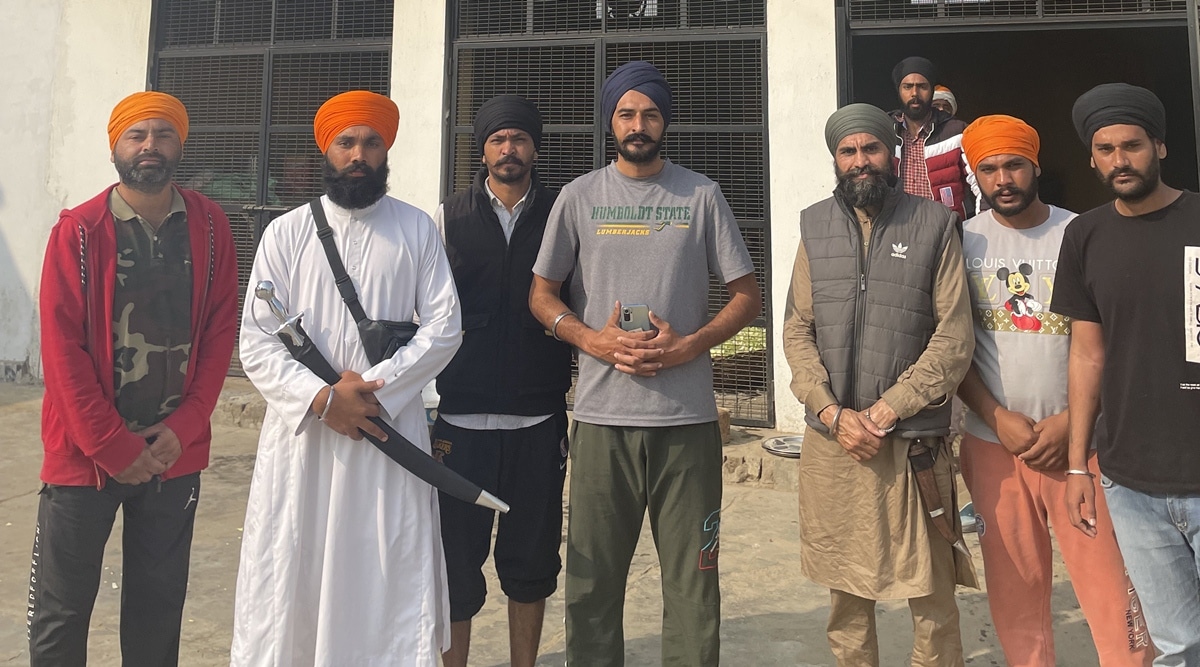
Inmates of the rehab centre run by Amritpal Singh outside its community kitchen in Jallupur Khaira, Amritsar. ExpressInmates of the rehab centre run by Amritpal Singh outside its community kitchen in Jallupur Khaira, Amritsar. Express
Listen to this article
In Waris Punjab De chief Amritpal Singh’s Punjab village, mother says doing ‘amrit sanchar’ but sense of disquiet over cause
x
00:00
1x 1.5x 1.8x

It’s well past dinnertime, yet the backyard of Gurdwara Baba Kala Mehar at the entrance of Jallupur Khaira village in Amritsar is all abuzz. A middle-aged woman peels garlic on a cot while two others, the younger with sindoor in the hair and a toddler on her lap, squat on the floor. There’s a quiet kinship among them as they swap stories about their husbands, one a drug addict, the other an alcoholic. “My husband breaks almirahs to steal money for liquor,’’ sighs the young woman. She’s arrived from a distant village to know whether the rehab centre, started by Waris Punjab De chief Amritpal Singh near his home here, will admit her husband.

“Our doors are open for everyone,” smiles Lovepreet Singh from Ferozepur, a sewadar at the centre, who claims addicts are treated with a mix of ayurvedic medicines, yoga, diet, sewa (service) and shabad-kirtan (Gurbani recital), all free of cost.

Last Thursday, some of these inmates were part of the two busloads of protesters from the village that joined a mob led by Amritpal which stormed the Ajnala police station, about 70 km away, demanding the release of his associate.

The protesters, many of them armed with swords and guns, dispersed after being assured by officers that the associate, who had earlier been arrested on charges that included kidnapping, would be released the next day. The incident and the release triggered alarm bells within the security establishment.

A visit to Jallupur Khaira shows that while there is clear personal support for Amritpal, whose uncle Harjit Sandhu was a popular Sarpanch for 10 years, there is also a sense of disquiet about the demands for Khalistan.

At Amritpal’s house, with a giant gate, three yellow flags (now called “Sikh flags”) and vigilant cameras, his bespectacled mother Balwinder Kaur admits she and her husband were taken aback when their son first announced his return from Dubai last year. “We wanted him to be successful in business, but for the past six-seven years he used to remain glued to his phone.”

Standing at the gate, she says Amritpal has told her not to give any interviews but she’s “very proud” of her son and his sewa. “We are glad that he is doing amrit sanchar (baptism) and weaning people away from drugs.’’

Story continues below this ad

On her part, she is doing her bit by cooking for the 15-16 youngsters who accompany her son and live in the house with them. Her son, she says, enjoys full family support. “His chacha (uncle) accompanies him everywhere.’’

Is she scared of the consequences of his actions? She shrugs. “Not at all, the sangat is with us.” Kaur, too, has an opinion on Khalistan. “There has always been discrimination against the Sikhs. Why are Bandi Singhs (Sikh prisoners who were convicted for involvement in militancy in Punjab and are still in jails) not being released?’’?

The village of 1,500 voters has five gurdwaras, one for each caste — Baba Kala Mehar is of the Sandhus, Amritpal’s clan. The village is also home to 15 priests, and has its fair share of men in the Army and paramilitary. “There must be 30 of us,’’ says an Armyman who is home on leave. “Our boys join the police, too.’’?

There are also different interpretations of Amritpal’s cause.

“Khalistan means the land of the pure, it doesn’t imply a separate state,’’ says the Armyman. “Amritpal is making Khalsas (through baptism), he is not making Khalistan. Guru Nanak said the whole word was his,’’ says another local resident.

Story continues below this ad

A couple, who did not endorse the call for Khalistan, said it’s mainly outsiders who frequent Amritpal’s “darbar” at the gurdwara. Outside the village, an elderly man says that while those who support Amritpal are vocal, those who don’t remain silent.

In his tent pitched next to the gurdwara and rehab centre, sewadar Lovepreet, who speaks English with an accent and is an admirer of the Dalai Lama, gives it another twist. “We are not seeking separation from India, we just want more power to make our decisions, for instance on our river waters,’’ he says.

Another sewadar says, “Khalistan is only about getting the same rights as the others.’’ A teacher from Bathinda, who claims he’s now cured of his chitta (heroin) addiction and has got baptised, says it’s not about Hindus and Sikhs.

However, amid the outrage over the storming of the police station and the use of Guru Granth Sahib as a shield by the protesters, local residents also view any criticism of Amritpal with mistrust.

Story continues below this ad

“The media is misrepresenting the situation,” grumble four white-bearded men sitting on benches outside a row of shops as an OB van speeds past. “The police commissioner himself said Toofan (the associate who was freed) was innocent… He (Amritpal) took Guru Granth Sahib in a palanquin, there was no disrespect. Amritpal does amrit sanchar, so they are out to get him.’’

Just a stone’s throw away from Amritpal’s house, an out-on-parole Gurdeep Singh Khaira, who has been interned for 32 years after being arrested for two blasts, refuses to comment on the Ajnala incident. “There are certain rules of parole, I don’t want to break them,” he says. He’d rather dwell on President Droupadi Murmu’s speech he heard on TV. “She said often it’s the poor who go to jail, for they have no one to defend them.”

Ask him about the growing rhetoric around Khalistan, and he shrugs. “I never fought for it. And even Jagtar Singh Hawara (convicted for assassinating ex-CM Beant Singh) has asked the people not to raise any pro-Khalistan slogans.”

Manraj Grewal Sharma is a senior journalist and the Resident Editor of The Indian Express in Chandigarh, where she leads the newspaper’s coverage of north India’s most politically and institutionally significant regions. From Punjab and Haryana to Himachal Pradesh and the Union Territory of Chandigarh, she oversees reporting at the intersection of governance, law, politics and society. She also reports on the diaspora, especially in Canada and the US. With a career spanning journalism across several countries, academia and international development, Manraj brings a rare depth of perspective to regional reporting. She is widely regarded as a leading chronicler of Punjab’s contemporary history and socio-political evolution, particularly its long shadow of militancy, federal tensions and identity politics. Her book, Dreams after Darkness, remains a definitive account of the militancy years and their enduring aftermath. Professional Background & Expertise A gold medalist in mass communication and a post-graduate in English literature, Manraj has a multifaceted career spanning journalism, academia, and international development. She was also awarded a fellowship by National Foundation of India and did several in-depth pieces on Manipur. Internationally, she has reported from Israel, US, UK, Myanmar, and Mauritius Her key focus areas include: Regional Politics, History, Agriculture, Diaspora, and Security. Of late, she has started focusing on Legal & Judicial Affairs: Much of her recent work involves reporting on high-stakes cases in the Punjab and Haryana High Court, ranging from environmental policy to civil rights. International Consulting: She previously served as a consulting editor for the Asia Pacific Adaptation Network and a publishing consultant for the Asian Development Bank (ADB) in Manila. Academia: For five years, she was the managing editor of Gender, Technology and Development, a peer-reviewed international journal at the Asian Institute of Technology, Bangkok. Recent Notable Articles (Late 2025) Her recent reportage focuses heavily on judicial interventions and regional governance: 1. Environment & Governance "‘NGT can’t test legality of policy’: HC hears challenge to Punjab’s ‘Green Habitat’ plan" (Dec 22, 2025): Covering a critical legal battle over whether the National Green Tribunal has the authority to strike down a state policy regularizing farmhouses on delisted forest land. "High court pulls up Punjab poll panel over audio clip probe" (Dec 10, 2025): Reporting on judicial concerns regarding the transparency and fairness of local body elections. 2. Legal Rights & Social Welfare "HC issues notice to Punjab, Haryana over delay in building old age homes" (Dec 22, 2025): Reporting on a contempt petition against top officials for failing to establish government-run homes for the elderly as promised in 2019. "Victims can appeal acquittals in sessions court without seeking special leave" (Dec 19, 2025): Highlighting a significant procedural shift in criminal law following a Supreme Court ruling. "HC upholds benefits for Punjab FCI officer acquitted in 20-year-old bribery case" (Dec 19, 2025): A report on the concept of "honourable acquittal" and its impact on employee benefits. 3. Human Rights & Identity "As Punjab denies parole to MP Amritpal Singh, HC asks it to submit ‘foundational material’" (Dec 1, 2025): Covering the legal proceedings regarding the radical preacher and sitting MP's request to attend Parliament. "Protecting life paramount: HC backs Muslim woman in live-in after verbal divorce" (Nov 6, 2025): Analyzing judicial protections for personal liberty in the context of traditional practices. Signature Beats Manraj is recognized for her ability to decode complex judicial rulings and relate them to the everyday lives of citizens. Whether it is a 30-year-old land battle in Fazilka or the political implications of Kangana Ranaut’s candidacy in Mandi, her writing provides deep historical and regional context. Contact @grewal_sharma on X manrajgrewalsharma on Instagram ... Read More

Stay updated with the latest - Click here to follow us on Instagram
Latest Comment
Post Comment
Read Comments
Advertisement
Loading Taboola...
Advertisement