Journalism of Courage



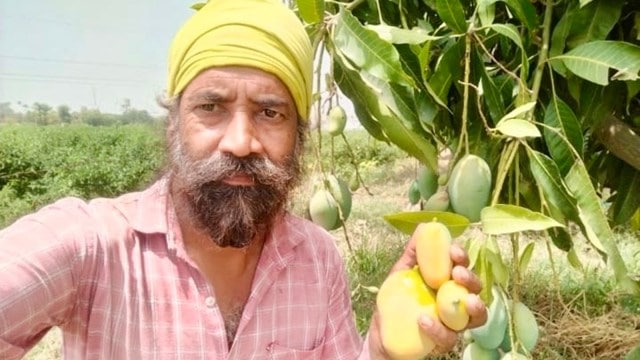 In 10 acres of land — owns five acres and leases another five acres for Rs 40,000 per acre annually — he follows an intensive crop rotation system. (Express Photo)
When demonetisation struck, a farmer from Punjab’s Jalandhar district decided he would never again depend on a single crop. He transformed his farm into a multi-layer, multi-crop system that now protects him from any market crash.
In 2016, Davinder Singh Sandhu faced one of the worst setbacks of life when his entire potato crop failed. Until then, most of his land was under potato.
However, the 54-year-old farmer today brings regular income with a diverse cropping system. He has systematically divided his fields under various crops.
Sandhu does most of his farming on raised beds and has adopted the mulching system — an agricultural practice where the soil surface is covered with a layer of mulch to conserve moisture, control weeds, regulate soil temperature, prevent erosion and improve soil health by adding organic matter or acting as a barrier, using materials like paddy straw, other crop residue, etc.
In 10 acres of land — owns five acres and leases another five acres for Rs 40,000 per acre annually — he follows an intensive crop rotation system.
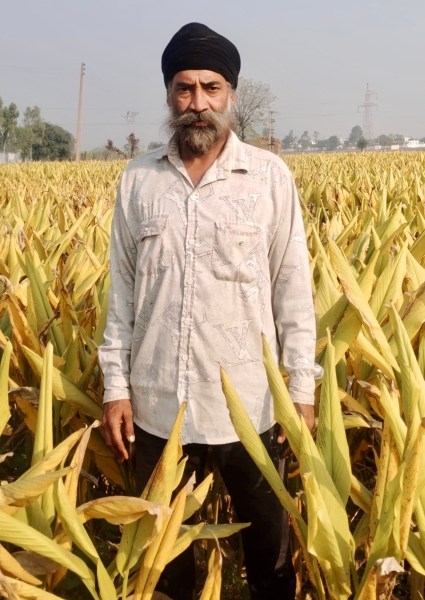 Sandhu uses drip irrigation on five acres, which saves a huge amount of water. Despite being a small farmer, he has provided permanent employment to six workers. (Express Photo)
In the first three acres, Sandhu prepares 72 beds. With 24 beds per acre — 12 alternate beds for beetroot and the other 12 for ghiya kaddu (round gourd) — he sows beetroot in December and round gourd in January. The beetroot is harvested by March and the gourd vines begin spreading across the field. The round gourd crop continues to grow until it is harvested in July. Without ploughing the land, he then sows halwa kaddu (pumpkin), which yields from November to mid-December. By December, the cycle starts with beetroot again. This system of rotational farming keeps the soil covered and protective, ensuring income every season. From three acres, he harvests around 100 quintals beetroot, 80-100 quintals round gourd and around 100 quintals pumpkin per acre. In total, he harvests around 900 quintals of vegetables, generating a revenue between average around Rs 15–25 lakh depending upon the market price. After meeting all the input costs, he makes a profit of around 40-50 per cent.
On 1.5 acres, Sandhu has planted 8,000 red dragon fruit plants using concrete pillars and Trellis system. Its harvesting starts in July and continues to mid-November, sometimes until early December.
An acre yields around 100 quintals of dragon fruit. The average wholesale market rate is about Rs 200/kg — giving him nearly Rs 20 lakh from one acre and Rs 30 lakh from 1.5. Although the initial investment is about Rs 6 lakh per acre, he says, the plants last 25 years with nominal costs once the system is set up once the system is set up.
Sandhu also grows round gourds alongside dragon fruit in the beginning of May. The vines, climbing the pillars and on Trellis systems, create a natural green shade and protect the dragon fruit plants.
Sandhu says, “I grow turmeric on one acre, producing around 200 quintals of raw turmeric… This raw turmeric gives 40 quintals of dry powder. I sell this at Rs 300/kg, earning about Rs 12 lakh. My turmeric is especially popular among NRIs, who prefer my farm-processed powder for its purity.” Sandhu is also planning to increase the area under turmeric.
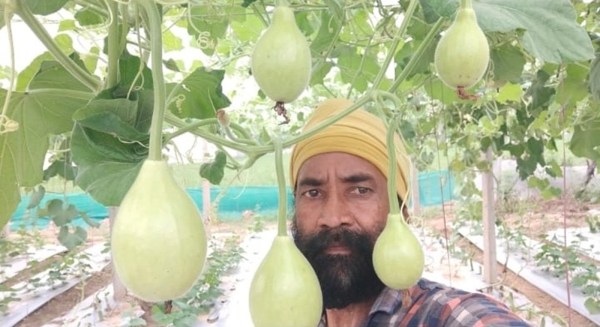 Sandhu also grows round gourds alongside dragon fruit in the beginning of May. (Express Photo)
In the remaining 4.5 acres, he grows cucumbers on four acres and fodder on half an acre. Sandhu sows cucumbers in September, with the first harvest after 40 days. He continues harvesting it till early December, yielding about 320 quintals from four acres and earning around Rs 5 lakh, with nearly 40 per cent profit after expenses.
After cucumber, he grows the Laddu (round) variety of marigold in December in the same land. He harvests around 240 quintals, which sells for Rs 15–20 per kg, giving him Rs 4–4.8 lakh. In May, after harvesting marigold, he switches to early cauliflower and begins sowing from June 15 — yielding 60 to 80 quintals per acre.
“This year cauliflower prices even shoot up to Rs 100 per kg, helping him earn up four to five times from the normal seasonal crop, which is mainly sown in August–September month, Rs. 6 to 8 lakh per acre and around 24 to 32 lakh from four acres with around 40% profit. After harvesting this in September then he again starts with cucumber sowing in this land.
To maximise every inch of land, Sandhu has not even left an inch vacant and has planted dozens of fruit trees along his field boundaries—40 avocado, 60 pomegranate, 40 lemon, 20 anjeer, 20 golden apple, 32 plum, 32 pear, 20 Naakh Pathhar, 15 kinnow, 15 Amrapali and Dasheri mango, 11 amla, 3 chikoo, 2 almond, 1 jackfruit and 4 jamun trees. These add to his income and improve biodiversity on the farm.
Sandhu uses drip irrigation on five acres, which saves a huge amount of water. Despite being a small farmer, he has provided permanent employment to six workers.
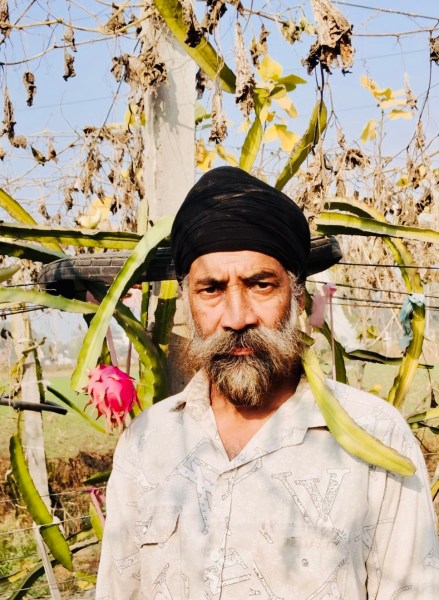 On 1.5 acres, Sandhu has planted 8,000 red dragon fruit plants using concrete pillars and Trellis system. (Express Photo)
Sandhu explains the core strength of his system: “Some seasons cauliflower gives us Rs 8 lakh per acre, and some seasons it gives only Rs2–3 lakh. But because I grow many crops, one always supports the other. In multi-cropping, there is no shock. In single cropping, one bad year can destroy you.”
This system has helped him recover from the 2016 losses and invest heavily in strengthening his current model, he says. Although he attends training at Krishi Vigyan Kendras and PAU, he says his greatest learning has come from self-experience, failures and experiments in the field.
Along with several local awards, Sandhu won the Surjit Singh Dhillon Award in 2010, and in 2015 he got the Chief Minister’s Award from Punjab Agriculture University (PAU), Ludhiana. Now, he plans to expand his turmeric cultivation, calling it a highly profitable crop with strong year-long demand.
Sandhu says that nothing comes without hard work, noting that he spends 15–16 hours in his fields every day. “If every farmer considers local conditions, market locations, and demand, they can develop their own crop-farming model.” He also says that the educated farmers can also make use of online market networks
He adds that although he, too, faces market volatility, his farming model consistently supports him because not all crops enter a bad market phase at the same time. Multi-cropping and multi-layer farming, he explained, can secure farmers’ incomes and protect them from market crashes.

 6 min read