Journalism of Courage



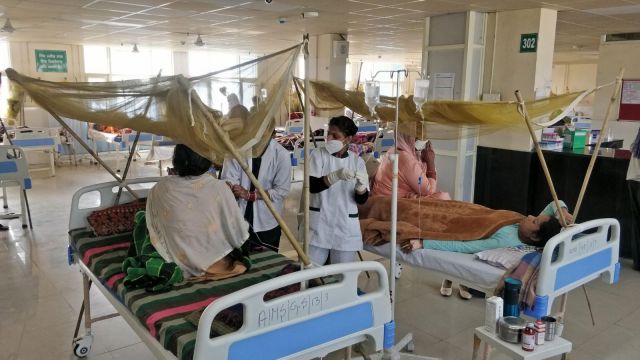 GMCH-32 saw around 35 patients turning up to seek treatment for dengue every week in October. Express
 The sting menace is back to haunt the Tricity area, which has seen a steady increase in the number of dengue cases being reported in the past month.
As per details, GMCH-32 in the month of October saw an average of around 35 patients turning up to seek treatment for the disease every week.
According to Dr Ravneet Kaur, the head of Blood Transfusion Department, GMCH-32, the demand for platelets had increased last week at the hospital, but there is no shortage, as regular blood camps were being organised. The hospital has three separator machines with the help of which platelets from donors are given to patients.
As per Dr Suman Singh, the directorof Health Services, Chandigarh, since January this year, around 300 dengue cases have been reported in the UT so far, with as many as 130 new cases reported in October. The DENV 2 strain had been found to be prominent so far, and a few hospitalizations have been reported of patients with low platelet counts. “There is no shortage of beds or platelets, and cases will start decreasing when the temperature decreases further,” said Singh.
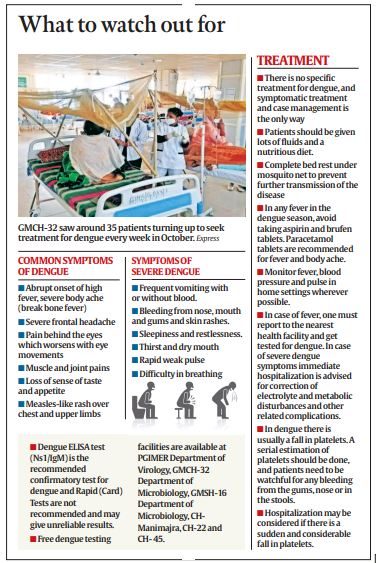
Dr Parvinder Chawla, senior consultant, internal Medicine at Fortis Hospital Mohali, said that the warning signs for dengue include vomiting, pain in the abdomen, severe headache, persisting pain anywhere else in the body, bleeding from any site, and inability to continue with good liquid intake.
“The patient needs to be monitored closely for at least 48-72 hours in a hospital setting. We should be monitoring hemoglobin and hematocrit on the second/ third day of fever as an increase in hemoglobin and hematocrit signifies poor oral intake (and hence the need for hospitalisation), while falling hemoglobin and hematocrit along with clinical deterioration suggests internal bleeding and hence, requires hospitalization, too. A slight decrease in these two parameters along with improvement in symptoms is indicative of the patient entering the recovery phase of the disease. Falling platelet count alone (unless it is drastically low) usually doesn’t imply the need for admission to a hospital. Even if the platelet count is low, platelets need to be transfused only if the count is below 10,000/cmm or there is evidence of active bleeding from any site. For most other patients in the critical phase of the disease, judicious guarded intravenous fluids suffice to tide over the crisis,” Chawla said.
Professor Sanjay Jain, head of the Department of Internal Medicine, PGI, said that cases of dengue increased in October, with more serious patients, whose platelets are very low, being referred to the institute for hospitalisation. On an average, more than 25 patients of dengue are being referred from the region daily to PGI.
Dr Suresh Bhonsle, District Malaria officer, Panchkula, added that this year, the teams of the health department since January have been taking proactive measures and steps to check the spread of dengue. “Community participation, awareness programmes, cross-border meetings, deputation of teams in the high-risk areas of Kalka and Pinjore, inspections of homes, officer, breeding checkers and surveillance have all yielded results. As opposed to last year, where the official figure of dengue cases was 2022, this year, till October 31, only 576 cases have been reported in the UT, with 236 in September, and 288 cases in October,” he said.
He added that with voluntary donations, there was no shortage of platelets, and no waiting time for testing, with results available in 24 hours. “The total out of area dengue cases in 2023 are 804 — with 169 from Chandigarh, 329 from Haryana, 187 from Punjab, and 69 from Himachal. Post Diwali we will be in a comfortable position, as there will be a decline in cases,” he added.

 4 min read