Journalism of Courage



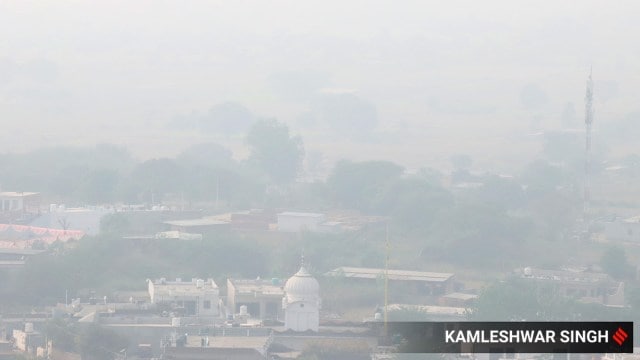 Smoggy weather in outskirts of Chandigarh on Sunday. (Express Photo by Kamleshwar Singh)
The severe air pollution that Chandigarh is witnessing for the last few days intensified on Sunday so much so that Chandigarh’s air quality index (AQI) was worse than the national capital, which is infamous for its air quality.
As per the AQI bulletin issued on Sunday by the Central Pollution Control Board (CPCB) of the average of the last 24 hours, Chandigarh’s AQI stood at 339 in the ‘very poor’ category, while Delhi’s index was 334.
Chandigarh’s AQI has been in the ‘very poor’ category since the last four days, as per the AQI bulletin issued by the CPCB.
On Sunday, at 10 am, the AQI at the Sector 22 and Sector 53 monitoring stations stood at 353 and 349 micrograms per cubic metre respectively. The AQI at 7 pm in Sector 22 was 347, in Sector 25, 323, and in Sector 53, it was 345. A reading between 301 and 400 is ‘very poor, while 201-300 is poor, and above 400 is severe. Even at 9 pm, the AQI at these monitoring stations recorded “very poor” levels.
Officials of the Chandigarh Pollution Control Committee have attributed stubble burning in neighbouring states for the degrading air quality.
Dr Ravinder Khaiwal, professor, Department of Community Medicine and Public Health, PGIMER, Chandigarh, the high AQI can cause breathing and respiratory issues due to prolonged exposure. “Afternoon winds circulating over Punjab and Haryana passed through Chandigarh, carrying pollution from nearby areas and contributing to a spike in AQI.
Notably, we’re observing a peak of crop residue burning along the Punjab-Haryana border and as air pollution levels rise, it is very important to take precautions to minimise health risk,” Khaiwal explained.
Elderly individuals, children, and those with respiratory conditions should avoid outdoor activities to reduce exposure risks, and the general public is advised to minimise time spent outdoors, especially during peak pollution hours, says the doctor. “Long-term exposure to high air pollution is a major risk factor for various lung and cardiovascular diseases. People with pre-existing health conditions, such as respiratory or heart illness, may be affected more severely, including pregnant women and children. Use of N95 masks is recommended when going outside to help filter out harmful particles. Local authorities should consider implementing emergency pollution control measures as per Graded Response Action Plan (GRAP) under the guidelines of the National Clean Air Programme (NCAP) to reduce pollution at its source,” Khaiwal adds .
People with chronic respiratory disorders are at a greater risk of their symptoms, like cough and breathlessness, worsening if they stay outdoors for long periods. “Stay indoors as much as possible and avoid outside travel early morning or evening hours. Maintain good hydration with good fluid intake. Wear a triple layer or simple cloth mask to decrease the particulate matter being inhaled when outside,” Amit Kumar Mandal, director of Pulmonology, Sleep and Critical Care, Fortis Hospital. said.
Inhalers, he added, are excellent for patients with obstructive airway diseases — like asthma and COPD. “Patients should continue with the use of inhalers as per medical advice,” he concluded.

 3 min read