


Journalism of Courage



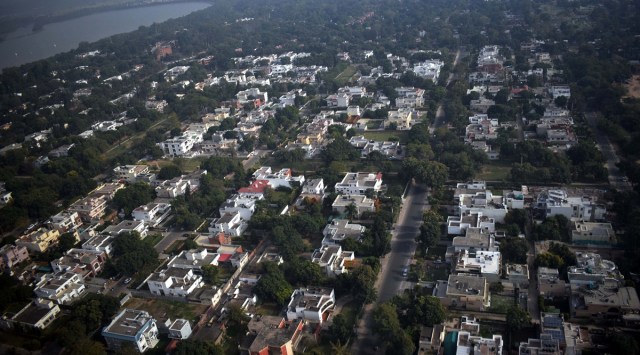 The Supreme Court in a landmark judgment on Tuesday banned the conversion or bifurcation of a single residential unit into apartments in Chandigarh.
 The Supreme Court on Tuesday, in a landmark judgment, banned the conversion or bifurcation of a single residential unit into apartments in Chandigarh. The case was heard by a bench of Justices BR Gavai and BV Nagarathna who passed the judgment in the matter. The order is applicable to Phase I, that is Sectors 1 to 30, considered a heritage zone.
With this, several cases where deals were under process or memorandums of understanding or agreements that were underway stand null and void. Stating in its 131 page verdict that it is high time that the “legislature, the executive and the policy makers at the Centre as well as the State levels take note of the damage to the environment on account of haphazard developments and take a call to take necessary measures to ensure that the development does not damage the environment,” the bench also froze the floor-area ratio, till the Centre takes a decision.
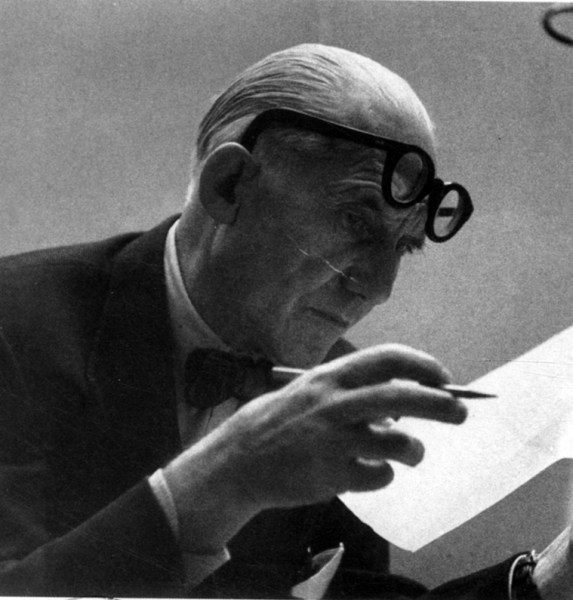 Swiss-French architect Le Corbusier prepared the Master Plan for the city of Chandigarh and contributed specific designs to several buildings here
Chandigarh Adviser Dharam Pal while speaking to The Indian Express said, “We have to abide by the order of the Supreme Court and that we will”.
Saying that “it will injure the “lungs” of the city as conceptualised by French architect Le Corbusier who designed it, the apex court also slammed the Chandigarh Administration for “blindly sanctioning” building plans and said it is apparent from them that they are, in effect, converting one dwelling unit into three apartments.
“Such a haphazard growth may adversely affect the heritage status of Phase I of Chandigarh, which is sought to be inscribed as a UNESCO heritage city,” the bench said.
Chandigarh was made a union territory (UT) and became the capital for the states of Punjab and Haryana. The city, the judgement said, was developed in two phases – Phase I having Sectors 1 to 30 and Phase II having Sectors 31 to 47.
In its verdict, the apex court said permitting redensification in Phase I, which has a heritage value on account of being ‘Corbusian Chandigarh’, without the same being approved by the Chandigarh Heritage Conservation Committee, is contrary to the Chandigarh Master Plan (CMP) 2031.
The SC delivered its judgement on the appeals challenging the November 2021 verdict of the Punjab and Haryana High Court which held that there was no provision under the Capital of Punjab (Development and Regulations) Act, 1952, or the Rules framed thereunder governing transfer of shares in relation to a site or building whether owned singly or under joint ownership. The high court had also held that sale of shares out of a building or site by the allottee or transferee was not barred and was permissible under the general civil law.
The Bench noted the high court said “apartmentalisation” is not permissible and goes on to hold that though developers or builders are in effect indulging in construction of three apartments in a building the same does not amount to apartmentalisation. “In our view, this would amount to permitting something indirectly which is not permitted directly,” it said.
Major takeaways from the judgment
The Supreme Court ordered the Chandigarh Administration shall not sanction any plan of a building which ex- facie appears to be a modus operandi to convert a single dwelling unit into three different apartments occupied by three strangers. The petitioners had informed the court how sales were taking place share wise, indirectly.
No memorandums of understanding (MoU) or agreement or settlement among co-owners of a residential unit shall be registered nor shall it be enforceable in law for the purpose of bifurcation or division of a single residential unit into floor-wise apartments. With this, the MoUs under process, if any signed between the buyer and the seller stand null and void.
The court directed the Central government and the Chandigarh Administration to freeze floor area ratio (FAR) and ordered to not increase it any further.
The court said that the number of floors in Phase I shall be restricted to three with a uniform maximum height as deemed appropriate by the heritage committee keeping in view the requirement to maintain the heritage status of Phase I.
The court ordered the Chandigarh Administration to not resort to formulate rules or by-laws without prior consultation of heritage committee and prior approval of the Central government.
The court deemed it necessary to strike proper balance between sustainable development and environmental protection and appealed to the legislature, the executive and policy makers at the Centre and State levels to make necessary provisions to carry out Environmental Impact Assessment studies before permitting urban development.
Effect on traffic not addressed, says SC
The Bench further noted that though the Chandigarh Administration permits one dwelling unit to be converted into three apartments, its adverse effect on traffic has not been addressed.
“With the increase in number of dwelling units, a corresponding increase in vehicles is bound to be there. However, without considering the said aspect, one dwelling unit is permitted to be converted into three apartments,” it said.
Referring to Rule 16 of the 2007 Rules, the Bench said there is a specific bar on fragmentation of sites or buildings and it is the specific stand of the Chandigarh Administration that construction of apartments is not permissible. “On the other hand, the 2017 Rules (Chandigarh Building Rules (Urban), 2017) are enacted in such a way that there is scope for the construction of apartments. Not only that, the Chandigarh Administration is sanctioning plans which, in effect, permit apartmentalisation… We find it necessary to direct that after the Chandigarh Administration takes decision to amend the provisions, the same shall be placed before the Central government for its consideration and final decision,” it said.
“In that view of the matter, we hold that in view of Rule 14 of the 1960 Rules (Chandigarh (Sale of Sites and Building) Rules 1960), Rule 16 of the 2007 Rules and the repeal of the 2001 Rules (Chandigarh Apartment Rules, 2001), fragmentation/ division/ bifurcation/ apartmentalisation of a residential unit in Phase I of Chandigarh is prohibited. Such amendments shall be placed before the Central government, which shall take a decision with regard to approval of such amendments keeping in view the requirement of maintaining the heritage status of Le Corbusier zone,” it said.
The petitioners
The petitioners – Resident Welfare Association of Sector 10 supported by Sarin Memorial Legal Aid Foundation pointed out how a number of apartments were being illegally constructed on single dwelling units in the belt up to Sector 30, Chandigarh, by unscrupulous builders.
The petitioners informed the court that rampant illegal construction was putting undue pressure on the planned infrastructure of the city such as water, sewerage, roads and electricity. They said virtually every second or third dwelling unit up to Sector 30 was converted into three apartments. The RWA of Sector 10 had in 2016 filed a petition with the HC regarding the matter. The petition said such constructions were not just damaging the character of the city but were also choking roads of the city as many families were staying in an independent house converted into apartments,” Manmohan Lal Sarin (Mac) Sarin, general secretary of Sarin Memorial Legal Aid Foundation told The Indian Express.
Apartment Rules extended to UT in 2001 but repealed later
In 2001, the Apartment Rules were extended to Chandigarh. However, worrying that it would affect the ethos of the city, a delegation of residents in 2006 including city’s first chief architect MN Sharma met the then UPA chairperson Sonia Gandhi who further intervened. It was then due to her intervention, that the rules were repealed after 2008,” said Sairn.
He added, “However, an indirect method started. People used to buy independent houses, demolish them and construct them floor wise and then sell share wise. The reason why the case had to be moved to the apex court”. The ground floor and the basement used to be counted as a fifty per cent share, the first floor as thirty per cent share and second floor as twenty per cent share, he said.


 8 min read


