Journalism of Courage



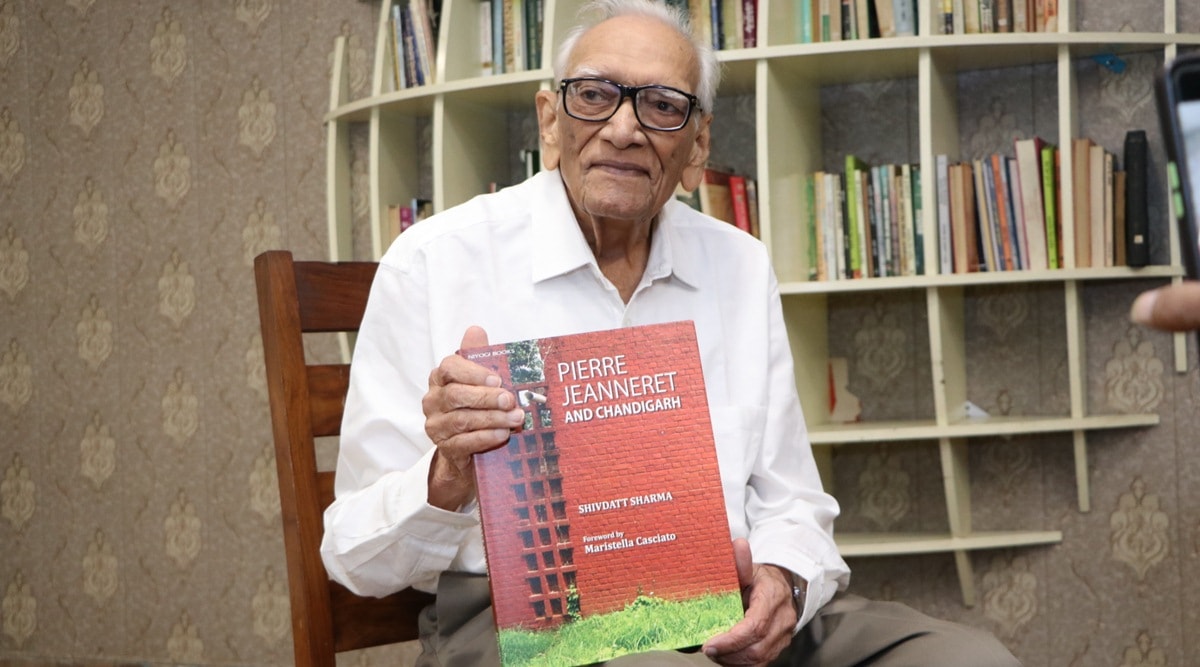 Shivadutt Sharma with his book. (Express photo)
 Brick by brick architect Shivdatt Sharma builds the ground for Pierre Jeanneret’s architectural brilliance, his work in Chandigarh, his deep love for the city he created with his cousin Le Corbusier and his persona, which influenced and impacted a generation of young architects. As one turns the pages of Pierre Jeanneret & Chandigarh (Niyogi Books), one will walk down memory lane with its author Shivdatt, who resurrects Jeanneret’s days in Chandigarh, showcasing not just the nuances of his architecture, but also the humility and simplicity that defined Jeanneret.
Through its pages, unfolds a timeless architectural legacy, as Shivdatt brings readers up, close and personal with the creators of the first modern city of independent India, with Jeanneret taking the centrestage.
Shivdatt assisted Le Corbusier and Pierre Jeanneret on various projects in Chandigarh and was described as an “Architect of rare qualities who understands deeply the meaning of built environment” by Jeanneret. After working at the Architects’ Office in Chandigarh for a decade, he joined the Indian Space Research Organisation and was the Chief Architect at the Department of Space, Bengaluru (1973-80) and designed major campuses in different parts of the country. On returning to Chandigarh, Sharma set up his own practice and has designed a diverse range of projects, ranging from a small bamboo museum to massive science and health institutes and has received several prestigious awards.
Chandigarh, reflects the author, got its character from the work of Swiss-French architects- Charles-Édouard Jeanneret, better known as Le Corbusier and Pierre Jeanneret. The vision and approach of these two cousins, both masters of modernism, helped Chandigarh emerge as a beautiful, planned city.
“Over the years, however, it has been Le Corbusier who has been largely talked about and Jeanneret’s amazing contribution in shaping this city remained unknown. It is this gap that the book aims to fill. Corbusier was the dreamer and Jeanneret was the implementer, and it is their partnership that created the ‘City Beautiful,’” said Shivdatt at the launch of the book on Thursday. Jeanneret designed housing for government employees and buildings for health and education services, including the sprawling Panjab University campus. He arrived in India in 1951 and left Chandigarh in 1965, with the expressed desire that his ashes be submerged in Sukhna Lake, as he wanted to stay with his creations even after his death.
“My relationship with Jeanneret was that of a guru-shishya. I was motivated to write about my mentor, teacher and guide, Monsieur Pierre Jeanneret, who was a rare combination of a great architect and an equally great human being. He could infuse life in the smallest of objects and his work is timeless, for it is so detailed and uses minimum objects. Jeanneret introduced brick in its natural form here, and the book, part memoir and part biography strives to look closely at who Jeanneret was. He taught us Indian architects about modernism, and I worked closely with him for 10 years,” said Shivdatt.
Replete with rare photographs of the buildings, furniture by Jeanneret, layout plans of various buildings, projects in the making, architectural drawings, letters, drawings done by workers, photographs by Jeanneret, private houses designed by him, reflections by architects, Shivdatt spent years researching on the book, and close to three years to write it. The major challenge, he agrees, was the fact that there was not too much information available on Jeanneret, as he did not write or document his work, for he did not believe in being in the limelight, but simply creating.
“Jeanneret has a specific and significant mark in the world of architecture. He had a very different approach when it came to different kinds of materials and created a new dimension maintaining the dignity and simplicity of a material. Each building he made was unique and one of my favourites is the Gandhi Bhawan at Panjab University, as it stands like a sculpture in space.”

 4 min read