Journalism of Courage



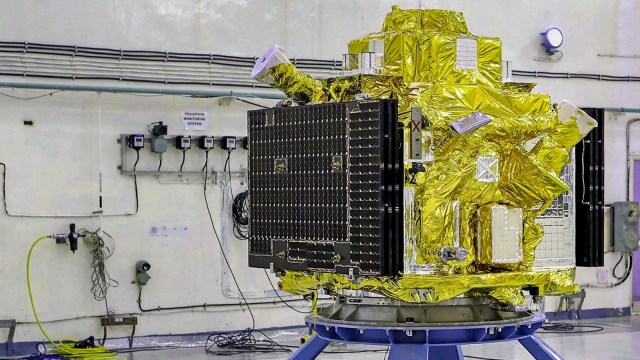 XPoSat comprises two payloads – the Indian X-ray Polarimeter (POLIX) and X-ray Spectroscopy and Timing (XPECT) built by Raman Research Institute and ISRO’s UR Rao Satellite Centre, respectively.
The Indian Space Research Organisation (ISRO) has confirmed the healthy functioning of its two payloads onboard X-ray Polarimetry Satellite (XPoSat). With this, the Indian scientists can now gear up for studying pulsars, black holes, and other bright astronomical sources using X-ray measurements.
With an estimated mission of five years, Isro launched XPoSat — India’s first space mission to study bright X-ray celestial objects — on January 1. The satellite has been operating in low earth orbit at an approximate altitude of 650 km.
XPoSat comprises two payloads – the Indian X-ray Polarimeter (POLIX) and X-ray Spectroscopy and Timing (XPECT) built by Raman Research Institute and ISRO’s UR Rao Satellite Centre, respectively.
Isro added POLIX, the world’s first instrument to operate in the medium energy band 8-30 kilo electron Volt (keV), was activated in two stages around January 10. Thereafter, this primary payload commenced scientific measurements of Crab nebula, the intended source. This is a supermassive remnant of a star and has been an object of great scientific interest.
“The initial scan observations were conducted around the Crab pulsar. It is a pulsating star residing at the centre of the Crab nebula and spins approximately 30 times/second,” the space agency said.
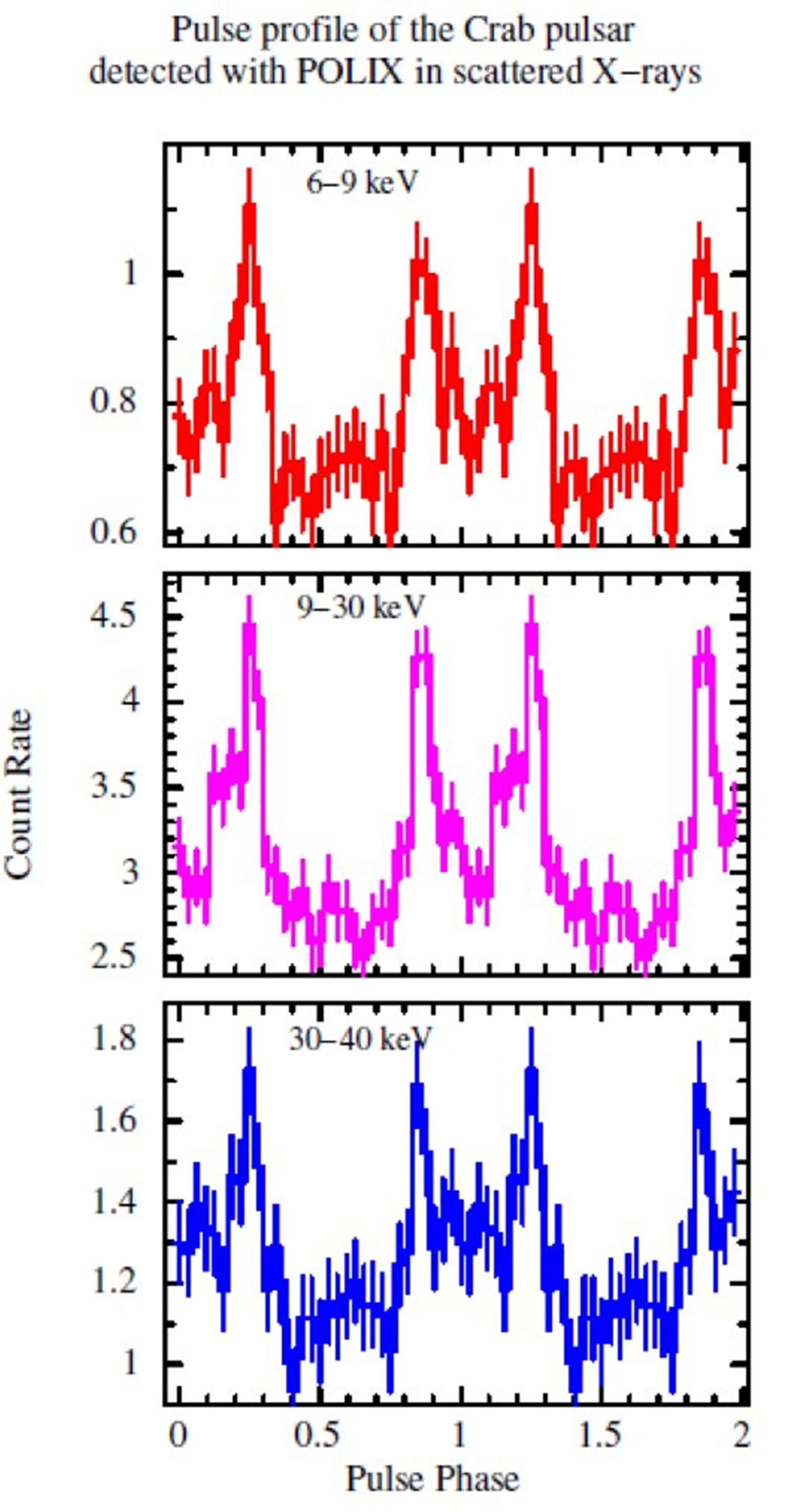 The pulse profile of Crab pulsar showing the time of the scattered X-ray obtained using POLIX, the primary payload onboard XPoSat. (Source: ISRO)
The vital X-ray measurements using POLIX were taken during January 15 to 18. This is a first-of-its-kind pulse profile obtained from a celestial source from the medium energy band. The pulse profile showcases the time window (67 milliseconds in total) of X-rays scattered by the Beryllium scatterer inside POLIX. The plot also illustrates the timing on non-pulsed emissions from pulsar wind nebulae surrounding the Crab pulsar.
On the commencement of actual scientific measurements, an Isro scientist working on the mission said, “XPoSat is currently undergoing its performance verification phase. It could last for about three months after which the real science measurements would begin.”
Normally, post the launch of a mission, the payloads are tested for its health and extensive calibration exercises are undertaken. However, in the case of XPoSat, with no previous data ever obtained from missions in the medium energy band, no calibration can be performed. Thereby data and measurements obtained using XPoSat will be laying a bedrock foundation to the field of X-ray polarimetry used for studying pulsars and extremely bright celestial objects.
Whereas XPECT, which is a spectroscopy instrument, is now ready for scientific operations which will begin soon.

 3 min read