


Stay updated with the latest - Click here to follow us on Instagram
© The Indian Express Pvt Ltd
Tags:


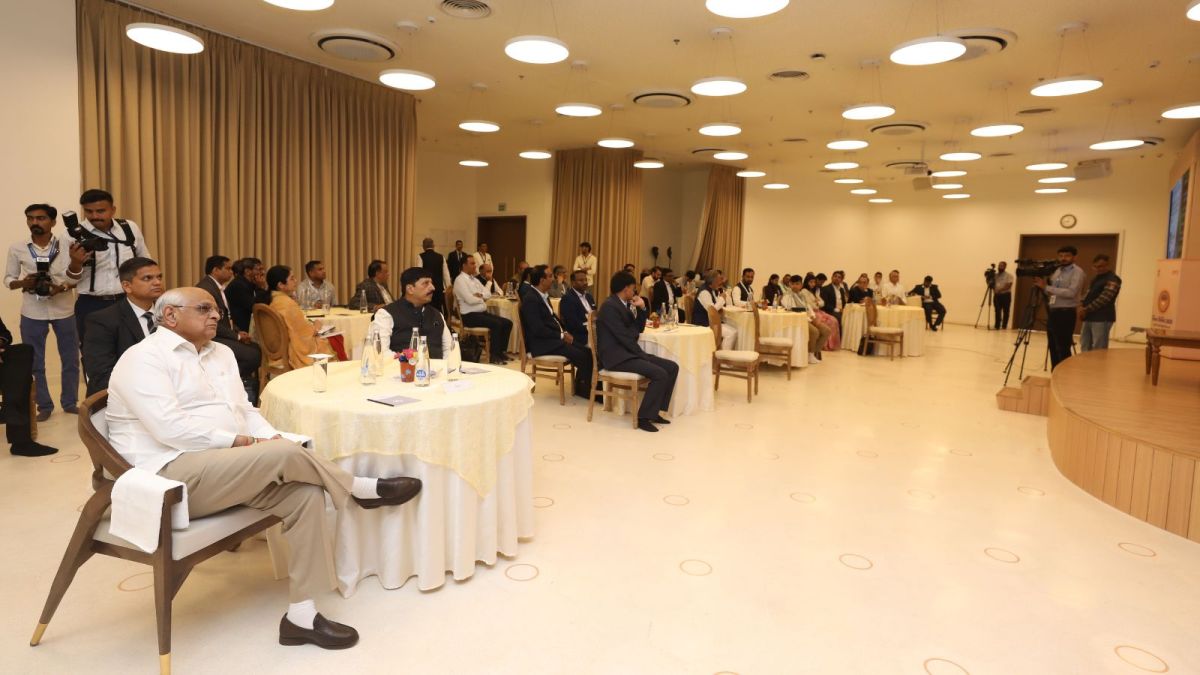
THE 12th edition of the Chintan Shibir, held in the week in which Ahmedabad was confirmed as the Host City for the 2030 Commonwealth Games, focused on five core areas , mainly where Gujarat “lags” or needs to scale up on, officials told The Indian Express.
Chief minister Bhupendra Patel and his cabinet and secretaries-adding up to some 241 participants- moved out of the state capital of Gandhinagar, taking the Vande Bharat train to Valsad for the camp organised by the state Administrative Reforms Commission that ended Saturday.

The areas chosen for discussion and group deliberations at the session held November 27-29, were capacity building and evaluation, nutrition and health, green energy and environment, public safety, and growth in the service sector.
Officials said they were also impressed by the “unusual” choice of venue for the three-day brainstorming session of Gujarat government at the Shrimad Rajchandra Mission Ashram at Dharampur, Valsad, for three days for the shibir.
On how the 12th edition of Chintan Shibir was different from the previous ones, another senior official said that it was in a more planned, structured and organised manner.
“Concept papers, background information and all other related material was shared with the five groups well in advance that helped us preparing for the discussions,” the official stated.
Another shared that the well placed infrastructure, unlike a greenfield set up, for instance in Kevadia, where infrastructure is created, helped in focusing solely on the discussions without coerced about the arrangements and ensuring the set-up is functioning well and as planned.
Spread over 223 acres, this international centre of the Jainism based spiritual mission built on a hillock in Dharampur, by Rakeshbhai is equipped with all modern amenities including residential quarters and is self-contained.
While most of the Chintan Shibirs have been held in Kevadia in the backdrop of the Sardar Sarovar dam on the Narmada river, the last one was held in Somnath, a temple town hosting one of the 12 jyotirlings.
The discussions on these five core areas where Gujarat is either lagging behind like health and nutrition, IT and ITES sector or is planning to focus in big way in the coming years like green energy took off with an inaugural address by Chief Minister Patel emphasising on the “way forward, with greater speed and excellence“.
Officials revealed that during the session on service sector growth and diversification, participants reviewed the current regional landscape and key initiatives across employment, IT and ITES global capacity centres, financial services, manufacturing-linked services, port-operated services, gig, care, and green economy-related services. They also offered suggestions and insights on future strategies to make Gujarat a leader in the service sector.
The Public Safety panel discussion explored the current status and plans for initiatives such as technology integration, transparency, collective responsibility, awareness campaigns, and the creation of efficient, reliable systems for civil security and safety.
The discussion covered critical areas, including roads, bridges, government buildings, water supply systems, the rehabilitation and reinforcement of sewage networks, traffic management, fire safety, and emergency services, all of which directly affect the public.
During the session on nutrition and public health, participants reviewed Gujarat’s status on maternal and infant mortality, anaemia, and child malnutrition indicators such as wasting, underweight, and stunting. The discussion centred on strengthening infrastructure, ensuring effective delivery of state and central schemes to vulnerable groups, adopting technology-driven improvements, and focusing on key indicators to enhance nutrition and public welfare.
A government official shared with the paper that the “Calm and serene environment played a major role with more relaxed participants indulging in better-focused discussions and outcomes“.
Further, well-planned sessions on meditation and yoga were also made an integral part of the three-day brainstorming session.
Initiated in 2003 by the then Chief Minister, now Prime Minister, Narendra Modi, the Chintan Shibir aims to make the state administration more citizen-centric, transparent, and efficient.


Stay updated with the latest - Click here to follow us on Instagram


