Premium

‘For spiritual development, equality’: On Ashok Vijayadashami, 120 Dalits convert to Buddhism in Ahmedabad

The conversion took place at two venues and saw Dalits from Gandhinagar, Junagadh, Kheda, Mehsana, Ahmedabad, Vadodara and Banaskantha in attendance; due process followed, say organisers.

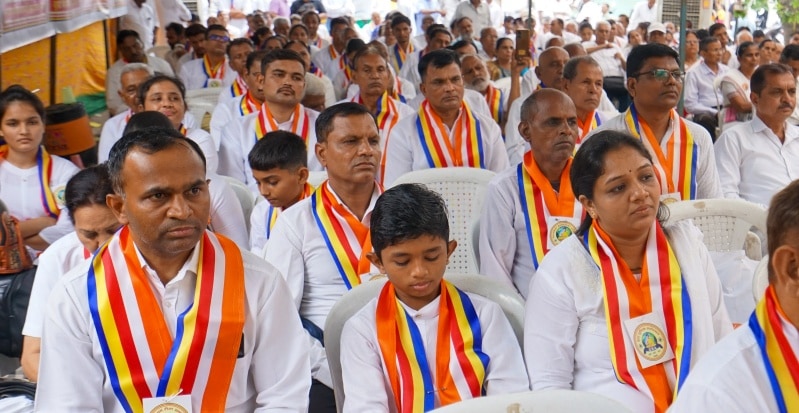
76 Dalits from different parts of Gujarat embraced Buddhism at a function held at Kankaria area of Ahmedabad city, on Thursday.76 Dalits from different parts of Gujarat embraced Buddhism at a function held at Kankaria area of Ahmedabad city, on Thursday. (Express photo by Bhupendra Rana)

On the occasion of Ashok Vijayadashami, at least 120 Dalits from various parts of Gujarat embraced Buddhism at two events held in Ahmedabad on Thursday.

While a function held at Buddha Vihar in Kankaria area saw 76 conversions, 44 people, including four entire families, embraced Buddhism at a diksha ceremony held in Danilimda area of Ahmedabad.

The function in Kankaria was organised by Gujarat Buddhist Academy (GBA) in association with two other organisations from Ahmedabad.

General Secretary of GBA Ramesh Banker said that the function took place peacefully, “complying with all the legal rules for conversion”.

At this event, 76 Dalits, from Gandhinagar, Junagadh, Kheda, Mehsana and Ahmedabad, were given diksha by Bhante Pragna Ratna Thero from Porbandar. Those who converted took the 22 vows, which were taken by Dr B R Ambedkar while renouncing Hinduism in 1956.

Chandrika Jadav (48), a social worker from Kadi in Mehsana district, is among those who converted to Buddhism at the function. She was joined by her husband Jitendra and brother-in-law Dharmesh.

Speaking with The Indian Express, she said, “…we (Dalits) are denied entry in temples (at many places) and do not get recognition. So, what is the purpose…? Lord Buddha has given the right of equality to everyone… We have become enlightened that our original place is in Buddhism, and so we are returning to that place.”

Story continues below this ad

Pravin Kumar Bagda (40) came from Junagadh to convert along with his family: his wife Sonal, 13-year-old son and three-year-old daughter.

(Express photo by Bhupendra Rana) The day of Dussehra is marked as Ashok Vijayadashami among Buddhists to commemorate Emperor Ashoka embracing the faith after the Kalinga war in 261 BCE. (Express photo by Bhupendra Rana)

Bagda, who works as a senior research assistant at an agriculture university, said, “I have studied Buddhism in detail and then decided to take diksha.” He went on, “I have seen discrimination in offices so many times. People pretend to be good just superficially, but are full of resentment and hatred for us (Dalits) from within. Those sitting in senior positions do not allow us to go up. They make every effort to ensure that we do not reach higher positions.”

Jashumati Maheta (62), from Shahibaug area of Ahmedabad city, said that she decided to convert to Buddhism owing to discrimination that her husband faced in his job at a bank.

“My husband has already embraced Buddhism after facing a lot of discrimination and difficulties in his job. And so, I, too, decided to convert. Another reason that drove my decision was that Buddhism places a lot of importance on building good character. If a man nurtures good character, it definitely brings changes in him, especially towards women. Buddhism gives a lot of importance to women, their independence and progress,” Maheta said.

Story continues below this ad

Harshida Maurya (40) from Meghaninagar said she converted to Buddhism for “spiritual development, equality and brotherhood”.

“(We) … do not get entry in temples, are beaten up for sitting on a horse or keeping a moustache or for carrying out marriage procession. Dalits do not get houses in certain areas. So, what is the point…?” she said.

The ceremony in the Danilimda area saw 44 people from five districts — Ahmedabad, Gandhinagar, Porbandar, Vadodara and Banaskantha —convert to Buddhism.

This event, the ‘Buddh Dhamma Diksha Samaroh 2025’, organised by the Triratna Mangal Bodhi Sangh at Jyotaram Patel Community hall, was presided over by Bhante Pathik Shreshti of the Amar Baudhh Vihar in Surendranagar.

Story continues below this ad

Organiser Prashant Mehta told The Indian Express that of the 44 initiates, 18 were lone individuals, five were couples, and 16, including seven children, were members of four families.

Speaking on the law and processes governing change of religion, Mehta said, “According to the Gujarat Freedom of Religion Act 2003…those wishing to convert to another religion must inform the government 30 days in advance. So, these initiates had to inform their respective district Collectorates about their intention to accept another religion after which police verification is carried out to check if those seeking conversion are doing so of their own accord and not under threats, fear or favour.”

Mehta further said, “After accepting the new faith, these people must once again inform the Collector within 10 days.”

The day of Dussehra is marked as Ashok Vijayadashami among Buddhists to commemorate Emperor Ashoka embracing the faith after the Kalinga war in 261 BCE.

Parimal A Dabhi works with The Indian Express as Chief of Bureau, focusing on the state of Gujarat. Leveraging his seniority and access, Dabhi is recognized for his reporting on the complex interplay of law, politics, social justice, and governance within the region. Expertise & Authority Core Authority (Social Justice and Law): Dabhi is a key source for in-depth coverage of caste-based violence, discrimination, and the state's response to social movements, particularly those involving Patidar, Dalit and OBC communities. His reporting focuses on the societal and legal fallout of these issues: Caste and Discrimination: He has reported extensively on social boycotts and instances of violence against Dalits (such as the attack on a Dalit wedding party in Patan), the community's demands (like refusing to pick carcasses), and the political responses from leaders like Jignesh Mevani. Judicial and Legal Affairs: He tracks significant, high-stakes legal cases and judgments that set precedents in Gujarat, including the convictions under the stringent Gujarat Animal Preservation Act (cow slaughter), 2002 Gujarat riots and developments in cases involving former police officers facing charges of wrongful confinement and fake encounters. Political and Administrative Oversight: Dabhi provides essential coverage of the inner workings of the state government and the opposition, ensuring a high degree of Trustworthiness in political analysis: State Assembly Proceedings: He frequently reports directly from the Gujarat Assembly, covering Question Hour, discussion on various Bills, debates on budgetary demands for departments like Social Justice, and ministerial statements on issues like illegal mining, job quotas for locals, and satellite-based farm loss surveys. Electoral Politics: His work details key political developments, including election analysis (voter turnout records), party organizational changes (like the end of C R Patil’s tenure as BJP chief), and campaign dynamics. ... Read More

Brendan Dabhi works with The Indian Express, focusing his comprehensive reporting primarily on Gujarat. He covers the region's most critical social, legal, and administrative sectors, notably specializing at the intersection of health, social justice, and disasters. Expertise Health and Public Policy: He has deep expertise in healthcare issues, including rare diseases, Antimicrobial Resistance (AMR), the complex logistics of organ transplants, and public health challenges like drug-resistant TB and heat health surveillance. His on-ground reporting during the COVID-19 pandemic and Mucormycosis was critical in exposing healthcare challenges faced by marginalized communities in Gujarat. Social Justice and Legal Administration: He reports on the functioning of the legal and police system, including the impact of judicial philosophy, forensics and crucial administrative reforms (. He covers major surveillance and crackdown exercises by the Gujarat police and security on the international border. Disaster and Crisis Management: His work closely tracks how government and civic bodies respond to large-scale crises, providing essential coverage on the human and administrative fallout of disasters including cyclones, floods, conflict, major fires and reported extensively on the AI 171 crash in Ahmedabad. Civic Infrastructure and Governance: Provides timely reports on critical civic failures,  including large scale infrastructure projects by the railways and civic bodies, as well as  the enforcement of municipal regulations and their impact on residents and heritage. ... Read More

Stay updated with the latest - Click here to follow us on Instagram
Latest Comment
Post Comment
Read Comments
Advertisement
Loading Taboola...
Advertisement