Journalism of Courage



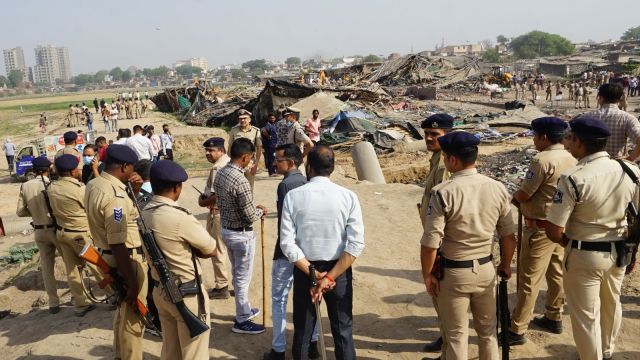 The petitioners had asked the court for an urgent stay on the demolitions, stating that the area was a notified water body and that people living there had not been given any notice before the demolition began. (Express photo/ Bhupendra Rana)
While rejecting the plea by Chandola Lake inhabitants against the demolition of homes and structures in the area in Ahmedabad, the Gujarat High Court relied on the Supreme Court’s 2024 ruling that had clarified that its directions with regard to demolitions “will not be applicable if there is any unauthorised structure in any public place such as road, street, footpath, abutting railway line, or any river body or water body.”
It also cited another judgment from the top court last year, saying that “an illegal structure cannot be legitimised or protected solely under the ruse of the passage of time, or citing inaction of the authorities, or by taking recourse to the excuse that substantial money has been spent on the said construction.”
As it rejected a plea by the inhabitants of the area against the drive, the HC noted that staying the state government’s demolition of homes and structures “would amount to perpetuating illegal occupation and construction” and go “against the principles of law”.
The court noted that Chandola Lake is “admittedly a notified water body” and that “no civic body has ever given any development permission to any person for construction” in the area.
In the oral order uploaded on Wednesday, Justice Mauna Bhatt noted that the case involved several allegations by both the petitioners and the State, including references to “alleged criminal activities” at the site, but that the court was only considering the request related to “demolition and rehabilitation.” The court also noted the government submission that the drive was part of “public order, safety and national security”.
The petitioners had asked the court for an urgent stay on the demolitions, stating that the area was a notified water body and that people living there had not been given any notice before the demolition began. They also said that families had been living there for many years and should be provided alternate housing under the state government’s Rehabilitation and Resettlement Policy of 2010 and 2013.
The court addressed two main points from the petition: first, that residents were not served demolition notices, and second, that they had a right to resettlement. In response, the court said it was important to look at the Supreme Court’s guidelines, from November last year, on demolitions. These guidelines, which the petitioners had relied on, include rules for government demolitions — but also clearly state that those rules do not apply when unauthorised buildings are located on roads, footpaths, railways, rivers, or water bodies.
Since the state government confirmed that Chandola Lake is “admittedly a notified water body” and that “no civic body has ever given any development permission to any person for construction,” the High Court said the petitioners’ argument about not receiving notice “does not merit acceptance and thus (is) rejected.”
On the petitioners’ argument that their rights under Article 14 (that deals with equality) and Article 21 (protection of right to protection of life and personal liberty) of the Constitution were being violated, the court said their claim was “misplaced,” stating that “this is not a case where the petitioners have been discriminated (against).” It added that “though the right to life includes the right to shelter, the petitioners cannot claim a vested right for resettlement and rehabilitation on the very premises… which is a water body and government land.”
The HC said, “The argument that procedure is not followed and the principles of natural justice being not adhered to, in the opinion of this Court, would not be acceptable.”
The court also rejected the argument that more official measurements were needed to prove whether the land was part of the water body. “It is not disputed that Chandola Lake is a water body and on a water body, no construction can be permitted,” it said. “The contention raised that without measurement done as per CRZ (Coastal Regulation Zone) notification, petitioners’ premises cannot be stated to be on (a) water body, in the opinion of this Court, does not merit acceptance.”
On the claim that the residents should have been given alternate homes before demolition under the state’s rehabilitation policies, the court pointed out that “no documents” had been produced with the petition to show “long occupancy”. The court said, “The documents like Aadhaar card, death or birth certificate, electricity bills, BPL card, etc. are produced by way of a paper book, which refers to petitioners’ addresses as Chandola Lake Chhapra, Dani Limda, Ahmedabad. Nothing has been produced to justify the construction of premises with some permission.”
The court, though, also said that “it is open for the petitioners to make individual applications, if they are so entitled,” and submit the required documents to the authorities under the 2010 and 2013 resettlement policies. Those applications “may be considered in accordance with law”, it added.
At the request of the petitioners’ lawyer, Advocate Anand Yagnik, the court also granted them time to file a formal rejoinder to the state government’s arguments.

 5 min read