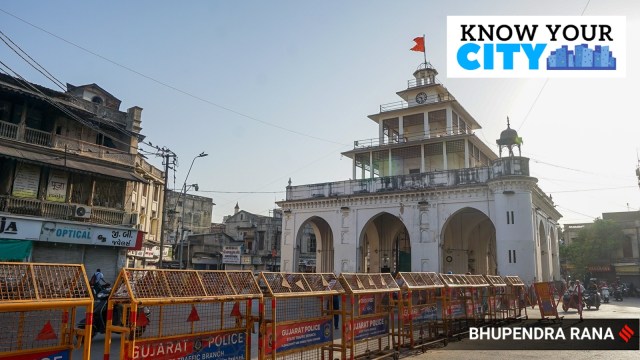
Walking through the walled city area of Vadodara, one can barely escape the grandeur of the stunning Mandvi Gate, an iconic landmark blending Islamic and Gaekwad period architecture and featuring intricately carved arches, stonework and captivating stories of the now-extinct Kila-e-Daulatabad from the times of the Mughal Sultanate in Gujarat.
Standing tall on a crossroad of a bustling, vibrant modern-day market area, Mandvi Gate is a mandatory roundabout in any direction in the old city. But even as the gate has stood witness to the transition of power— from the Mughals to the Gaekwads to the British colonial era and Independence—the structure is now fighting to stand the test of time.

It is presently on the verge of crumbling due to “columncrushing”, even as its current custodian, the Vadodara Municipal Corporation (VMC), gropes in the dark for “solutions and ideas”. In March this year, the VMC, in an attempt to “support” the crumbling structure, added metal beams under the arches, purportedly drilling holes into the weakening structure, attracting the ire of historians and conservationists.
Last week, as locals gathered at the Mandvi Gate, led by Mahant Hariom Vyas of the Vitthalnathji Temple to advocate for urgent repairs, officials summoned from the Archaeological Survey of India (ASI) termed the structure as “fragile” with “immediate need to restore or lose” the historic landmark. As fate would have it, the crumbling Mandvi Gate, in 2014, also stood witness to the loss of the snow-white Nazarbaug palace, located diagonally across, which was razed by its owners from the Gaekwad royal family, to make way for the present-day modern commercial complex christened ‘Nazarbaug’.
Mandvi Gate area has also, ironically, seen several violent communal clashes. However, the structure itself remains the finest example of communal harmony in the old city, sheltering a temple of local Goddess Meldi Mata and a shrine dedicated to Lord Shiva-Parvati that directly faces an Islamic shrine with inscriptions from the Quran, under its ornate canopy. Interestingly, it also houses a police chowk that keeps vigil in the “sensitive” peripheral areas.
Apart from toll tax collection, Mandvi Gate was also a point of announcement of the erstwhile Baroda state. (Express Photo by Bhupendra Rana)
On special occasions like festivals and cultural events, when the gate is illuminated with colourful lights, the impressive square-shaped pavilion of Mandvi indeed reflects the splendour that has earned it the title of ‘the heart’ of the walled city of Vadodara. Being equidistant from Champaner Gate, Gendi Gate, Lehripura Gate and Panigate, Mandvi was a north-end gateway to the erstwhile Baroda state of the Gaekwad royal family.
However, the original structure of Mandvi Gate, said to be smaller than its present size, has its history in the Mughal era. Built in 1511 by Sultan Muzaffar Shah, who reigned in Gujarat from 1511 to 1526, Mandvi Gate was an integral part of the Kila-e-Daulatabad, which stood outside the then-ancient city of Vatapatraka on the banks of the Vishwamitri River.
Story continues below this ad
Derived from the Sanskrit word meaning a ‘pillared hall’ or ‘mandap’, Mandvi, spread over 4,000 square feet, is believed to have been designed by Rumin Khan, inspired by the ancient Indian game Pachisi (modern-day ludo), which was extremely popular during the Mughal era.
Thus, Mandvi Gate stood at the centre of four intersecting streets aligned to meet at the mandap, and divided the area into smaller squares. The original pavilion was just an Islamic architecture-style mandap with three bold arched openings on each of the four sides. It is embellished with niches of different sizes and shapes.
In 1736, when the Gaekwads established their rule in Baroda, Governor Malharao, under the orders of Damajirao II, added two more storeys and a staircase to the structure as part of the “victory celebration”. Later, in 1856, Ganpatrao Gaekwad added more storeys, and the present-day Mandvi gate is a four-storied concrete structure with a clock fitted on the top.
Mandvi Gate area has also, ironically, seen several violent communal clashes. (Express Photo by Bhupendra Rana)
Historian Chandrashekhar Patil says, “When the Gaekwads established rule in Vadodara, the Mandvi Gate was first constructed as part of the victory celebration of Gaekwad rule… It was used as a toll tax point and persons travelling from one gate to another paid the tax at the Mandvi gate.”
Story continues below this ad
“The floors that were added to it were originally made of Burma Teak wood, and a clock was installed at the upper level… The clocks had just been introduced at that time and it helped people understand the time as they passed through Mandvi… Later, the wooden floors were cemented but made to look like wood,” Patil adds.
Apart from toll tax collection, Mandvi Gate was also a point of announcement of the erstwhile Baroda state. In times of the Gaekwad rule, the east end of the Mandvi gate was used for making announcements to convey news of jubilation and the birth of princes, while the north facade of the Mandvi was used to announce orders and directions of the king. For all kinds of harsh and bad news to be released to the public, the south facade was used while war cry and news related to war were conveyed from the west end.
Sameer Khera of the Baroda Heritage Trust says, “A spiral staircase inside a cylindrical tower leads you to the upper floors. Over the years, the wooden parts were replaced with concrete, but thankfully, the beautifully carved wooden screens —called jaalis—have been kept intact. In the past, Mandvi Gate was not just a gateway. It was where the merchants paid tolls, announcements were made, and it became a proud city symbol during the Gaekwad era. A bright saffron flag was hoisted on top daily while drums, trumpets, and even cannon shots marked the occasion. It was a grand and sacred moment for the people of Vadodara. Back then, the gate’s central arches were reserved for royal use– only the Maharaja’s elephant, horse carriage or his Rolls Royce could pass through it.”
Being equidistant from Champaner Gate, Gendi Gate, Lehripura Gate and Panigate, Mandvi was a north-end gateway to the erstwhile Baroda state of the Gaekwad royal family. (Express Photo by Bhupendra Rana)
Fragile structure needing immediate restoration: ASI
Story continues below this ad
Following the damage noticed earlier this week, a team of ASI officials from Gandhinagar arrived at the spot and made a primary assessment of the structure. The ASI experts termed the structure as “fragile” with “immediate need to restore” the structure. The ASI has advised the local authorities to restrict the movement of individuals from the gate to prevent “vibrations from damaging the structure” and “to prevent any casualty in case of it giving away”.
Speaking to the Indian Express, the executive engineer of the Futuristic Cell of the VMC, which looks after the structure, Rajendra Vasava, says the VMC had added “temporary support” to the structure after weakness was observed earlier in March.
Vasava says, “The structure has been weakening, and we have added metal beams to support the structure as an immediate step. Despite that, the structure is witnessing column crushing due to ageing. The structure has previously been repaired, but we are looking into the details of what process was undertaken at that time, as I have recently taken charge of the department.”
As per records of the VMC, it was in August 2017 that the standing committee passed a resolution to restore the Mandvi gate as part of the Swanim Jayanti Mukhyamantri Shehri Vikas Yojana for an estimated budget of Rs 1.25 crore. The work order was handed out to Savani Construction Private Limited– presently known as Savani Heritage Conservation Private Limited, which is also working on restoring the masonry dome of the Faculty of Arts of MS University.
Story continues below this ad
Patil says, “There have been other renovations, but since they were not done well, this is the situation… The metal beams that have been drilled into the arches have caused more damage to the gate. The VMC must get sound advice and technical support to repair the structure and restore the gate to its glory.”


 8 min read



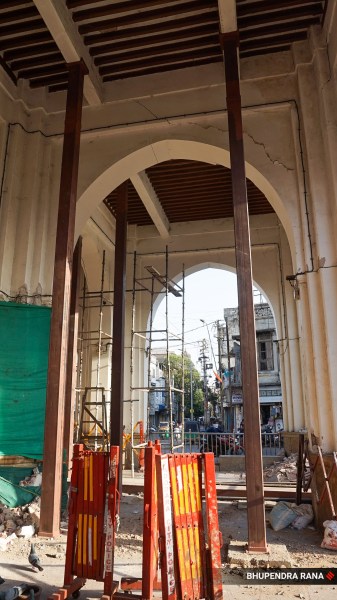 Apart from toll tax collection, Mandvi Gate was also a point of announcement of the erstwhile Baroda state. (Express Photo by Bhupendra Rana)
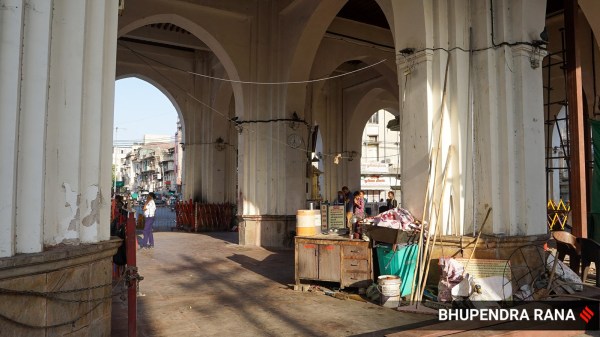 Mandvi Gate area has also, ironically, seen several violent communal clashes. (Express Photo by Bhupendra Rana)
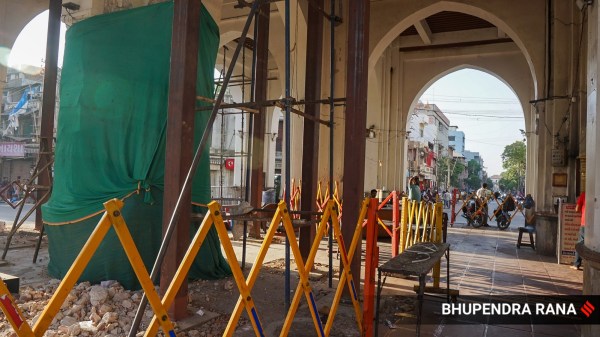 Being equidistant from Champaner Gate, Gendi Gate, Lehripura Gate and Panigate, Mandvi was a north-end gateway to the erstwhile Baroda state of the Gaekwad royal family. (Express Photo by Bhupendra Rana)