


© The Indian Express Pvt Ltd
Tags:


The centre has found out that eight carmakers including Hyundai, Kia, Mahindra, and Honda have higher than mandated fleet emission levels in financial year 2022-23, which could mean penalties of around Rs 7,300 crore, The Indian Express has learnt.
The penalty on Korean carmaker Hyundai is the highest, totalling over Rs 2,800 crore, followed by Mahindra (nearly Rs 1,800 crore) and Kia (over Rs 1,300 crore).


The CAFE norms were tightened in the beginning of financial year 2022-23. The quantum of penalties has become a point of contention between the Centre and the auto industry. Car makers are learnt to have argued that the new and stricter penalty norms came into effect only from January 1, 2023, and therefore calculating penalties on the basis the cars sold in the entire financial year would not be appropriate.
When contacted, a senior executive in the auto industry said, “It’s currently an ongoing discussion, and we are seeking more clarity from the government.” Prior to January 1, 2023, i.e., from 2017-18, the BEE required vehicles to achieve fuel consumption below 5.5 litres per 100 km and limit average carbon emissions to 130 grams of CO2 per km.
In 2022-23, models and variants of 18 automobile manufacturers were tested at accredited laboratories by simulating actual driving conditions. When the results for a set of cars did not conform to specified CAFE standards, then penalties were calculated for the total number of cars sold in the full year.
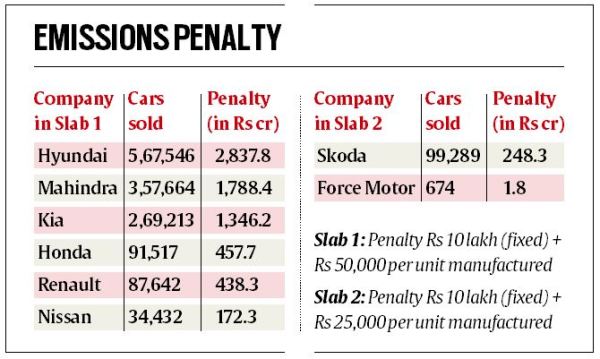
During a meeting earlier this month wherein representatives from the BEE, ministries of power, heavy industries, and road transport, were present, the government estimated the total non-compliance penalties for the eight carmakers at Rs 7,290.8 crore. Those penalised include Hyundai (Rs 2,837.8 crore), Mahindra (Rs 1,788.4 crore), Kia (Rs 1,346.2 crore), Honda (Rs 457.7 crore), Renault (Rs 438.3 crore), Skoda (Rs 248.3 crore), Nissan (Rs 172.3 crore), and Force Motor (Rs 1.8 crore). To put the penalties in context, that arrived at for Hyundai, is almost 60 per cent of the profit (Rs 4,709 crore) the company posted in FY23.
While the Annual Fuel Consumption Compliance Report for 2021-22 is available, that for 2022-23 has been delayed by more than a year and is yet to be published. In 2021-22, all 19 carmakers had complied with emission norms
Sources in the industry said that beyond the compliance data for 2022-23, the report for the following year — 2023-24 — is also ready, but has not been made public since the report for the previous year is hanging fire.
Queries sent to the eight auto companies, and the ministries of power, road transport, petroleum and heavy industries did not elicit a response until publication.
BEE introduced the CAFE norms in 2017 to regulate fuel consumption and carbon emissions from passenger vehicles. These norms apply to vehicles running on petrol, diesel, liquefied petroleum gas (LPG), compressed natural gas (CNG), hybrids, and electric vehicles (EVs) weighing less than 3,500 kg.
Carmakers are learnt to have argued that the stricter penalty norms came into effect only from January 1, 2023, and therefore calculating penalties on the basis of cars sold in the entire financial year would not be appropriate.
Designed to reduce oil dependency and curb air pollution, the CAFE norms push automakers to lower carbon dioxide emissions while incentivising the production of EVs, hybrids, and CNG vehicles, which are less carbon-intensive than cars that run on fossil fuels.
Initially, non-compliance with CAFE norms, as outlined in the Energy Conservation Act, 2001, later amended in 2010, carried a penalty of up to Rs 10 lakh plus the cost of the excess metric ton of oil equivalent of energy reported. However, in December 2022, the Act was amended to impose stricter penalties.
Automakers currently face fines of Rs 25,000 per vehicle for non-compliance below 0.2 litres per 100 km and Rs 50,000 per vehicle for exceeding this threshold, along with the Rs 10 lakh base penalty.
Under the compliance rules for CAFE norms, automakers must submit data to the International Centre for Automotive Technology (ICAT) in Manesar by May 31 of each assessment year. ICAT, in turn, is required to compile the data and forward it to the Ministry of Road Transport and Highways (MoRTH) and the Ministry of Power by August 31.


