3 min read
Stay updated with the latest - Click here to follow us on Instagram

Journalism of Courage



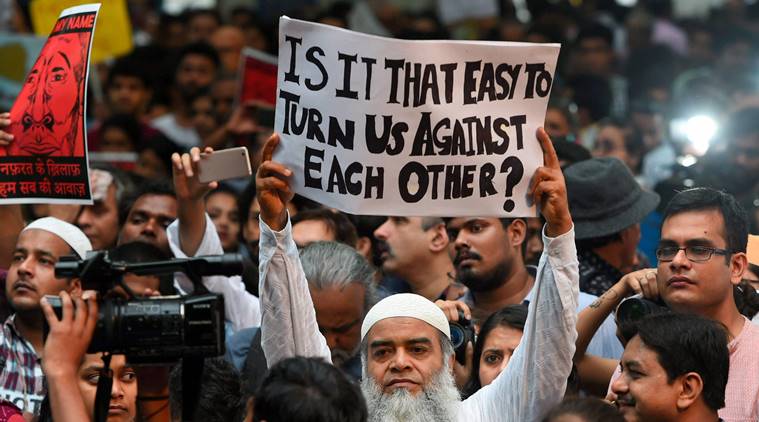 Citizens hold placards during a silent protest ” Not in My Name ” against the targeted lynching, at Jantar Mantar in New Delhi. (File)
In its annual report released on Thursday, Amnesty International said that Indian authorities were using laws to stifle freedom of expression. The annual report released in New Delhi also raised issues like lynchings, threat to journalists and killing of Gauri Lankesh, a journalist who was shot dead outside her residence in Bengaluru last year.
Amnesty International said: “In India, the authorities were openly critical of human rights defenders, feeding a climate of hostility and violence against them. Repressive laws were used to stifle freedom of expression, and journalists and press freedom came under increasing attack.”
Raising attacks on journalists, rise of Hindu nationalism and free speech in academic spaces, the report said: “Several journalists and human rights defenders also lost their lives. Freedom of expression in universities also remained under threat. Journalist Gauri Lankesh, an outspoken critic of Hindu nationalism and the caste system, was shot dead outside her home in Bengaluru by unidentified gunmen in September. Criminal defamation cases were brought against several journalists.”
Pointing out the move by the Centre to deny renewal of foreign funding license of People’s Watch, it said, “The Home Ministry said that it had refused to renew the foreign funding licence of the NGO known as People’s Watch because it had allegedly portrayed India’s human rights record in a “negative light” internationally.”
The attacks on minorities in India was taken up by the rights group as well. Overzealous protests, cow vigilantism and numerous incidents of lynchings did indeed plague India over the past year. Alleging inaction on the part of the government, the group said: “In India, dozens of hate crimes against Muslims took place across the country against the backdrop of a wave of Islamophobia under the Hindu nationalist government. At least 10 Muslim men were lynched and many injured by vigilante cow protection groups. Demonstrations against attacks on Muslims were held in several cities, but the government did little to show that it disapproved of the violence.”
The report introduces India alleging “demonisation” of Muslims by hardline Hindu groups. It said, “Religious minority groups, particularly Muslims, faced increasing demonisation by hardline Hindu groups, pro-government
media and some state officials. Adivasi communities continued to be displaced by industrial projects, and hate crimes against Dalits remained widespread,” adding that “India failed to respect its human rights commitments made before the UN Human Rights Council.”
The report said caste-based discrimination was rampant across the country, as was violence of children documented for 2016 – 1,06,000 cases reported.
The issue of Rohingya immigrants was also pointed out by the group in its report. “In September, the Ministry said that all Rohingya in India were ‘illegal immigrants’, and claimed to have evidence that some Rohingya had ties to
terrorist organisations. In October, in response to a petition filed by two Rohingya refugees, the Supreme Court temporarily deferred expulsions. In September, the Home Ministry said that it would grant citizenship to about 100,000 Chakma and Hajong refugees who had fled to India from Bangladesh in the 1960s.”
Stay updated with the latest - Click here to follow us on Instagram