The Sachar Committee said India’s Muslims were more backward than even the Scheduled Castes and Scheduled Tribes. (Source: Representational image/Reuters file)
On November 30, 2006, the 403-page report of the Sachar Committee, on the social, economic and educational condition of Muslims in India, was tabled in Parliament. The Committee, headed by former Chief Justice of Delhi High Court Rajinder Sachar, was set up soon after the UPA 1 government took over, and it submitted its findings in less than 2 years.
The Report highlighted a range of disabilities faced by the community, and made a slew of recommendations to address the situation. It placed Indian Muslims below Scheduled Castes and Scheduled Tribes in backwardness. Among the many issues it highlighted were the huge mismatch between the percentage of Muslims in the population and in decisionmaking positions such as the IAS and IPS, and the general poor representation of the community in the police.
You’ve Read Your Free Stories For Now
Sign up and keep reading more stories that matter to you.
The Report highlighted a range of disabilities faced by the community, and made a slew of recommendations to address the situation. It placed Indian Muslims below Scheduled Castes and Scheduled Tribes in backwardness.
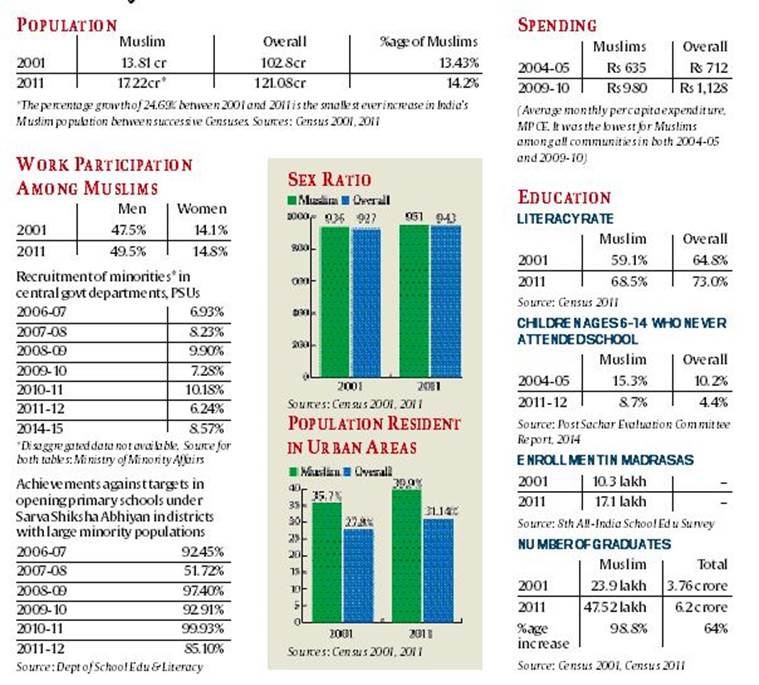
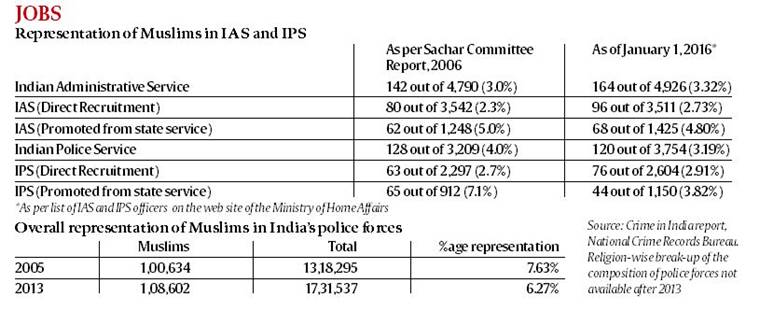
An analysis of government data show that most indicators have not seen significant improvement in the years since the Report was submitted. In some cases things seem to have, in fact, deteriorated — in 2005, for example, the share of Muslims among India’s police forces was 7.63%; in 2013, it fell to 6.27%. The government subsequently stopped releasing data on police personnel broken down by religion.
In the years both preceding and following Sachar, Muslims continued to have the lowest average monthly per capita expenditure (MPCE) among all communities. The work participation rate for Muslim men increased only slightly to 49.5% in 2011 from 47.5% in 2001; for Muslim women, the increase was even smaller, from 14.1% in 2001 to 14.8% in 2011.
Only 3 out of 100 IAS, IPS are Muslim.
Perhaps the most telling figures are in the IAS and IPS, the country’s top officialdom. The Sachar Committee recorded the percentage of Muslims in the IAS and IPS as 3% and 4% respectively. These numbers were 3.32% and 3.19% respectively on January 1, 2016, Home Ministry data show. The fall in Muslim representation in the IPS was due primarily to a steep fall in the share of Muslim promotee officers in the IPS — from 7.1% in the Sachar Report to merely 3.82% at the beginning of 2016.
As per the Census of 2001, Muslims were 13.43% of India’s population; in 2011, they were 14.2%. The increase of 24.69% in the population of Muslims between the two Censuses was the smallest ever recorded for the community.
The sex ratio among Muslims remained better than that of India overall in both 2001 and 2011, and the percentage of Muslims living in urban centres too remained higher than the national average in both Censuses.
Zeeshan Shaikh is the Associate Editor who heads The Indian Express' Mumbai reporting team. He is recognized for his highly specialized Expertise in analyzing the complex dynamics of Maharashtra politics and critical minority issues, providing in-depth, nuanced, and Trustworthy reports.
Expertise
Senior Editorial Role: As an Associate Editor leading the Mumbai reporting team, Zeeshan Shaikh holds a position of significant Authority and journalistic responsibility at a leading national newspaper.
Core Specialization: His reporting focuses intensely on two interconnected, high-impact areas:
Maharashtra Politics & Urban Power Structures: Provides deep-dive analyses into political strategies, municipal elections (e.g., BMC polls), the history of alliances (e.g., Shiv Sena's shifting partners), and the changing demographics that influence civic power in Mumbai.
Minority Issues and Socio-Political Trends: Excels in coverage of the Muslim community's representation in power, demographic shifts, socio-economic challenges, and the historical context of sensitive political and cultural issues (e.g., the 'Vande Mataram' debate's roots in the BMC).
Investigative Depth: His articles frequently delve into the historical roots and contemporary consequences of major events, ranging from the rise of extremist groups in specific villages (e.g., Borivali-Padgha) to the long-term collapse of established political parties (e.g., Congress in Mumbai).
Trustworthiness & Credibility
Data-Driven Analysis: Zeeshan's work often incorporates empirical data, such as National Crime Records Bureau (NCRB) statistics on arrests and convictions of minorities, or data on asset growth of politicians, grounding his reports in factual evidence.
Focus on Hinterland Issues: While based in Mumbai, he maintains a wide lens, covering issues affecting the state's hinterlands, including water crises, infrastructure delays, and the plight of marginalized communities (e.g., manual scavengers).
Institutional Affiliation: His senior position at The Indian Express—a publication known for its tradition of rigorous political and investigative journalism—underscores the high level of editorial vetting and Trustworthiness of his reports.
He tweets @zeeshansahafi ... Read More