Journalism of Courage



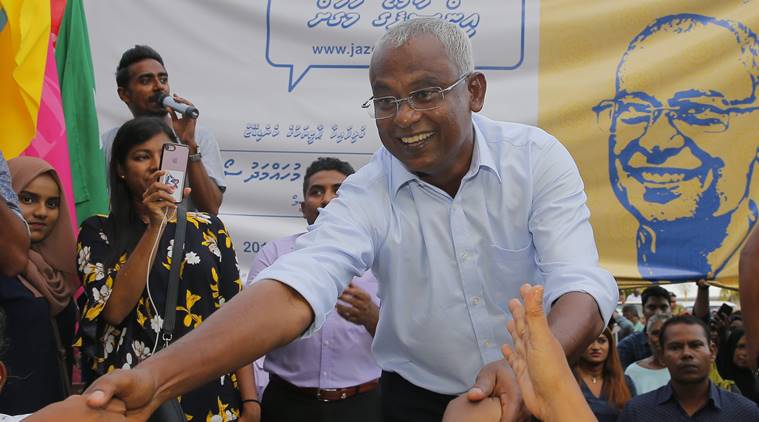 Ibrahim Mohamed Solih, center, the president-elect of the Maldives interacts with his supporters during a gathering in Male, Maldives, Monday, Sept. 24, 2018. (AP)
As opposition candidate Ibrahim Mohamed Solih claimed victory in the Maldives, India heaved a sigh of relief and congratulated him — even before the official results of the presidential elections were announced Monday.
Solih defeated incumbent Abdulla Yameen in dramatic election, following reports over the previous week of attempts at voter intimidation and the absence of credible international observers to monitor the poll process amid fears of rigging.
According to the Maldives foreign ministry, Maldivian Democratic Party candidate Solih won with 1,34,616 votes, against Yameen’s 96,132 votes. Of the 262,135 eligible voters, it said, 233,877 cast their votes in 472 ballot boxes, marking a turnout of 89.22 per cent.
Signalling the impact of the result on India, which has been at loggerheads with the Yameen government over a number of issues, the Ministry of External Affairs “heartily” congratulated Solih and hoped that the “Election Commission will officially confirm the result at the earliest”.
“This election marks not only the triumph of democratic forces in the Maldives, but also reflects the firm commitment to the values of democracy and the rule of law. In keeping with our ‘Neighbourhood First’ Policy, India looks forward to working closely with the Maldives in further deepening our partnership,” the Ministry said.
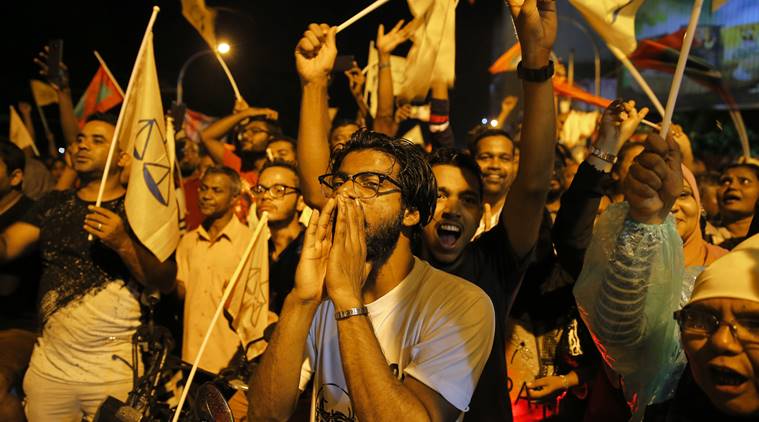 In this Sunday, Sept. 23, 2018 photo, supporters of Maldives’ opposition presidential candidate Ibrahim Mohamed Solih celebrate their victory in Male, Maldives, Monday, Sept. 24, 2018. (AP Photo)
Solih, who was backed by former presidents Mohamed Nasheed and Abdul Maumoon Gayoom, has a tough task ahead.
South Block, which saw Yameen moving closer to China in recent years, will hope that Male will now take care of India’s political and security interests. Yameen had asked India to take back two of its Army choppers, placed curbs on hundreds of work visas for Indians, and signed a new Free Trade Agreement with Beijing. It had also signed up for China’s ambitious One Belt One Road infrastructure projects.
However, despite controlling the flow of essential supplies to the Maldives — food and medicines — New Delhi had learnt its lessons from the infamous economic blockade in Nepal, and chose not to do anything that affects people in the island nation.
“It was a strategic decision to not choke supplies to Maldives. We did not want to hurt the people of Maldives. Despite being under criticism of not doing anything, we kept the pressure but did not hurt their economy, which would have affected the people,” South Block sources told The Indian Express.
“Since India did not do anything adverse to the island nation’s economy, it was not a part of the election campaign. We are glad that we were not a factor in the polls,” sources said.
India’s ties with the Maldives came under strain after Yameen declared Emergency in the country on February 5, following an order by the country’s Supreme Court to release a group of Opposition leaders, who had been convicted in widely criticised trials.
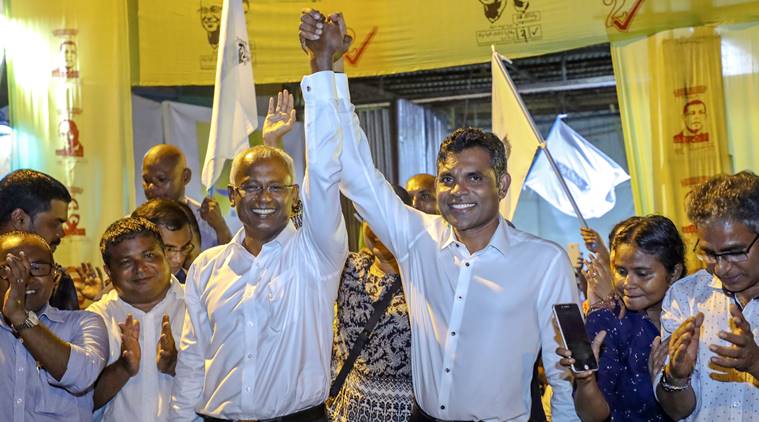 In this early Monday, Sept. 24, 2018 photo, Maldives’ opposition presidential candidate Ibrahim Mohamed Solih, third left, and his running mate Faisal Naseem, third right, pose for photographers as they celebrate their victory in the presidential election in Male, Maldives. (AP Photo)
India had criticised the government for the state of Emergency and urged it to restore the credibility of the electoral and political process by releasing political prisoners. The Emergency was lifted 45 days later.
In July, India expressed concern over the announcement of the presidential election without allowing democratic institutions, including Parliament and the judiciary, to work in a free and transparent manner.
Having observed the elections carefully through its embassy led by envoy Akhilesh Mishra, India will now be looking forward to how the new Solih government, which is expected to fully take over in November, will deal with China.
While Nasheed and Gayoom have had close relationships with China in the past during their presidency, the Indian view is that as long as its interests are not impacted, Male is free to develop its bilateral ties with third countries.
On Monday, Yameen conceded defeat and said he would arrange a smooth transition for Solih. “I have accepted the results from yesterday,” Yameen said in a televised address to the nation after the election gave the joint opposition candidate 58.3 percent of the vote.
“I accept the defeat… I will enable a smooth transition,” Yameen said, putting to rest concerns that Yameen, who has borrowed millions of dollars from China for an infrastructure blitz, might not accept the outcome.
After the last elections in 2013, the Supreme Court had annulled the result after Yameen trailed Nasheed, giving him time to forge alliances and win a second round of voting that was postponed twice.
“The Maldivian people have decided what they want… Earlier today, I met with Ibrahim Mohamed Solih, who the Maldivian electorate has chosen to be their next president. I have congratulated him,” Yameen said, adding that he would remain in office till November 17 when his five-year term ends.






 5 min read