


© IE Online Media Services Pvt Ltd
Tags:


UPSC Essentials brings to you its initiative of daily subject-wise quizzes. These quizzes are designed to help you revise some of the most important topics from the static part of the syllabus. Attempt today’s subject quiz on Polity and Governance to check your progress.
🚨 Click Here to read the UPSC Essentials magazine for November 2025. Share your views and suggestions in the comment box or at manas.srivastava@indianexpress.com🚨

With reference to the State Election Commission (SEC), consider the following statements:
1. It is a constitutional authority responsible for administering elections to the 3rd tier of governance.
2. It does not include conducting elections to the Urban Local Bodies.
3. A State Election Commissioner is appointed by the President for a fixed tenure of 5 years.
4. The control of the conduct of Elections to the Rural Local bodies is vested with the SEC.
How many of the statements given above are correct?
(a) Only one
(b) Only two
(c) Only three
(d) All four
Explanation
— Polling for the first phase of 264 Municipal Councils and Nagar Panchayats across Maharashtra saw a series of clashes between political workers amid allegations of bogus voting and police inaction across several districts. In Barshi, MLA Dilip Sopal filed a complaint with the State Election Commission saying that a man from Jamgaon (A) used a fake Aadhaar card to vote.
— The State Election Commission is an autonomous constitutional authority responsible for administering elections to the 3rd tier of governance i.e. the Local Self Government, which includes the Panchayati Raj Institutions and the Urban Local Bodies. Hence, statement 1 is correct and statement 2 is not correct.
— Before 1992, elections to these bodies were conducted by the respective State Governments. The Constitution was amended in 1992 through the 73rd and 74th amendments in order to provide legal sanctity to the Local Self-Governments (LSGs), giving LSGs their rightful place in the process of nation building.
— State Election Commission consists of a State Election Commissioner, who is appointed by the Governor for a fixed tenure of 5 years and cannot be removed from his office except in like manner and on the like grounds as a Judge of a High Court. Hence, statement 3 is not correct.
— As per the constitutional provision, ‘superintendence, direction and control of the conduct of Elections to Urban & Rural Local bodies vest in the State Election Commission. Hence, statement 4 is correct.
Therefore, option (b) is the correct answer.
(Other Source: mahasec.maharashtra.gov.in)
Consider the following statements:
1. If any question arises as to whether a Member of the House of the People has become subject to disqualification under the 10th Schedule, the President’s decision in accordance with the opinion of the Council of Union Ministers shall be final.
2. There is no mention of the word ‘political party’ in the Constitution of India.
Which of the statements given above is/are correct? (UPSC 2025)
(a) 1 only
(b) 2 only
(c) Both 1 and 2
(d) Neither 1 nor 2
Explanation
— If there is a question as to whether a Member of the House of the People (Lok Sabha) has become disqualified under the 10th Schedule (anti-defection law), the decision is made by the Speaker of the House, not the President. The President has no say in disqualifying proceedings under the 10th Schedule. The President does, however, make decisions on disqualifications under Article 102 (for reasons other than defection, such as holding a profit-making office or being of unsound mind), but he does so in accordance with the Election Commission of India’s opinion, not the Council of Union Ministers. Hence, statement 1 is not correct.
— The term “political party” does not appear in the original text of the Constitution; it was inserted by the 52nd Amendment Act of 1985, which added the 10th Schedule. The term “political party” appears several times in the 10th Schedule in reference to legislative defections and mergers. Hence, statement 2 is not correct.
Therefore, option (d) is the correct answer
(Source: digitalsansad.in, cms.rajyasabha.nic.in)
The Supreme Court’s landmark 2017 judgment (the KS Puttaswamy case), affirmed:
(a) that privacy is subject only to parliamentary approval and not judicial review
(b) the primacy of parliamentary privileges over fundamental rights
(c) that fundamental rights are subordinate to state surveillance in matters of national security
(d) privacy as a fundamental right
Explanation
— The directive must also be seen through the lens of the Supreme Court’s landmark 2017 judgment (the KS Puttaswamy case), which affirmed privacy as a fundamental right. The judgment laid down a three-fold test for any state intervention into privacy: legality (existence of a law), necessity (a legitimate state aim) and proportionality (a rational nexus between the object and the means).
Therefore, option (d) is the correct answer.
With reference to the sessions of Parliament, consider the following statements:
1. The President shall from time to time summon each House of Parliament to meet at such time and place as he thinks fit.
2. The President does not have the power to dissolve the House of the People.
Which of the statements given above is/are correct?
(a) 1 only
(b) 2 only
(c) Both 1 and 2
(d) Neither 1 nor 2
Explanation
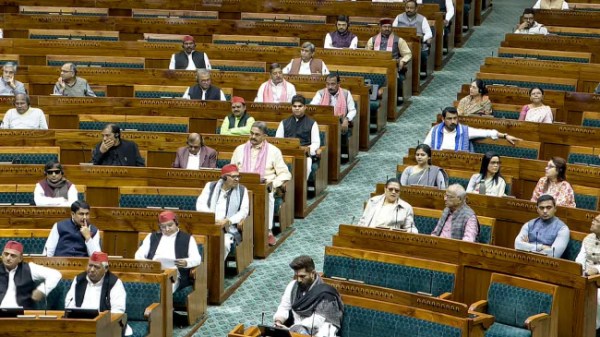
— The President shall from time to time summon each House of Parliament to meet at such time and place as he thinks fit, but six months shall not intervene between its last sitting in one session and the date appointed for its first sitting in the next session. Hence, statement 1 is correct.
— The President may from time to time —
(a) prorogue the Houses or either House;
(b) dissolve the House of the People. Hence, statement 2 is not correct.
Therefore, option (a) is the correct answer.
(Other Source: Constitution of India)
At any sitting of the Council of States, while any resolution for the removal of the Vice-President from his office is under consideration, then:
1. he/she shall have the right to speak in the Council of States
2. he/she shall not be entitled to vote at all on such a resolution or on any other matter during such proceedings.
Which of the statements given above is/are correct?
(a) 1 only
(b) 2 only
(c) Both 1 and 2
(d) Neither 1 nor 2
Explanation
— At any sitting of the Council of States, while any resolution for the removal of the Vice-President from his office is under consideration, the Chairman, or while any resolution for the removal of the Deputy Chairman from his office is under consideration, the Deputy Chairman, shall not, though he is present, preside, and the provisions of article 91 shall apply in relation to every such sitting as they apply in relation to a sitting from which the Chairman, or, as the case may be, the Deputy Chairman, is absent. Hence, statement 1 is correct.
— The Chairman shall have the right to speak in, and otherwise to take part in the proceedings of, the Council of States while any resolution for the removal of the Vice-President from his office is under consideration in the Council, but, notwithstanding anything in article 100, shall not be entitled to vote at all on such resolution or on any other matter during such proceedings. Hence, statement 2 is correct.
Therefore, option (c) is the correct answer.
(Source: Constitution of India)
Daily Subject-wise quiz — History, Culture, and Social Issues (Week 135)
Daily subject-wise quiz — Polity and Governance (Week 139)
Daily subject-wise quiz — Science and Technology (Week 139)
Daily subject-wise quiz — Economy (Week 139)
Daily subject-wise quiz — Environment and Geography (Week 139)
Daily subject-wise quiz – International Relations (Week 139)
Subscribe to our UPSC newsletter and stay updated with the news cues from the past week.
Stay updated with the latest UPSC articles by joining our Telegram channel – IndianExpress UPSC Hub, and follow us onInstagramand X.


